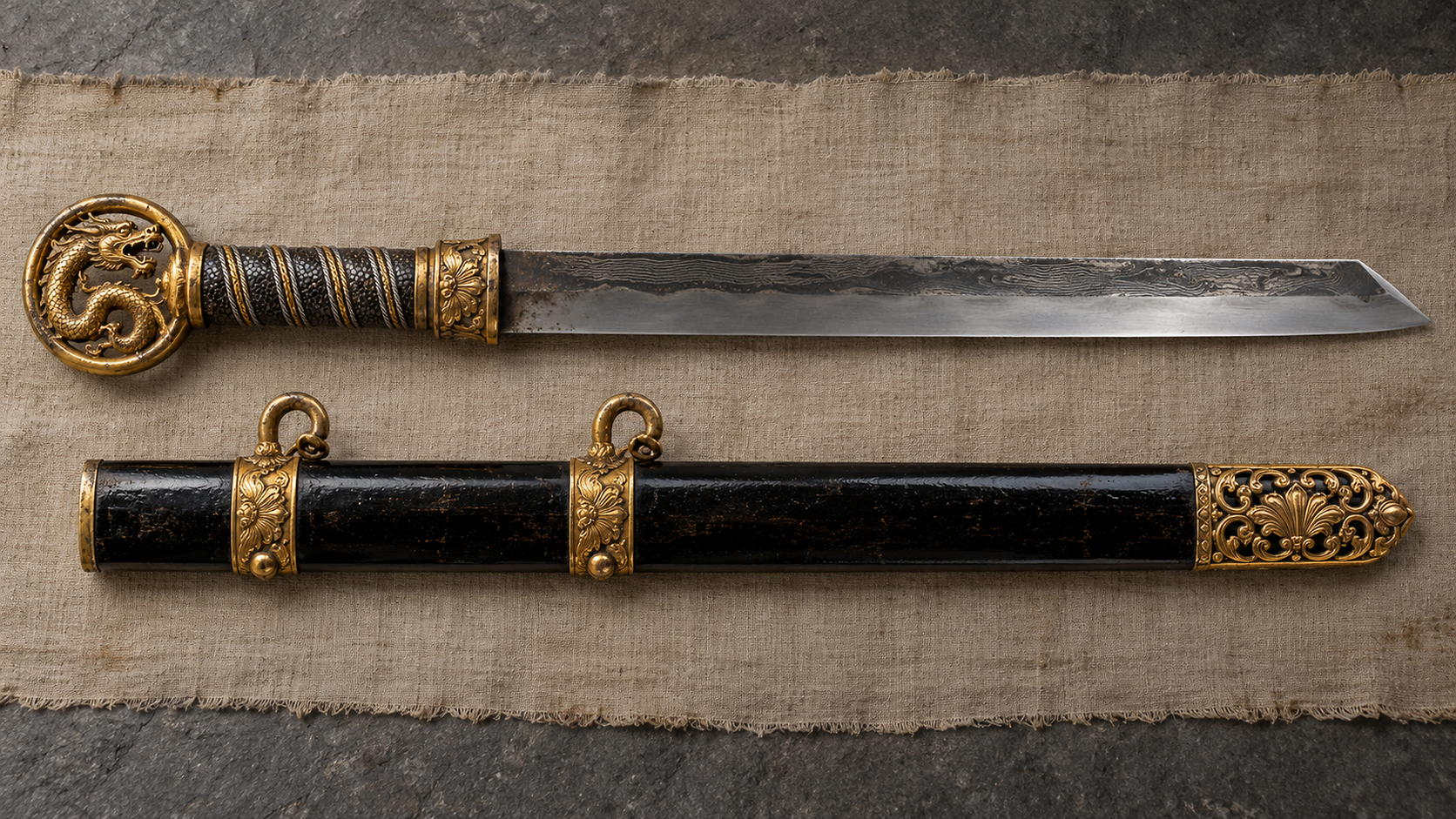
When excavators entered the unlooted tomb of King Muryeong of Baekje in Gongju in 1971, they found personal ornaments and mortuary goods that had rested undisturbed since 526 CE. Beside the king's wooden bier lay a single-edged iron sword of striking refinement. Its hilt terminated in an openwork gilt-bronze ring enclosing a dragon carved with raised scales, while the grip retained delicate bands of twisted gold and silver wire. In Korean archaeology, this weapon belongs to the class known as hwandudaedo, or ring-pommel large swords. Far from being mere display items, these blades combined laminated continental iron technology with gold and silver inlay, marking the apex of military authority and aristocratic hierarchy in early East Asia.
The Silhouette of Authority Across the Tumuli
In the tumuli of the Three Kingdoms period, weapons are not distributed at random. While plain iron spears, projectile points, and agricultural tools filled the outer perimeter of burial chambers, single-edged swords with elaborate ring pommels were placed against the rib cage or along the thigh of the deceased ruler. This placement matched the posture of wearing the sword in life, suspended horizontally or at a slight diagonal from a waist belt. The presence of the hwandudaedo signaled both military command and sovereign legitimacy, linking the bearer to regional lineages and ritual obligations.
The silhouette of these swords is unmistakable. The blade is straight and single-edged, tapering only slightly toward a clipped or rounded point. What draws the eye immediately is the pommel: an open circular or oval loop that crowns the wooden grip. In simpler examples, the ring is a continuous extension of the iron tang, hammered round and welded back against itself. In royal weapons, the ring is a separate cast or chased sculpture of gilt bronze or silver, enclosing mythological beasts that seem to twist within the confined perimeter.
These objects were produced during an era of sustained inter-polity warfare among Goguryeo in the north, Baekje in the southwest, Silla in the southeast, and the autonomous polities of the Gaya confederacy along the southern coast. Military clashes required dependable weapons in large numbers. At the same time, diplomatic gift exchanges between these peninsular courts, imperial Chinese dynasties, and Yamato Japan required objects of supreme craft, turning the functional ring-pommel sword into an international currency of prestige.
Origins on the Continental Frontier
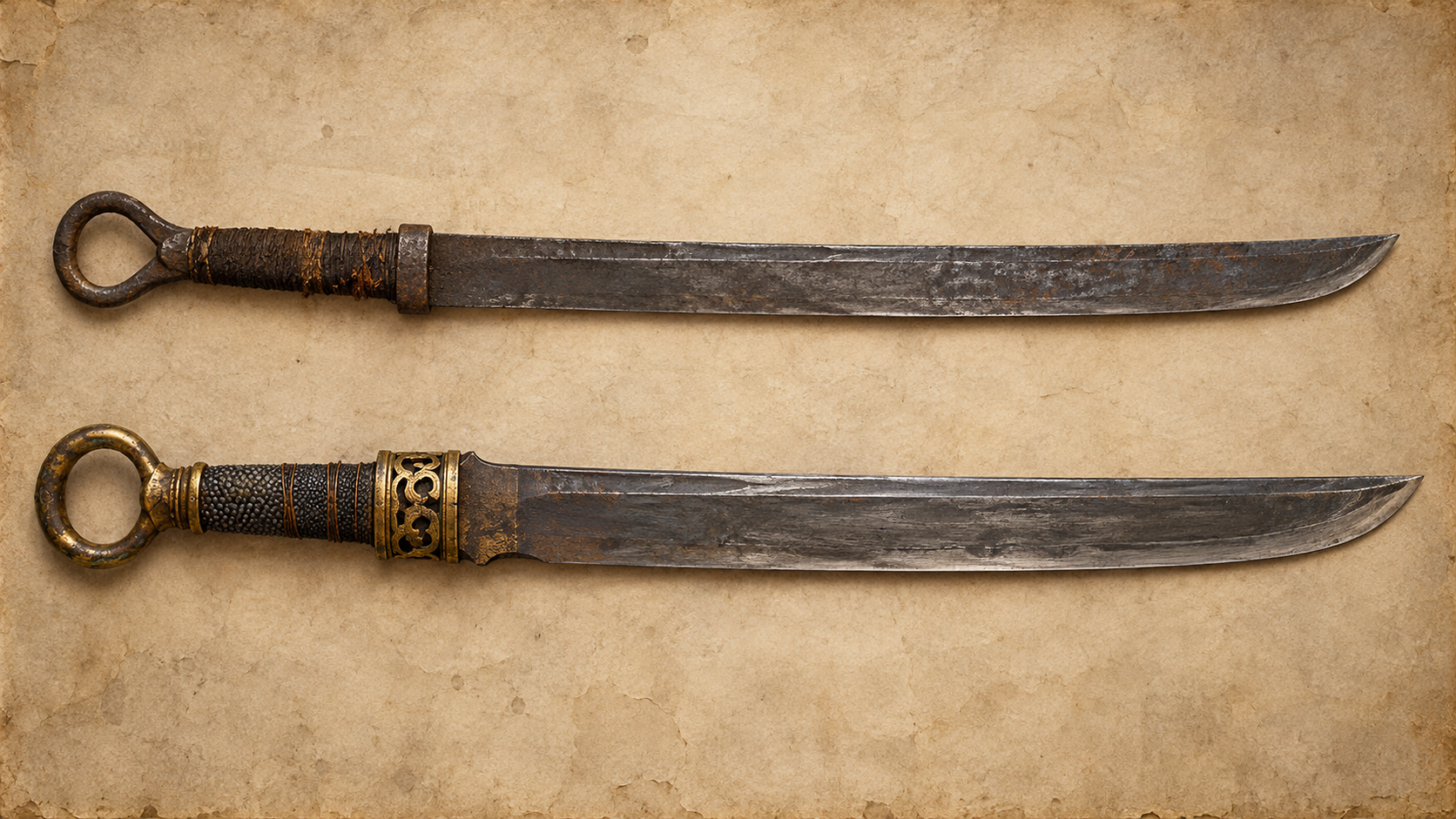
The single-edged iron sword with a ring terminal originated on the East Asian continent during the Western Han dynasty. Early Chinese iron swords replaced the long bronze jian as the primary sidearm of cavalry and infantry, pairing a thick, durable spine with a keen single cutting edge. The ring pommel originally served a practical mechanical purpose: it prevented the hand from sliding off the rear of the hilt during a cut, balanced the blade, and provided an anchor point for a fabric wrist lanyard.
As Han administrative commanderies, such as Lelang, were established in the northern Korean Peninsula, continental metalworking traditions mingled with indigenous bronze and iron traditions. Local elites acquired Chinese ring-pommel knives and swords as status symbols, but indigenous workshops quickly emerged. By the fourth century CE, peninsular smiths had adapted the design, shifting the proportions to match their own tactical and ceremonial preferences.
In the hands of Korean smiths, the ring pommel evolved from a plain, forged loop of iron into an ornate frame for mythological imagery. While Chinese workshops of the Han and Wei-Jin periods favored cast bronze rings, Three Kingdoms artisans embraced mercury gilding, gold foil inlay, and lost-wax casting to transform the pommel into a dense, symbolic field. The blade grew longer, adapted for combat on foot and from horseback as mounted warfare became dominant.
Bloomery Smelting and Folded Steel Billets
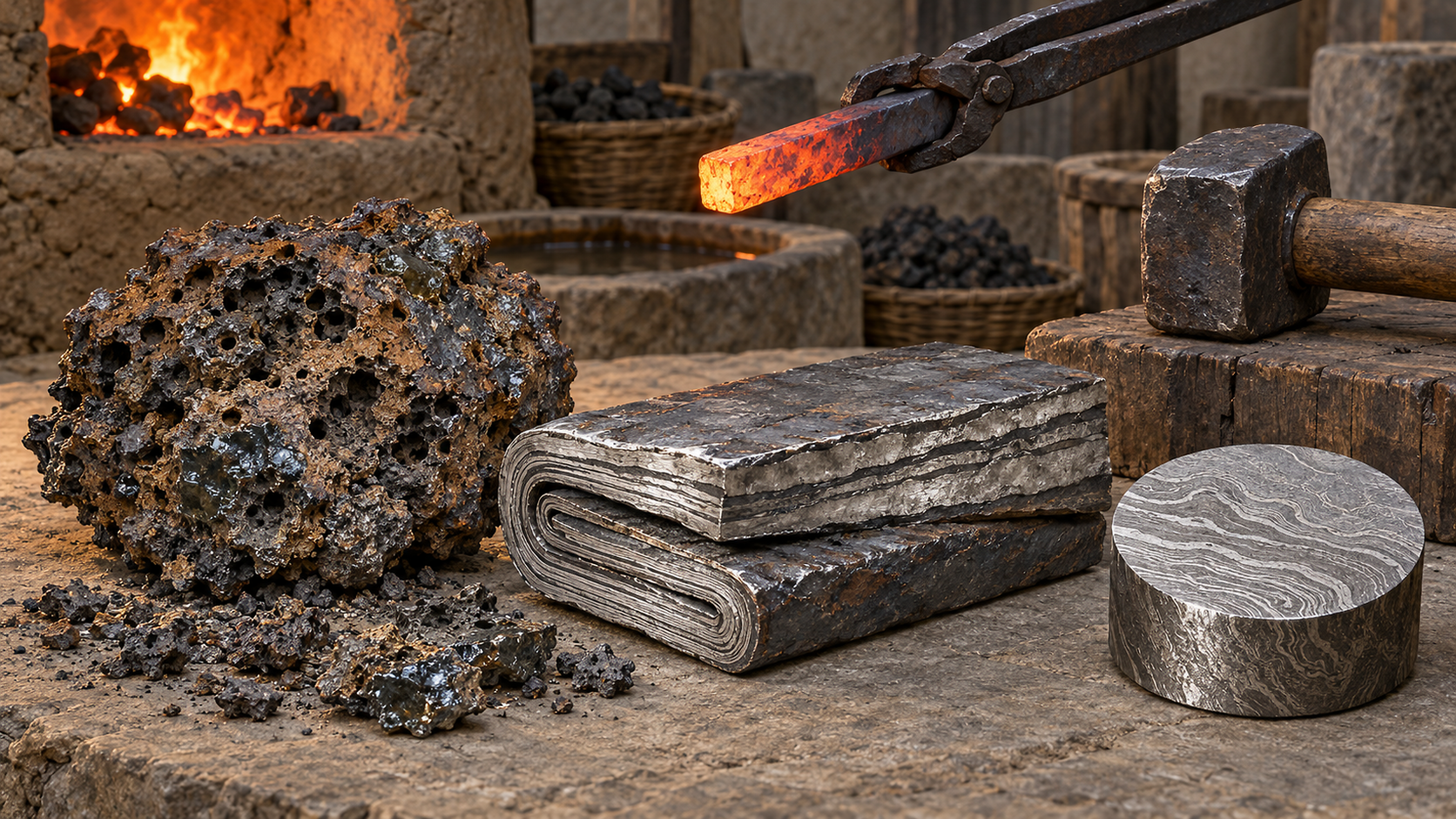
The metallurgical foundation of the hwandudaedo rested on peninsular iron production, particularly in the rich mineral basins of the Nakdong River valley held by Gaya and Silla. Excavations of ancient smelting furnaces, such as those at Jinju and Gimhae, show bloomery furnaces fed with local iron sands and bog ores, fired using hardwood charcoal. These furnaces produced a spongy mass of solid iron and slag known as a bloom, which required extensive secondary refining.
To convert this raw bloom into sword-grade steel, peninsular smiths used repeated folding and hammering. This process broke down silicate inclusions, consolidated the porous metal, and evened out the carbon distribution throughout the block. By repeatedly folding an iron bar over itself—sometimes ten to twenty times—the smith produced a layered composite material containing hundreds of paper-thin lamination sheets.
This folding technique, known broadly across continental East Asia as bailliam or multi-refined iron, produced steel capable of taking a sharp edge without shattering under blunt impact. Cross-sectional metallography performed on excavated blades reveals distinct ferrite and pearlite bands, testifying to the smith's deliberate control over carbon content during the forge-welding sequence.
Blade Geometry and Differential Heat Treatment
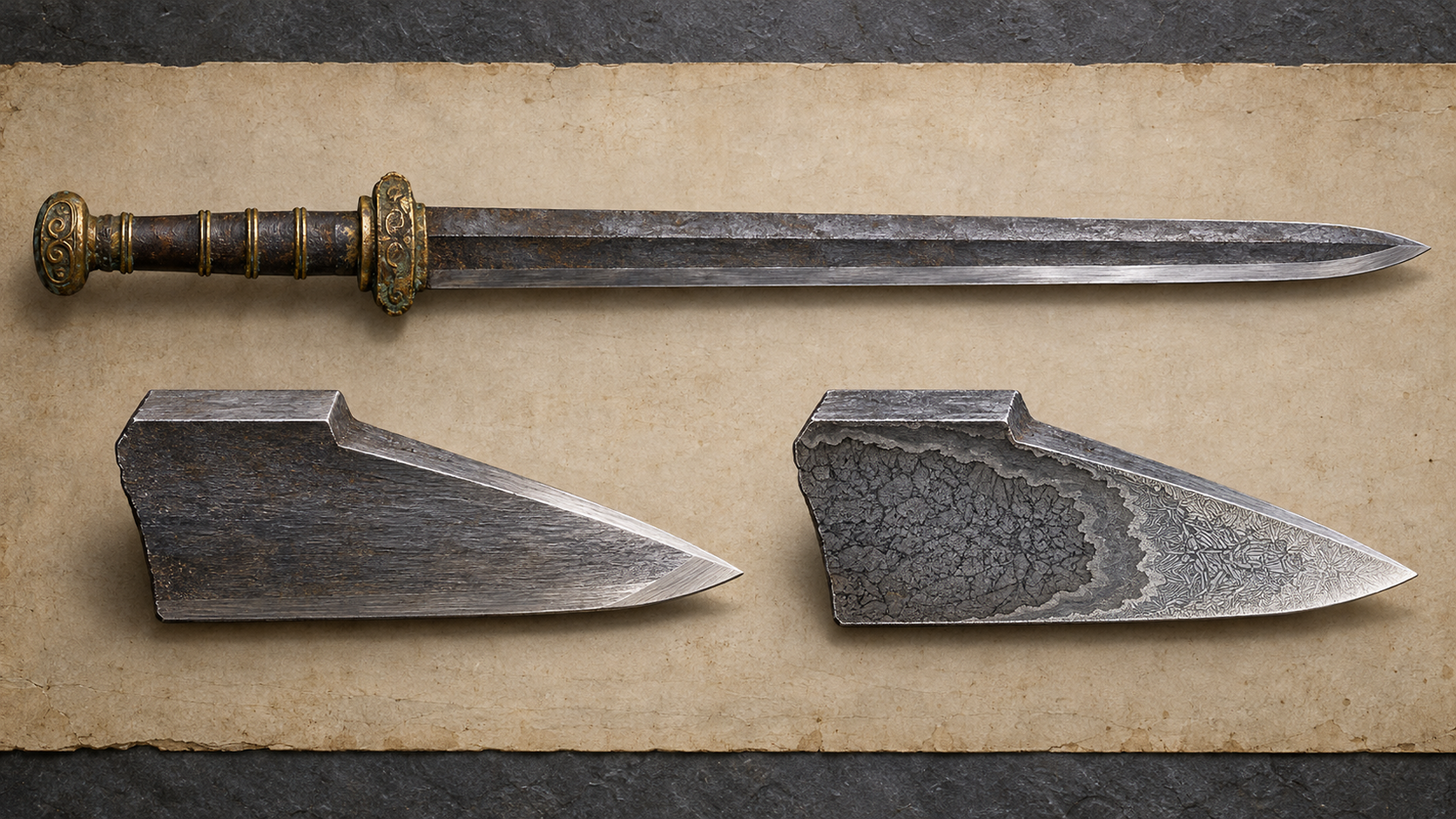
Unlike the curved blades of later centuries, the hwandudaedo is resolutely straight. The blade cross section is typically wedge-shaped or triangular, featuring a flat, stout spine that provided structural stiffness, tapering smoothly down to the primary cutting bevel. Some blades display an asymmetrical stepped bevel, where one side drops flat while the other carries a distinct shoulder, enhancing edge support against armor.
The thickness at the ricasso, where the blade emerges from the hilt, was substantial, often measuring six to eight millimeters. The blade thinned only moderately along its length, retaining mass near the center of percussion to deliver heavy cleaving blows against iron lamellar armor and lacquered leather coats. The tip was usually ground with an angular break, creating a reinforced point suitable for thrusting into seams between armor plates.
To harden the cutting edge, smiths used heat treatment that anticipated later Japanese differential quenching methods. By coating the spine in insulating clay or quenching the blade rapidly in water or oil, the edge was transformed into hard martensite, while the spine retained a tougher, shock-absorbing mixture of ferrite and pearlite. Due to deep corrosion from centuries in acidic burial soils, this temper line is rarely visible to the naked eye on peninsular finds, but microscopic examination confirms its presence in well-preserved specimens.
Forging and Mounting the Ring Pommel
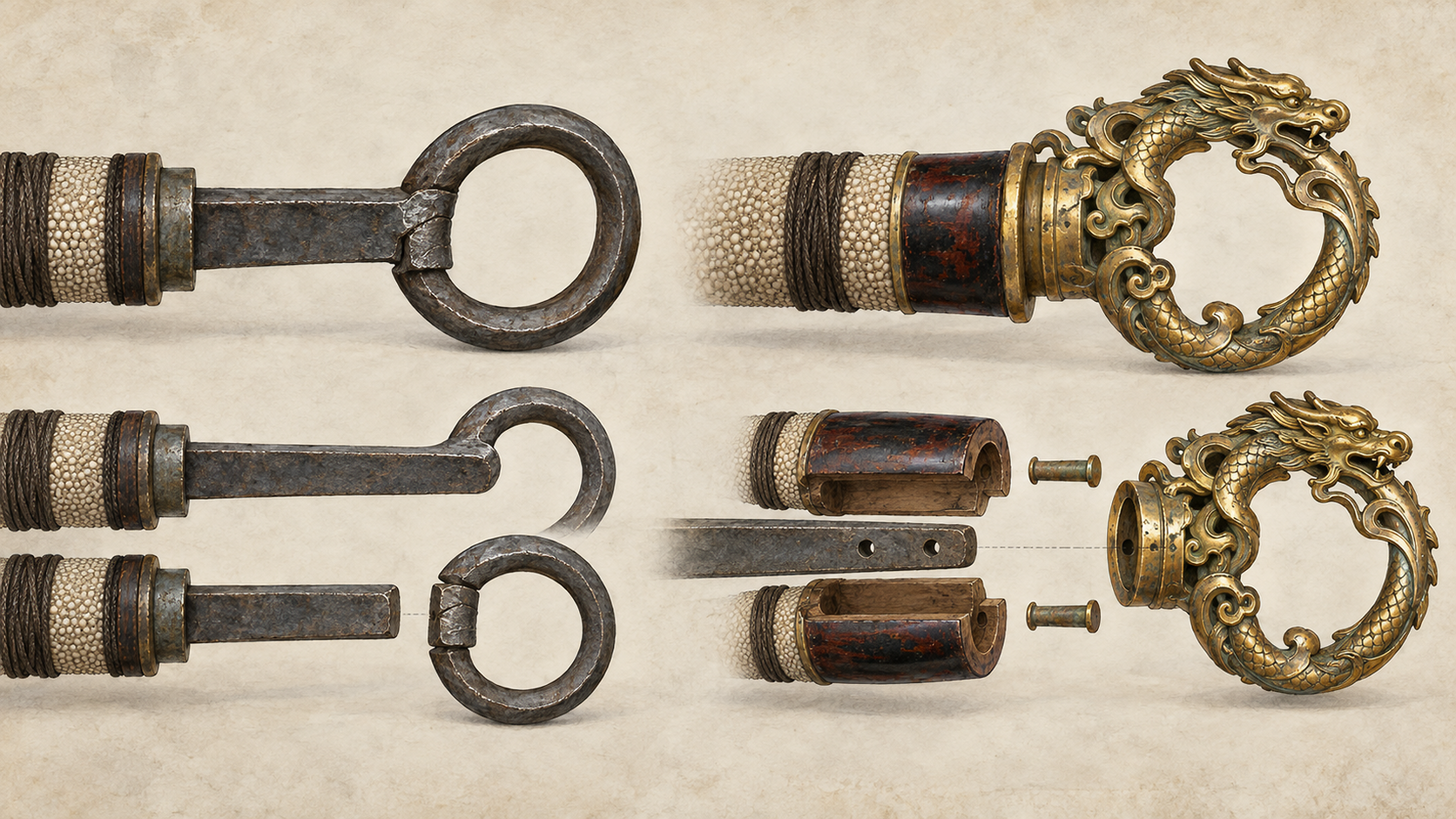
The structural connection between the blade tang and the ring pommel reveals the technological status of the sword. In the simplest class, known as sodal-hwandu or plain ring swords, the smith drew out the iron tang, bent the distal end around an anvil horn into a neat teardrop or circle, and forge-welded or riveted the tip back onto the tang. This made the hilt and blade a single, continuous piece of iron.
In higher-ranking swords, the pommel was manufactured as an independent decorative module. The smith or bronzeworker cast the ring using the lost-wax method or carved it from a solid billet of copper-alloy or iron. The base of the cast ring ended in a hollow collar or a pair of extended lugs designed to slot over the wooden grip core and the projecting end of the iron tang.
Once fitted, the ring was anchored using transversal copper or iron rivets that passed through the collar, the wooden core, and the metal tang. In select royal pieces, such as those recovered from Silla royal tombs in Gyeongju, the joint was further reinforced with melted silver solder or brazing alloys. This modular construction allowed goldsmiths and bladesmiths to work simultaneously, combining high-grade weapon steel with jewel-like precious metals.
The Iconography of Power: Dragon, Phoenix, and Trefoil
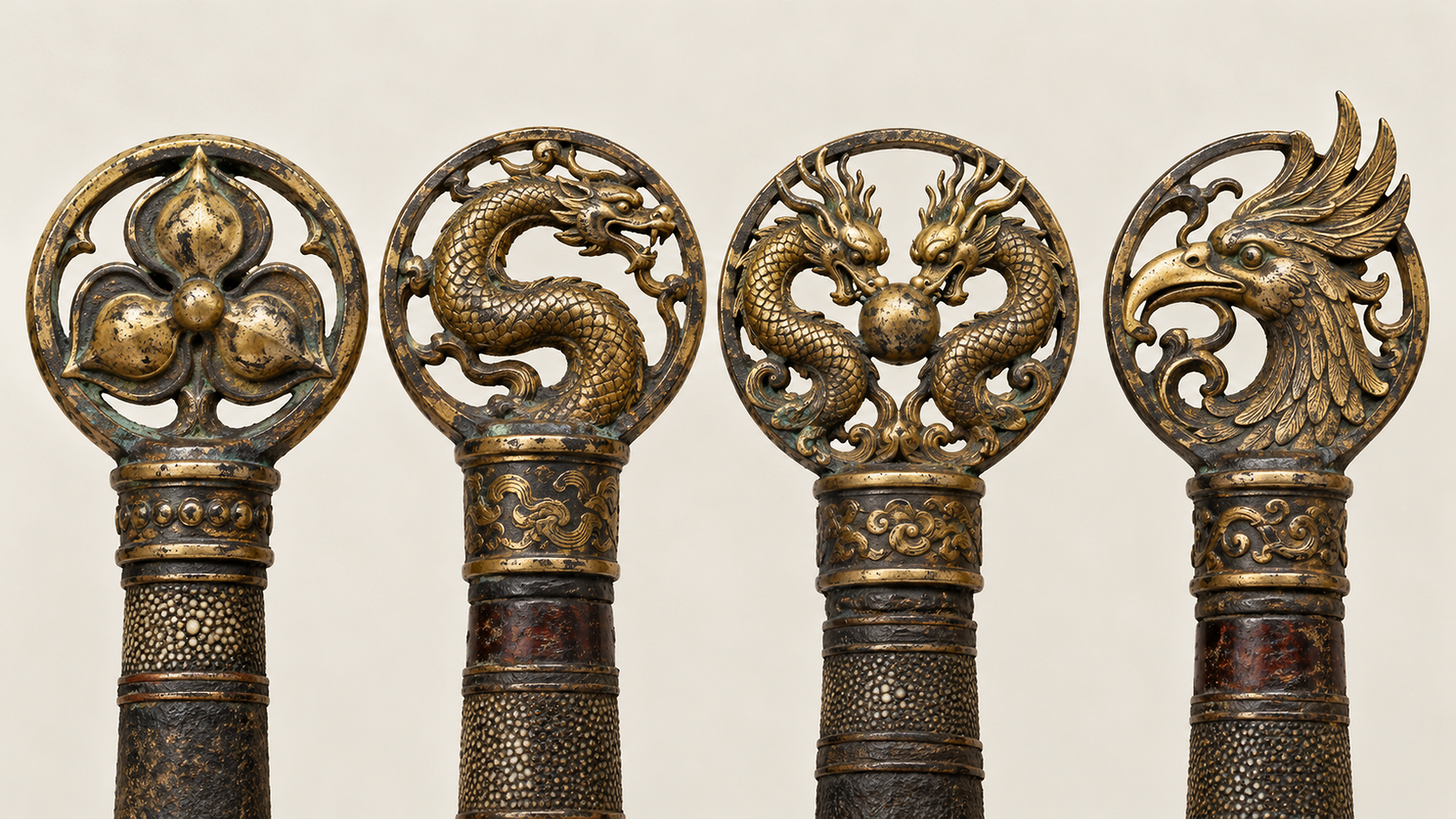
Archaeologists categorize decorated hwandudaedo into distinct typological classes based on the motif set inside the ring. These motifs served as visual markers of rank in the strict aristocratic hierarchies of the Korean kingdoms. A plain ring belonged to ordinary cavalrymen and junior officers. As social rank climbed, the internal space of the ring was filled with increasingly complex symbolic forms:
The primary decorative types found across Three Kingdoms cemeteries reflect specific rank and royal associations:
The dragon (ryong) and phoenix (bonghwang) designs carry deep cosmological weight. In the Silla royal tomb of Cheonmachong (Tomb of the Heavenly Horse), the recovered hwandudaedo features two interlocking dragons cast within the loop, their jaws wide, holding a central jewel between them. In Baekje tombs, particularly that of King Muryeong, single-dragon pommels were favored, with the serpent's body coiled tightly to fill the oval frame without touching the outer rim except at anchor points. These creatures represented sovereign vitality, heavenly mandate, and protection in the afterlife.
The primary decorative types found across Three Kingdoms cemeteries reflect specific rank and royal associations:
- Samyeop-hwandu: Trefoil pommels, where the interior forms a stylised three-lobed plant or lotus leaf, common among regional elites and allied commanders in Gaya and Baekje.
- Duryong-hwandu: Single-dragon pommels, showcasing a coiled serpentine body with textured scales, claws, and an open snout, typical of high royalty.
- Ssangryong-hwandu: Paired-dragon pommels, featuring two mirrored beasts confronting each other or intertwining their necks around a central orb.
- Bonghwang-hwandu: Phoenix-headed pommels, featuring a proud bird profile with a curved beak, crest feathers, and an expressive eye, associated with paramount court figures.
Inlay and Mercury Gilding: The Ipgusa Technique
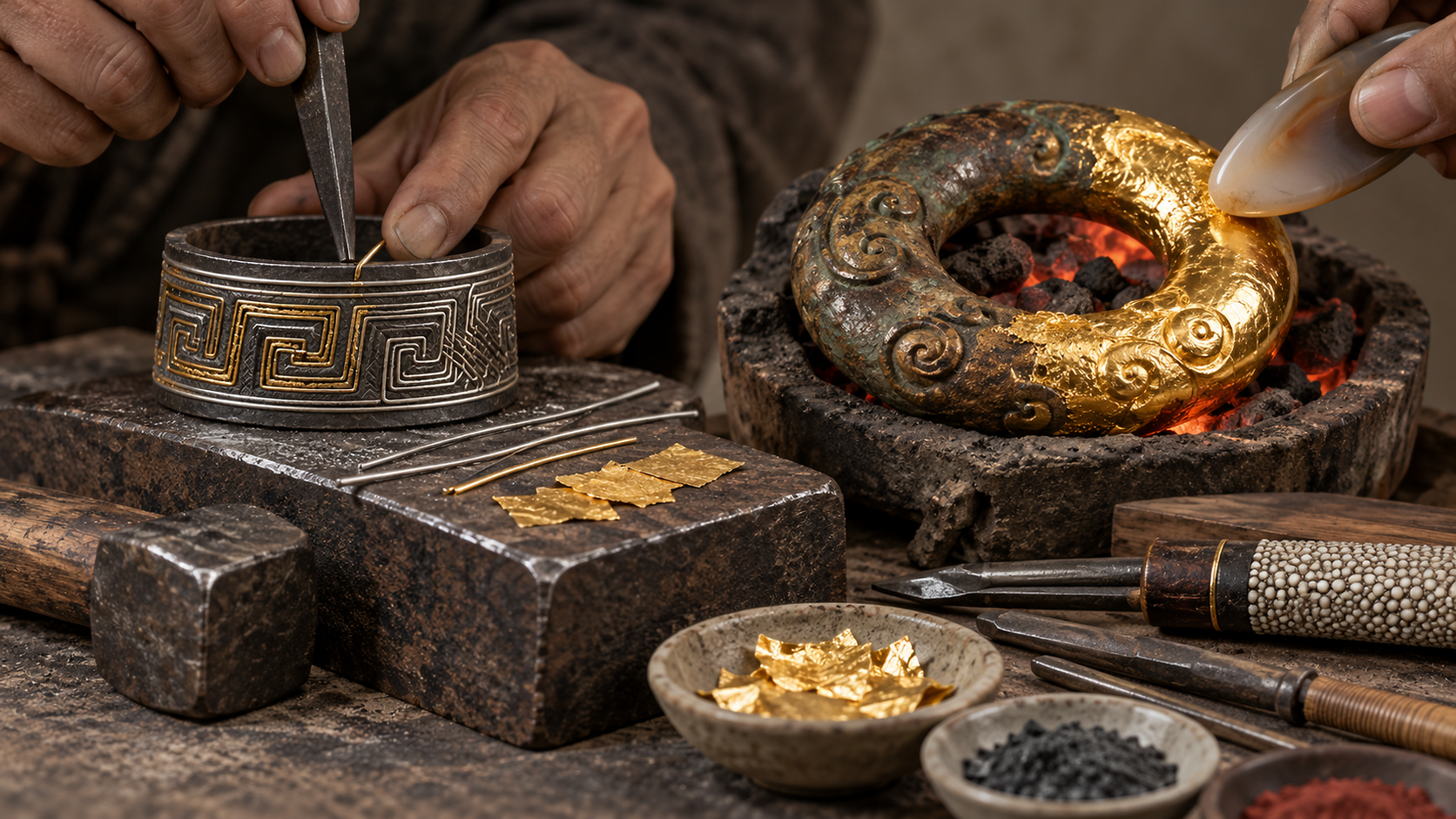
The metallic ornament on Three Kingdoms swords went far beyond plain casting. Peninsula craftsmen were masters of ipgusa, the art of grooving an iron ground and hammering fine wires or thin foils of gold and silver into the channels. On the ferrule, scabbard mouth, and blade shoulders, smiths cut crosshatched patterns into the cold iron using hardened steel chisels, then hammered sheets of gold foil into the teeth, creating shimmering geometric bands that never dislodged.
Mercury gilding, or fire gilding, was the preferred method for finishing bronze fittings. Craftsmen dissolved pure gold in boiling mercury to form a buttery paste known as amalgam. They rubbed this amalgam across the chased bronze pommel, then heated the piece over charcoal embers. The mercury evaporated as toxic vapor, leaving a continuous, tightly bonded layer of pure gold on the bronze surface.
After cooling, the surface was burnished using an agate or hardened iron point. Burnishing smoothed the microscopic pores left by the evaporating mercury, bringing out a brilliant, reflective luster. This golden finish served a practical purpose alongside its aesthetic appeal: it formed a barrier against moisture and skin acids, protecting the underlying copper alloy from corrosion during prolonged handling.
Grip Architecture and Organic Linings
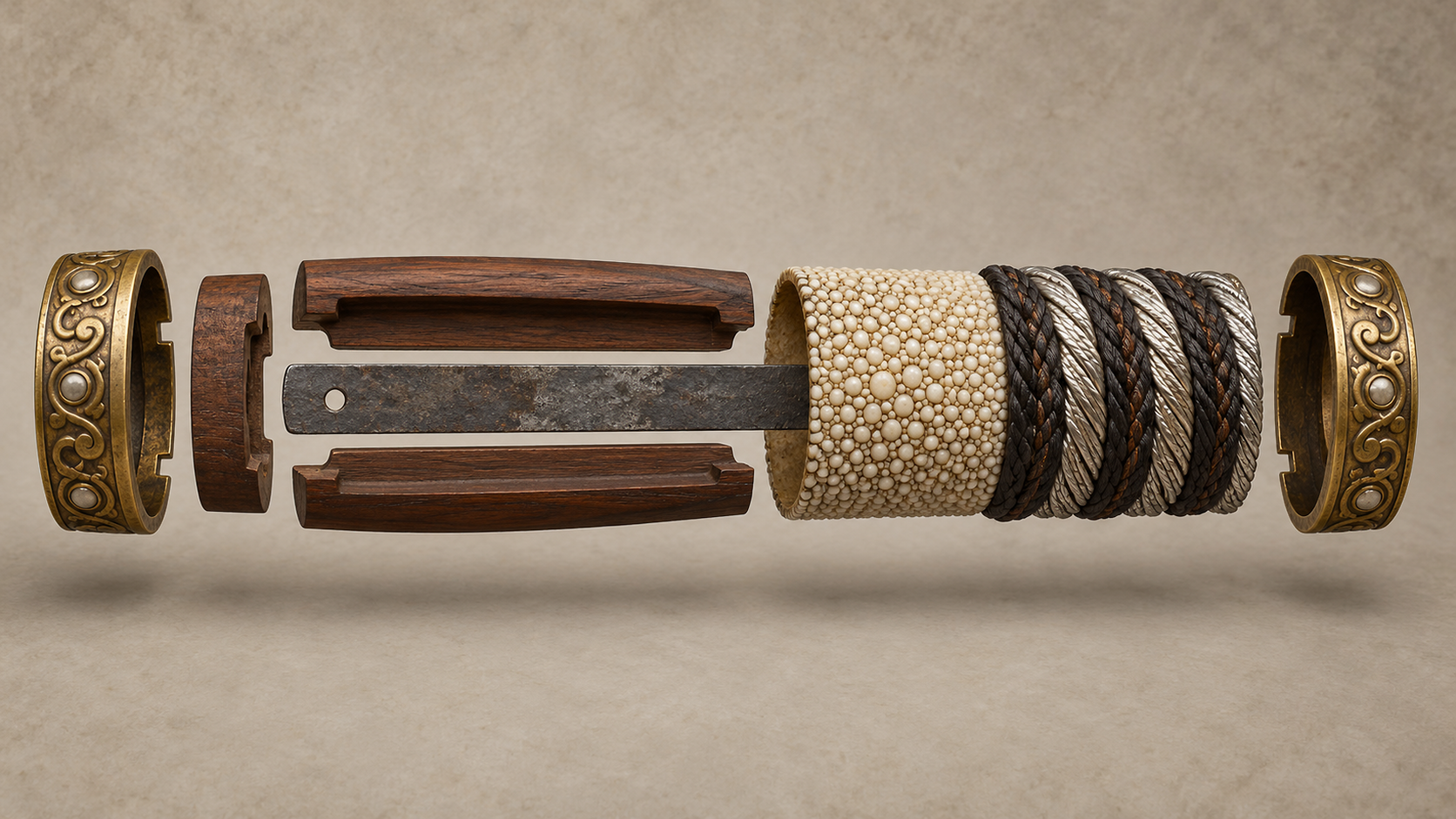
Beneath the gleaming gold mounts and wire bindings lay an organic structure engineered to absorb the shock of impact. The core of the grip consisted of two carved halves of dense hardwood, such as oak, pear, or zelkova. These halves were hollowed out to fit the flat iron tang tightly, preventing any rattling or play between the steel blade and the handle.
To provide a secure hold in wet or bloodstained conditions, the wood core was wrapped in organic materials. Elite swords were frequently covered with the skin of rays or sharks (same-hada), prized for its calcified, pebble-like surface that interlocked naturally with the palm. Over this rawhide layer, craftsmen wrapped fine braids of silk cord or tightly wound strands of silver and gold wire, laid down in alternating spirals.
Small cast spacers and ferrules, called goe-geum, capped each end of the grip. These collars prevented the wood halves from splitting outward when the weapon struck a target. In royal Baekje and Silla swords, these collars were chased with running scroll patterns, palmettes, and small inlaid garnets or glass beads, creating a tactile transition between the bare steel of the blade and the warm, textured grip.
The Scabbard and Two-Point Equestrian Suspension
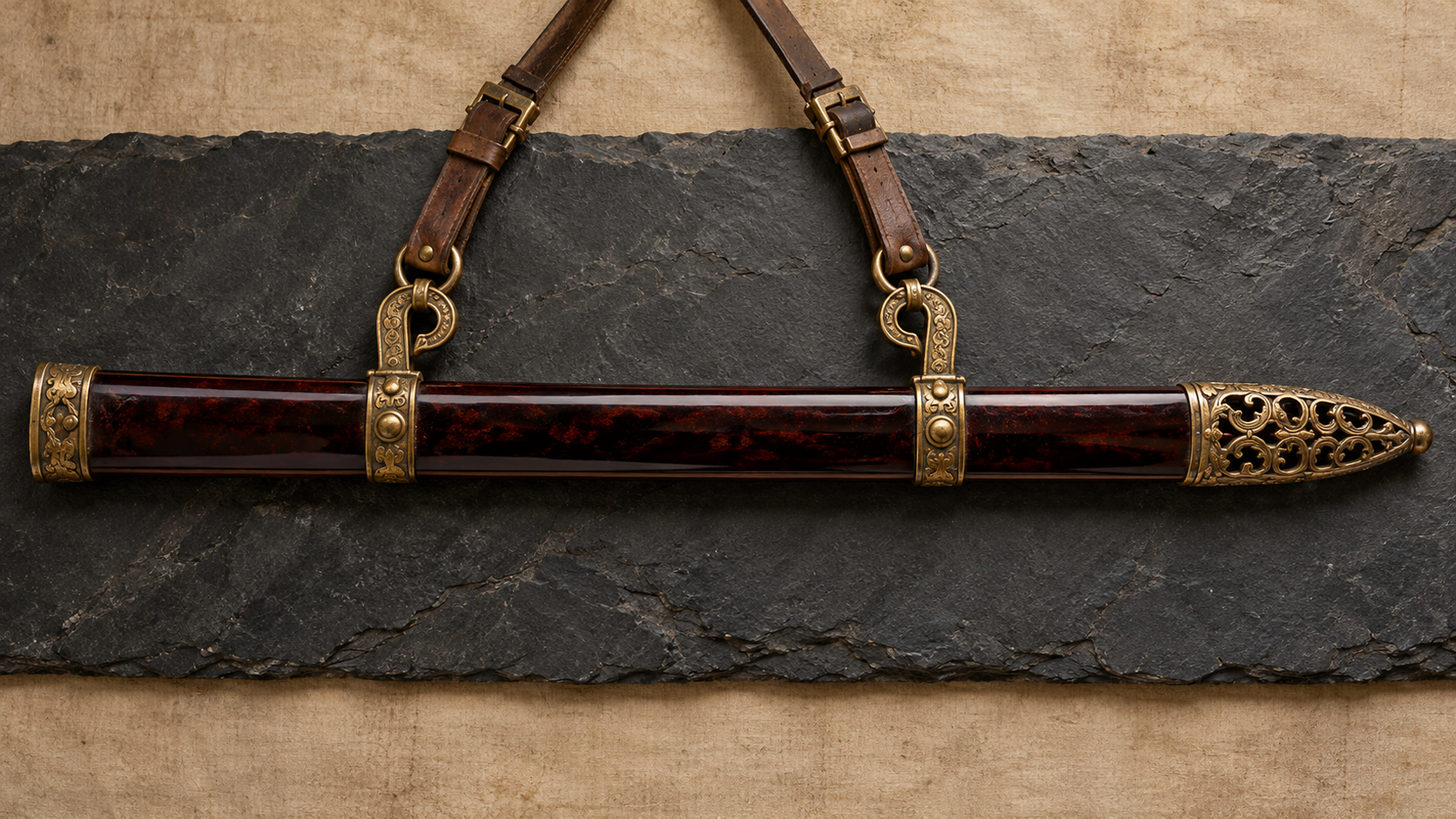
A sword designed for cavalry cannot simply be tucked loosely into a sash; the motion of the horse would throw it to the ground. Hwandudaedo scabbards were precision-engineered wooden sheaths, constructed from two hollowed laths glued together with animal fish glue, wrapped in silk or hemp cloth, and coated in multiple layers of natural urushi lacquer. The lacquer cured into an impermeable, waterproof shell that shielded the iron blade from atmospheric moisture.
Elite scabbards were fitted with two distinct suspension loops on one side of the sheath. These fittings, often shaped like a stylized letter P or fitted with pivoting bronze rings, accepted leather straps that ran up to the horseman's belt. This two-point suspension system ensured the sword hung horizontally or canted forward at an angle that allowed an immediate, smooth draw with the right hand while mounted.
The chape at the tip of the scabbard, termed the malli, protected the fragile wooden end from being crushed against stirrups or rocks. Made of cast bronze or folded iron sheet, the chape mirrored the decorative motifs of the pommel, featuring openwork trefoils or palmette scrollwork. On some Silla royal scabbards, the entire length of the wood sheath was covered with perforated sheet gold over red-lacquered bark, transforming the scabbard into a blinding band of gold.
Regional Traditions: Gaya, Baekje, Silla, and Goguryeo
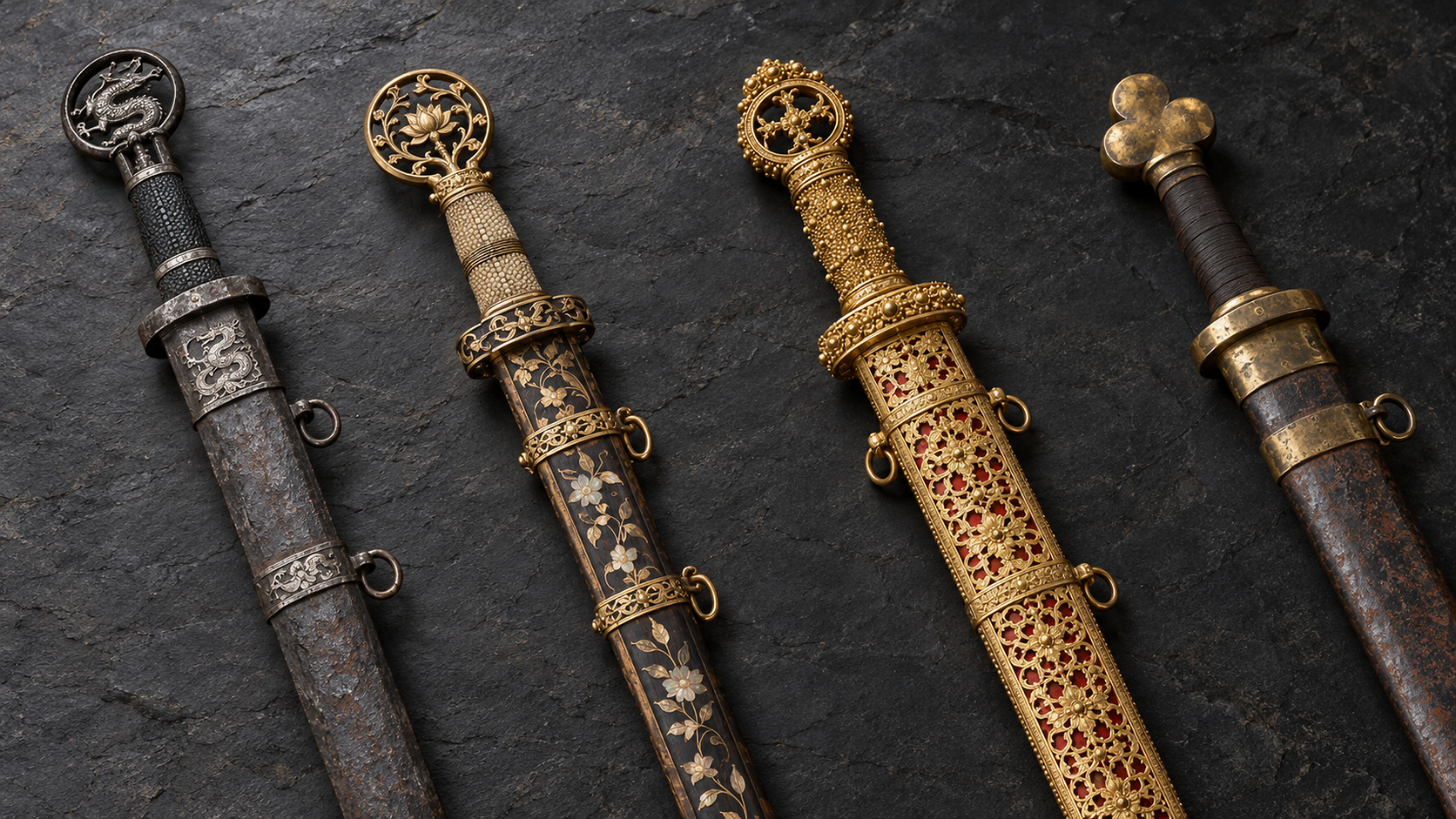
Although the Three Kingdoms shared a common metallurgical baseline, each kingdom developed distinct stylistic signatures that archaeologists use to identify workshop origins and trade networks:
Regional differences manifested in pommel geometry, casting depth, and decorative conventions:
Goguryeo swords, preserved mainly in stone chamber murals and northern fortress sites like Ji'an, emphasize utilitarian robustness, often retaining iron pommels with inlaid silver dragons rather than heavy gilded castings. Baekje works, centered in Buyeo and Gongju, stand out for fluid, dynamic line work and sculptural elegance, reflecting direct maritime contact with southern Chinese dynasties. Silla weapons from Gyeongju's massive wooden-chamber tombs display uninhibited ostentation, marked by thick sheets of pure gold and granulated beadwork. Gaya swords, particularly from the Daegaya tombs of Goryeong, demonstrate exceptional iron-smelting purity and a preference for bold, openwork trefoil pommels.
Regional differences manifested in pommel geometry, casting depth, and decorative conventions:
- Baekje: Characterized by refined, naturalist dragon forms, flowing leaf tendrils, and delicate wire inlay on the hilt ferrules, epitomized by finds from the Tomb of King Muryeong.
- Silla: Renowned for intense gold surface decoration, thick mercury-gilt bronze castings, paired-dragon motifs, and scabbards covered entirely in sheet gold.
- Gaya: Notable for structural clarity, heavy openwork trefoil rings, and an exceptional standard of bloomery iron refinement from the Nakdong River workshops.
- Goguryeo: Defined by powerful, lean proportions, often utilizing silver inlay over dark forged iron grounds, built for rugged northern border cavalry operations.
Maritime Exchange and Diplomatic Gift Networks
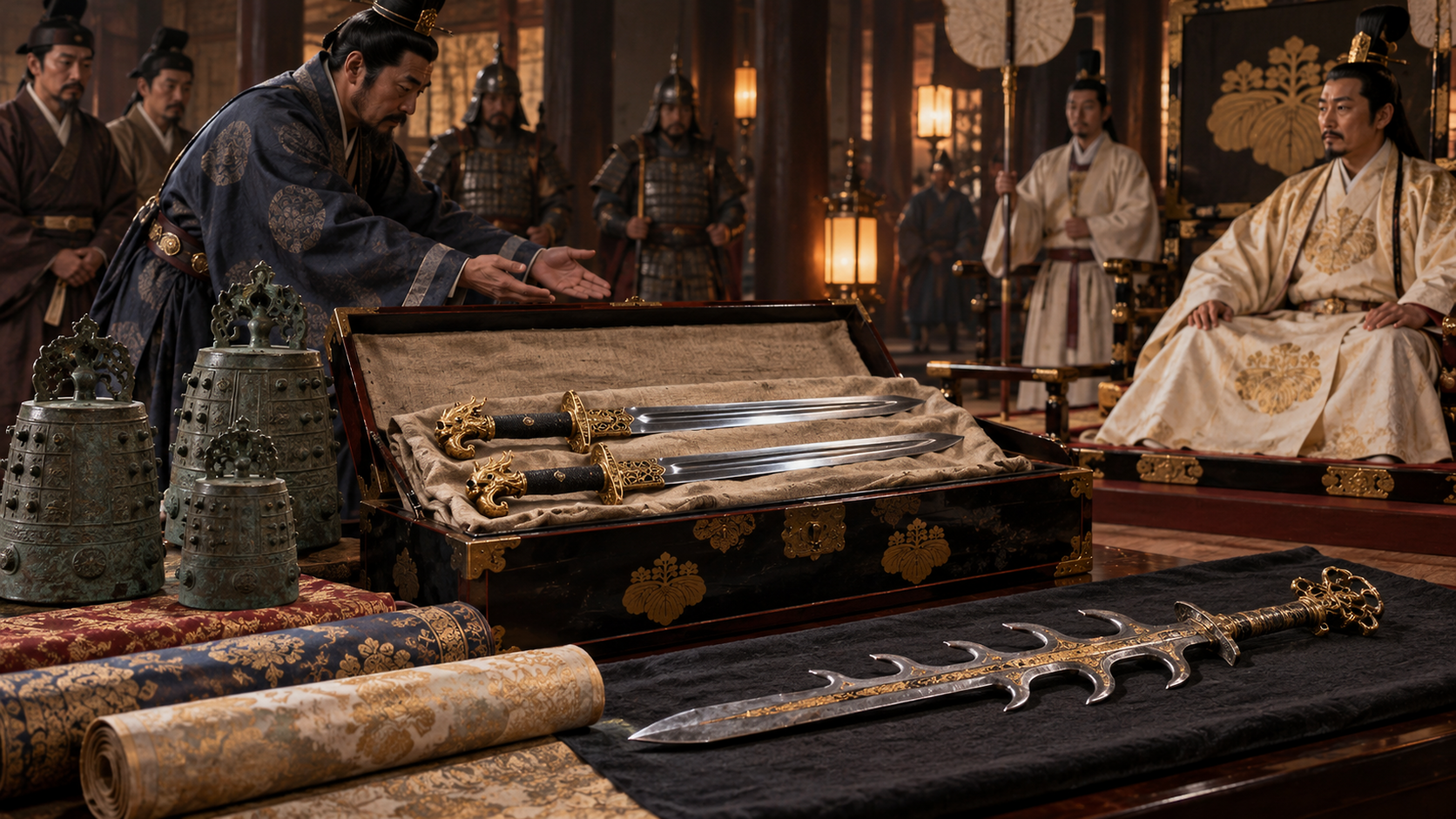
The hwandudaedo was not confined to the Korean Peninsula; it was an essential diplomatic tool across the East Asian maritime network. During the fifth and sixth centuries, peninsular courts sent crafted swords as formal gifts to Yamato chieftains in the Japanese archipelago. These gifts cemented military alliances, recognized regional authority, and accompanied the transmission of scribes, potters, and metalworkers.
A famous testament to this diplomatic exchange is the Seven-Branched Sword (Chiljido), preserved at Isonokami Shrine in Nara, Japan. While structurally distinct with its branching side projections, its golden inlaid inscription confirms it was forged in Baekje and presented to a ruler of Yamato. Excavations in Japanese kofun mounds—such as the Eta Funayama Tumulus in Kumamoto—frequently unearth hwandudaedo bearing Korean structural details, including dragon-pommel mounts and silver-inlaid blade spines.
These imported peninsular blades were known in Japan as kanto-tachi (ring-pommel tachi). They formed the prestige core of early Yamato armories, demonstrating that technical mastery of iron folding, mercury gilding, and animal-headed pommel design traveled directly from peninsular workshops into the evolving armory of proto-historic Japan.
Taphonomy and the Archaeology of the Grave Mound
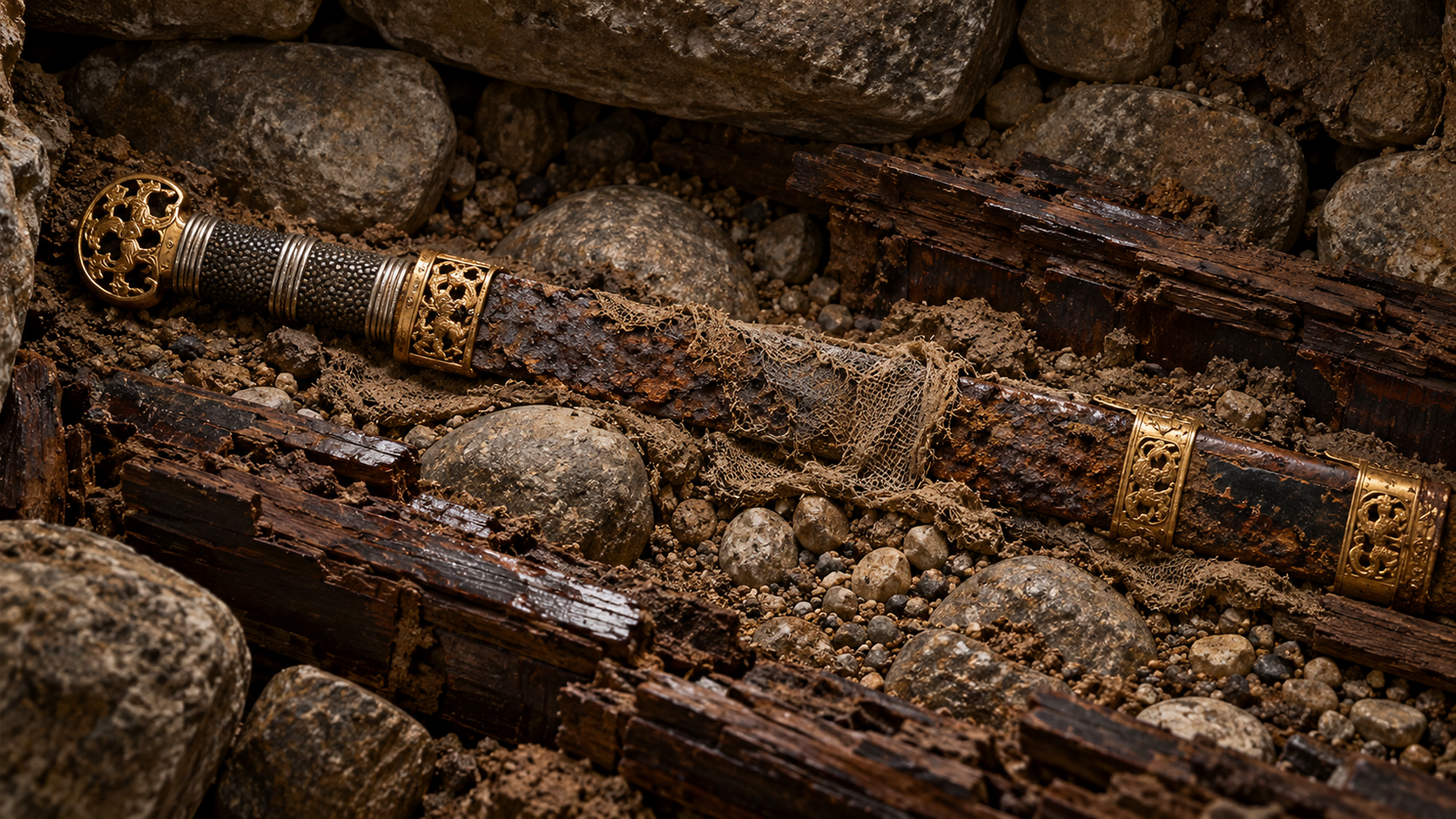
Most surviving hwandudaedo owe their preservation to the burial architecture of the Three Kingdoms. In Silla, the monumental stone-mound wooden-chamber tombs (dolmuji teokgwanmyo) created unique preservation environments. A wooden burial chamber was built, surrounded by towering layers of river boulders, and capped with an earthen mound. When the timber roofs eventually collapsed, the boulders fell inward, crushing the organic caskets and sealing the interior beneath tons of rock.
This collapse created an anaerobic, sealed environment that shielded metal objects from flowing groundwater and oxygen. Iron blades survived, though heavily oxidized and transformed into brittle layers of magnetite and goethite. The bronze, silver, and gold fittings fared far better: gold does not tarnish, silver developed a protective dark sulfide patina, and gilt bronze retained its bright skin wherever the underlying copper alloy remained intact.
In stone-cist graves, such as those found in Baekje and Gaya, taphonomic conditions were often harsher. Infiltration of acidic soil water frequently dissolved unprotected iron, leaving blades as hollow shells of rust or completely cemented into sand conglomerates. Excavators must consolidate the corroded iron with synthetic resins before lifting the sword, preserving fragile traces of organic materials like wooden scabbard laths and silk cords that cling to the rusting metal.
Conservation Science and Metallurgical Analysis
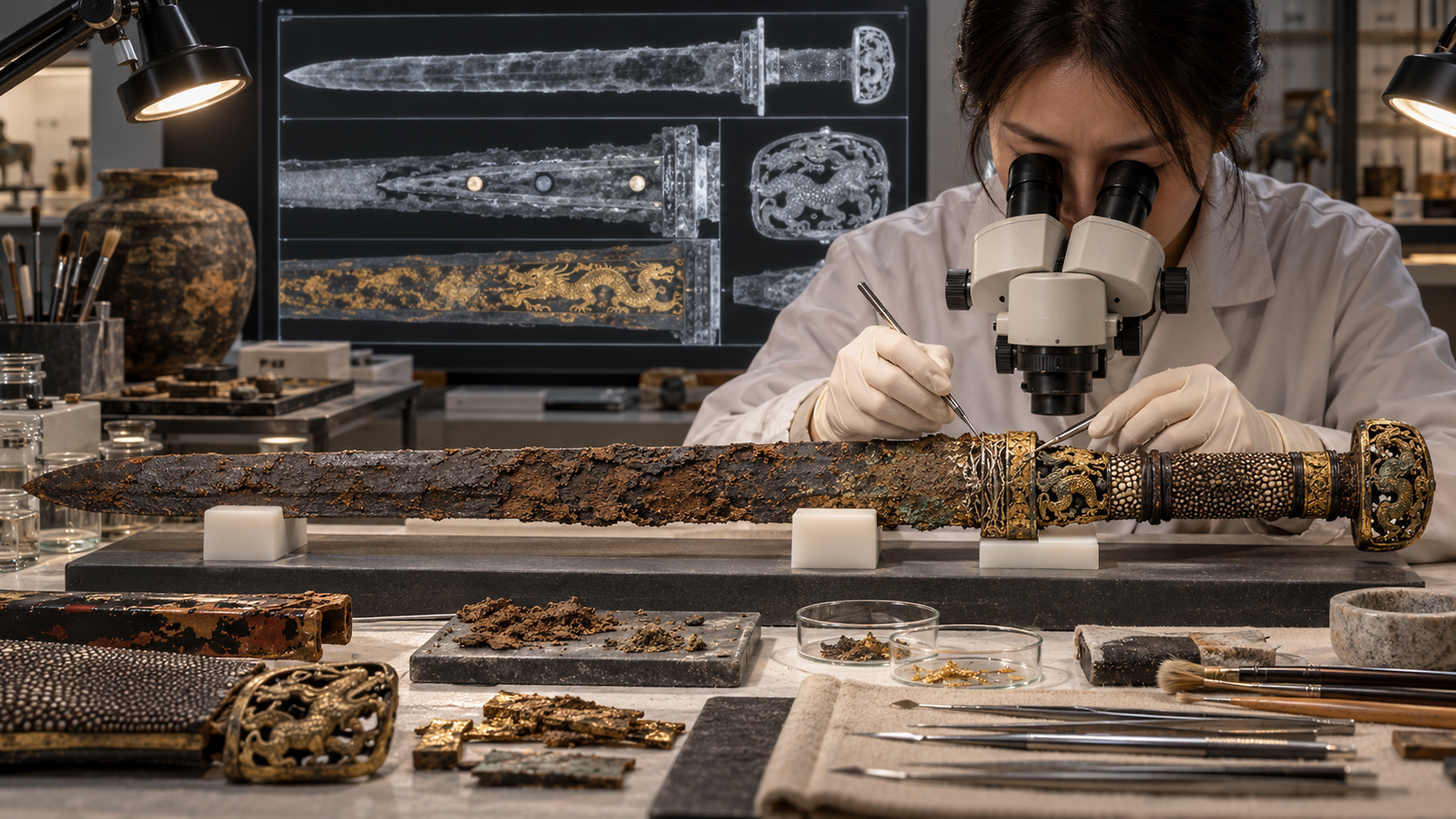
Modern conservation laboratories, such as those at the National Museum of Korea, use advanced non-destructive methods to study and stabilize these ancient weapons. High-energy X-ray radiography and micro-computed tomography (micro-CT) allow conservators to peer through thick crusts of iron corrosion. These scans reveal hidden structures: the exact geometry of the tang inside the wooden grip, internal rivet placements, and faint wire inlays hidden beneath surface oxide.
Metallographic analysis, performed on tiny fragments from broken blade edges, reconstructs the heat treatment cycles used by the ancient smiths. By analyzing the grain structure and slag composition through scanning electron microscopy with energy-dispersive X-ray spectroscopy (SEM-EDS), researchers trace the provenance of the iron ore to specific river basins and identify the fluxing agents used during smelting.
Cleaning treatments avoid harsh chemical stripping, which would destroy irreplaceable textile impressions and wood residues preserved in the corrosion products. Instead, conservators use micro-air-abrasion and delicate scalpels under binocular microscopes, followed by chemical stabilization using benzotriazole for bronze fittings and low-humidity storage environments to halt active bronze disease and weeping iron syndrome.
The Transition Away from the Ring Pommel
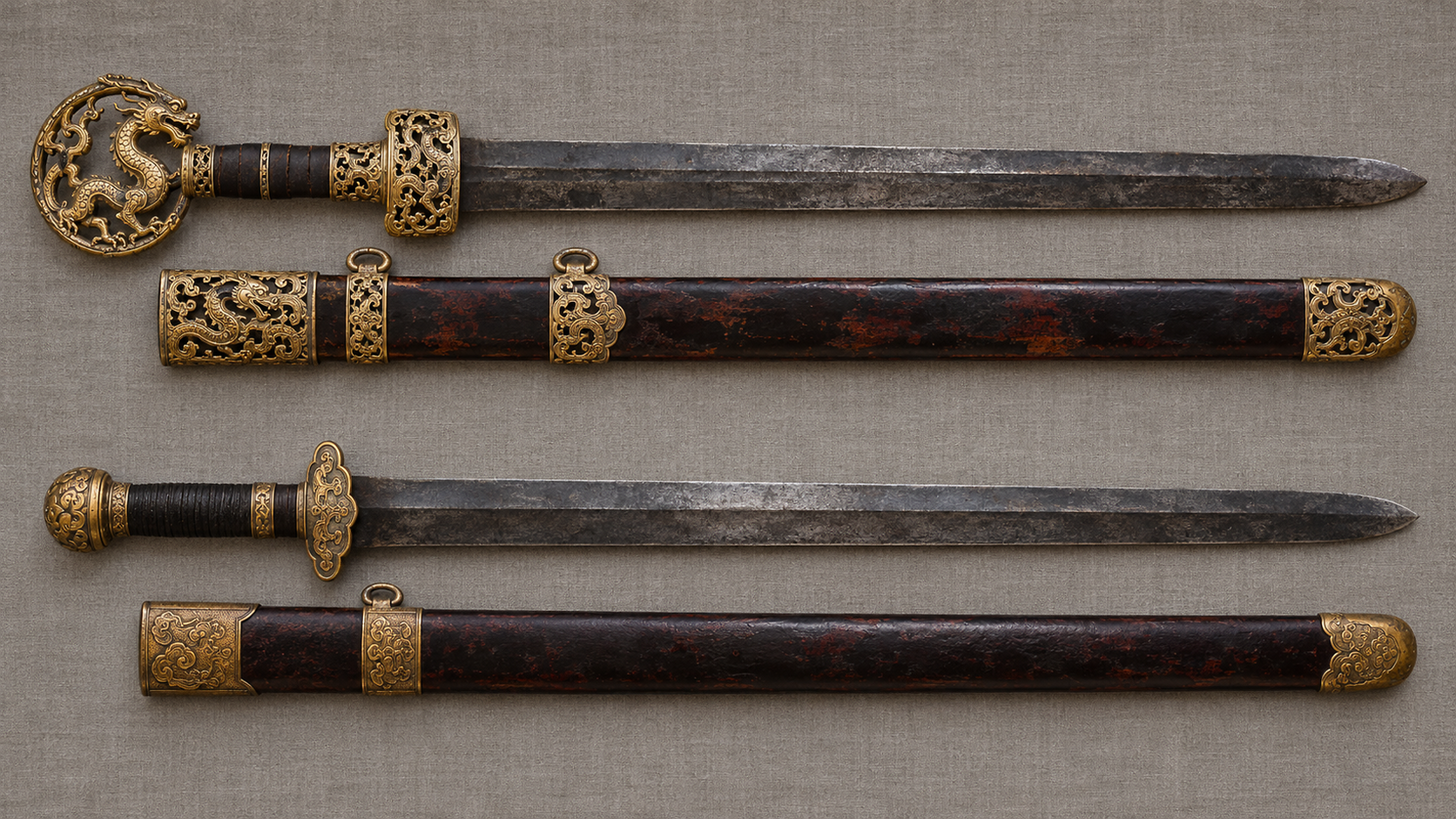
By the late seventh century, the geopolitical landscape of Korea changed permanently. Silla, allied with the Tang dynasty of China, unified the peninsula, bringing an end to the independent courts of Baekje and Goguryeo, while Gaya had already been annexed. With this unification came a profound shift in military technology, court dress, and weapon styles, driven by the continental influence of Tang material culture.
The ring pommel gradually vanished from active military service. It was replaced by swords featuring enclosed pommels, trefoil crossguards, and straight grips influenced directly by the Tang dao. These newer weapons dropped the open circular loop, adopting a curved or rounded pommel cap that sat flush with the scabbard, streamlining the weapon for rapid combat and standardized cavalry deployment.
Although the hwandudaedo disappeared from the battlefield, its legacy endured in the symbolic visual vocabulary of Korean weapons. The decorative motifs forged by Three Kingdoms smiths—entwined dragons, flame-like palmettes, and delicate wire inlays—reappeared on the ceremonial swords of the Goryeo and Joseon dynasties, such as the Byeolunggeom. The ancient ring-pommel swords discovered in the tumuli remain the definitive material witness to an era when iron metallurgy, cosmological belief, and royal prestige were forged into a single, luminous weapon.
Further reading
Follow the sources to examine the object and its historical context.
National Museum of Korea, Permanent Exhibition: Prehistory and Ancient History (Three Kingdoms)External reference · Opens in a new tab Buyeo National Museum, King Muryeong Tomb Collection CatalogueExternal reference · Opens in a new tab Gyeongju National Museum, Silla Tumuli and Gold Crown ArtifactsExternal reference · Opens in a new tab