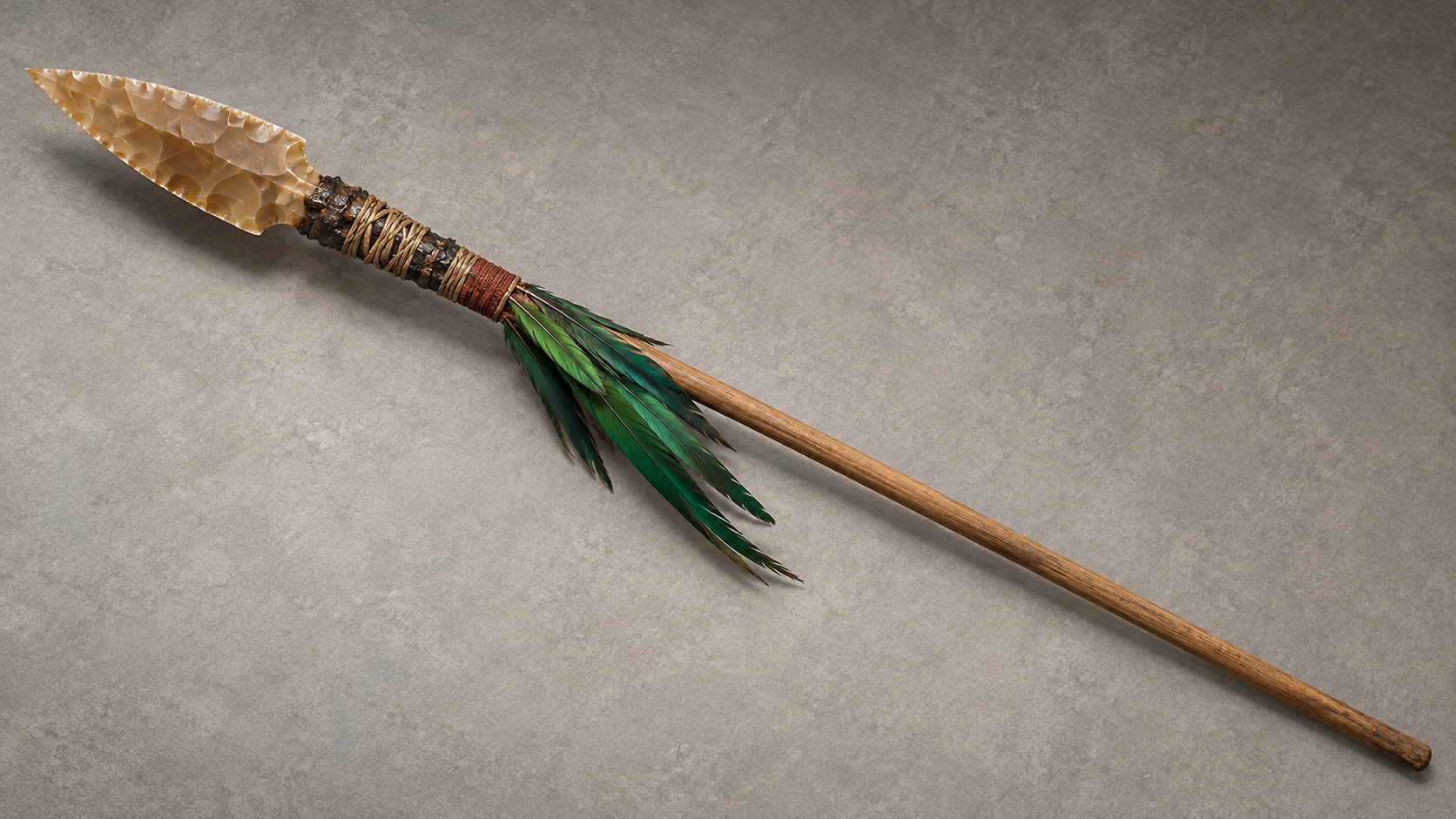
On the southern wall of Room 2 at Bonampak, painted during the late eighth century, warriors clash along a stepped terrace under a heavy tropical sky. Among the tangle of jaguar pelts, woven shields, and grasped topknots, the primary offensive weapon is not a sword or an axe, but a long, rigid thrusting spear tipped with a broad stone point. While popular imagination frequently fixes upon the razor edges of volcanic obsidian, the weapon that anchored Maya battle lines and took the brunt of heavy skeletal impacts was overwhelmingly tipped with chert, a tough microcrystalline stone quarried and flaked into robust bifacial blades. Mounted onto long straight shafts of upland pine or lowland hardwoods, these spears functioned both as decisive instruments of shock combat and as central emblems of dynastic power.
The Bonampak Murals and the Visual Evidence of Maya Shock Combat
The painted vaults of Structure 1 at Bonampak, completed around 790 CE in the Lacandon forest of Chiapas, provide the most vivid surviving visual record of Classic Maya warfare. In the central battle scene of Room 2, the combatants do not engage in distant, loose skirmishing with projectile weapons alone. Instead, heavy infantry lines collide chest-to-chest. Noble captains and rank-and-file fighters grip sturdy thrusting lances with two hands or balance a long shaft in one hand while steadying a hide-covered flexible shield in the other. The mural artists distinguished carefully between weapon types, painting slender dart shafts propelled by spear-throwers alongside thick-beamed thrusting spears tipped with broad, flaked stone blades that are deliberately rendered in tones of cream, tan, and mottled brown.
These painted spears feature prominent structural details that modern archaeology has confirmed. Just behind the stone head, the shaft is frequently wrapped in thick bands of cordage, bark paper, or dyed textile, often terminating in flowing quetzal feathers or dyed animal hair. These dressings were not mere artistic conventions. The depictions show the bindings extending several inches down the wood, protecting the spliced juncture where stone met shaft from splitting outward upon forceful impact. The artists also recorded varied grip positions: some warriors brace the butt beneath an arm to drive the point downward into an adversary's unarmored torso, while others hold the weapon level at shoulder height to strike over the rim of an enemy's shield.
Stone Over Glass: The Material Demands of a Shock Weapon
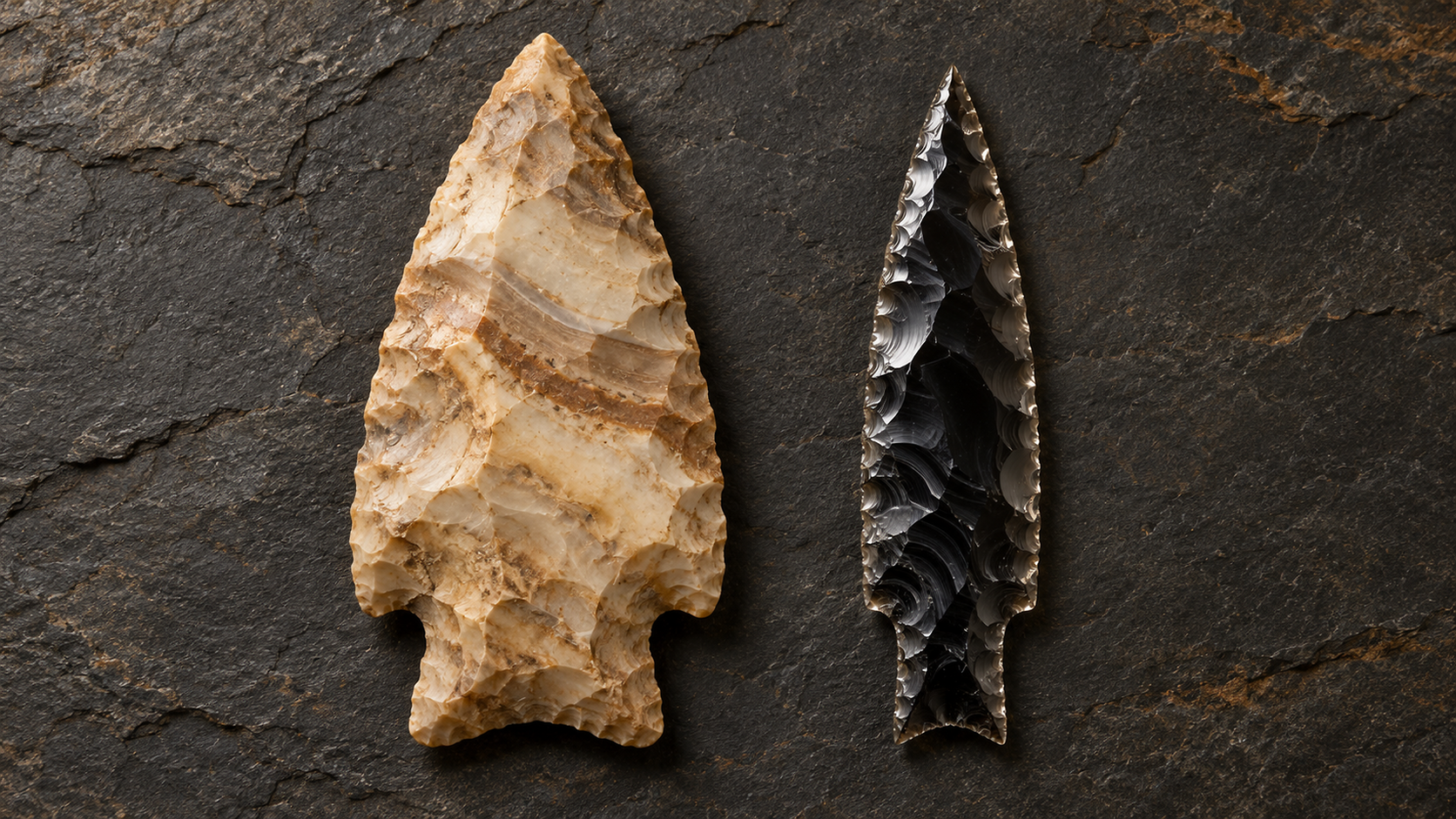
To understand the Maya armorer's selection of materials, one must contrast the physical properties of chert with those of obsidian. Mesoamerican obsidian could be knapped into an edge of atomic sharpness, far keener than any metal blade of antiquity, but this glass is inherently brittle. Under lateral stress, an obsidian biface or prismatic blade shears or shatters against dense bone or hard wooden shields. For a thrusting spear designed to breach heavy quilted cotton armor, split woven wicker, and survive repeated collisions, volcanic glass was often too fragile to serve as the main point, although smaller obsidian flakes found frequent use as projectile tips and razor inserts.
Chert, composed of microcrystalline quartz, fractures with a conchoidal break that produces an exceptionally sharp edge while retaining far greater compressive strength and toughness than obsidian. When a chert spearhead strikes a rib or collarbone, the microcrystals arrest micro-fissures that would otherwise propagate through glass, allowing the edge to sustain impact without catastrophic failure. The Maya recognized this distinction clearly. Regional polities fought tenaciously over access to rich chert outcrops, establishing industrial-scale extraction sites that transformed nodular stone into thousands of standardized weapon blanks.
The Colha Workshops: Industrial Lithic Production in Northern Belize
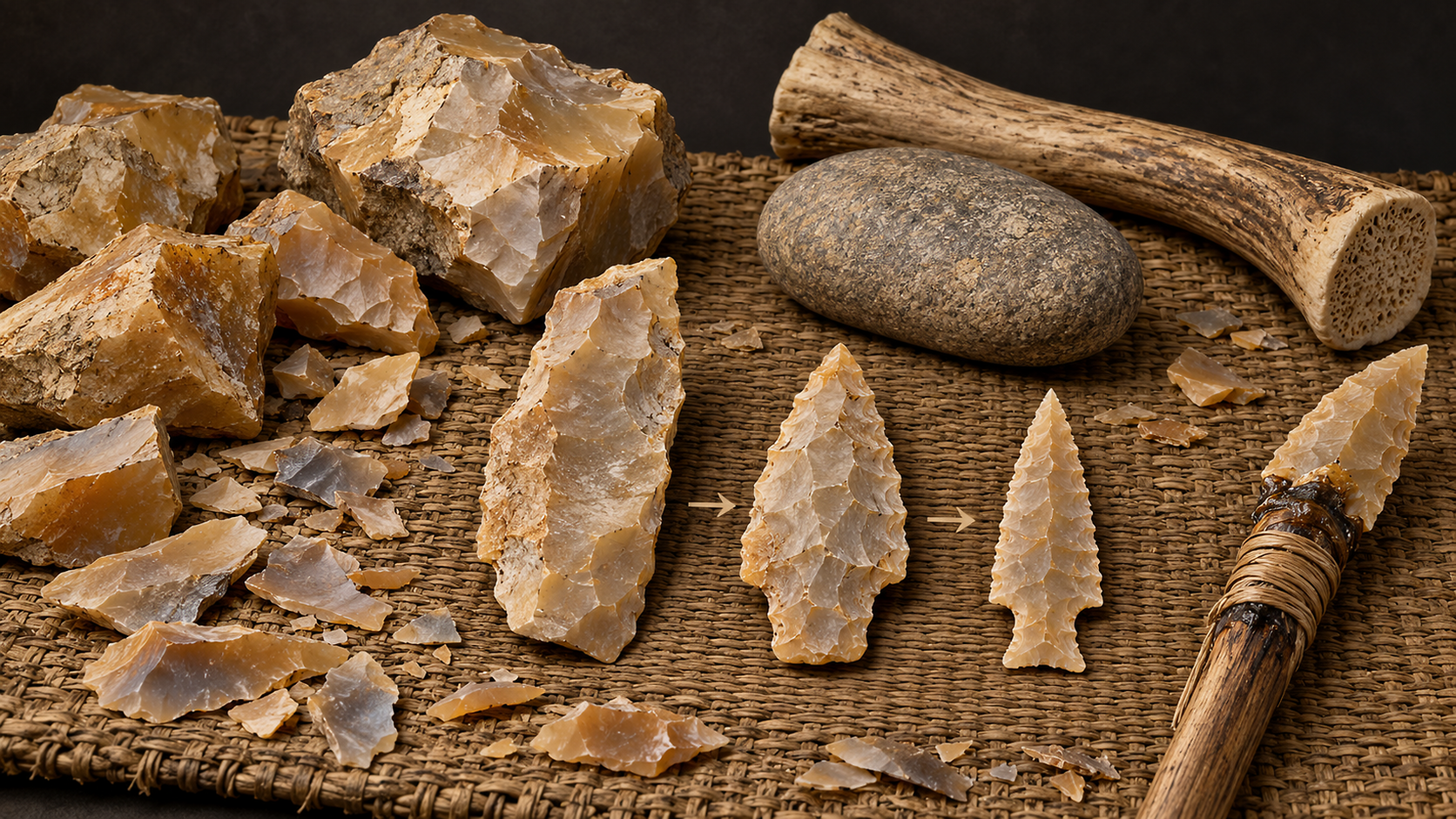
The scale of Maya weapon manufacture is nowhere clearer than at the site of Colha in northern Belize. Situated atop the chert-bearing limestone of the coastal shelf, Colha became an industrial workshop complex during the Late Preclassic and flourished throughout the Classic period. Excavations directed by Thomas Hester and Harry Shafer revealed vast debitage mounds containing millions of chert flakes, rejected preforms, and hammerstones, documenting a continuous tradition of standardized lithic mass production. Rather than individual hunters casually knapping their own points, specialized workshop communities produced formal weapon types for export across the lowlands.
Among the primary items leaving the Colha workshops were large bifacial projectile and thrusting points, classified by archaeologists as stemmed macroblades and stemmed bifaces. Craftworkers selected high-grade nodules of honey-colored chert, using large quartzite percussors to strike broad macroblade blanks from prepared cores. These blanks were then shaped through careful soft-hammer percussion and pressure flaking, creating tapered, symmetrical edges and a broad, rectangular or contracting stem at the base. Standardizing the stem dimensions was critical: it allowed lowland armories in distant allied cities to produce standardized wooden shafts and foreshafts that could receive fresh points without custom carpentry for every weapon.
Harvesting and Seasoning the Shaft: Pine and Tropical Hardwoods
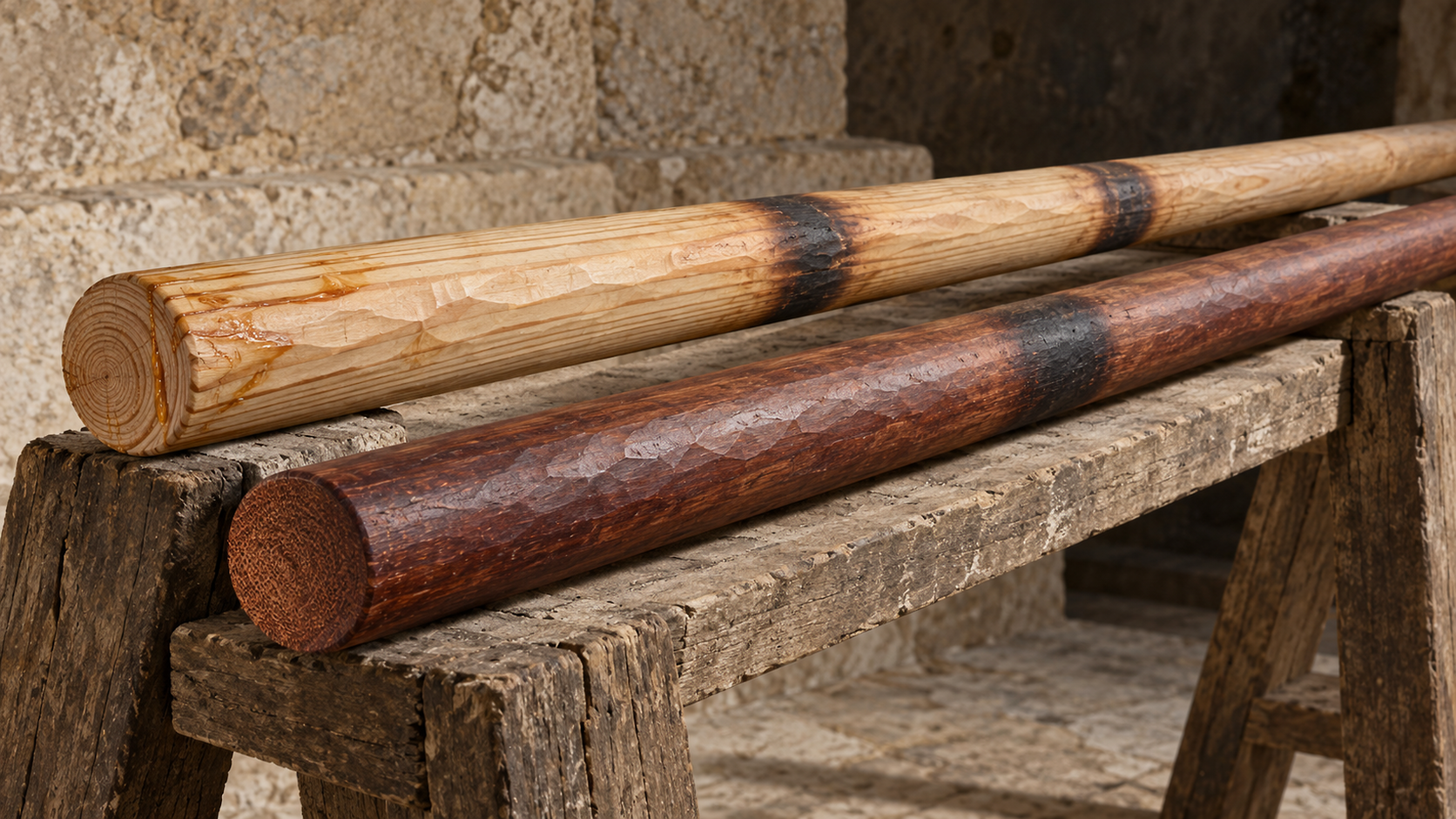
While the stone head delivered the lethality, the wooden haft determined the weapon's reach, balance, and kinetic transfer. Maya territories encompassed diverse ecosystems, from the pine-oak forests of the Chiapas and Guatemalan highlands to the dense rainforests of the Petén basin. Epigraphic and environmental data indicate that highland pine, particularly Pinus oocarpa and Pinus caribaea, was highly prized for spear shafts. Pine provided an exceptional strength-to-weight ratio, straight grain, and natural resin content that resisted rot in humid jungle conditions. These long timbers were traded down river networks into the lowland river valleys where tall, straight softwoods were scarce.
In lowland regions where imported highland pine was unavailable or reserved for the retinue of high lords, local hardwoods served as effective alternatives. Woodcutters selected sapodilla, known botanically as Manilkara zapota, as well as species of tropical cedar and dense palms. Sapodilla is exceptionally hard and dense, resistant to both warping and impact, though it produces a noticeably heavier spear that shifts the weapon's center of balance forward. Craftsmen seasoned these poles slowly over low, smoky fires, a process that drove out residual sap, hardened the outer grain against splinters, and allowed the shaft to be straightened while hot through deliberate leverage.
Hafting Mechanics: Sockets, Foreshafts, and Pitch Adhesives
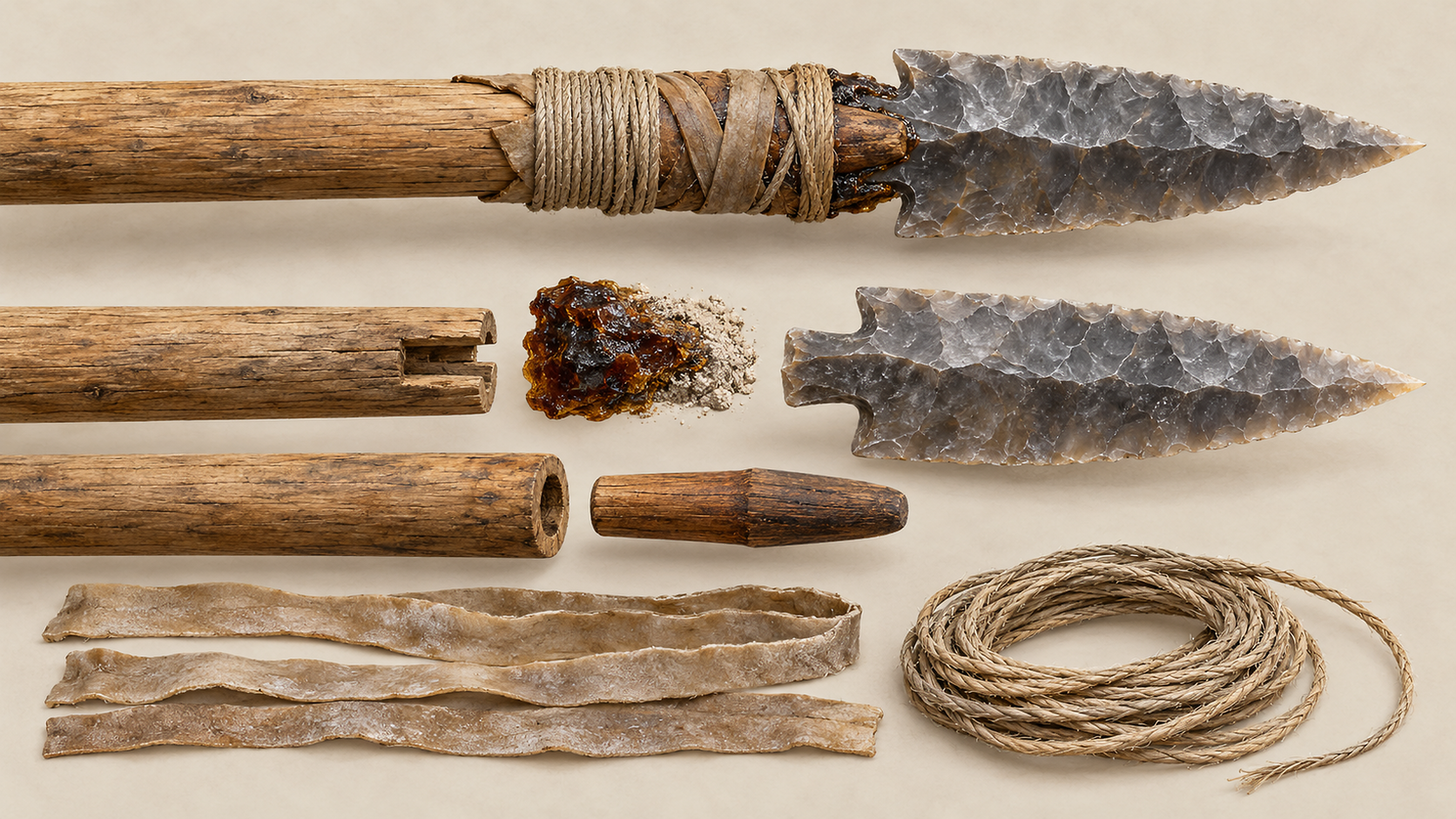
Securing a stone biface to a wooden pole subjected to violent kinetic shocks requires sophisticated joining techniques. Archaeological remains and ethnographic parallels indicate two predominant hafting methods in the Classic lowlands. In the direct method, the distal end of the shaft was split or grooved with a stone chisel to form a tight mortise matching the thickness of the chert stem. The point was seated into this cleft, bedded in a mastic compound made of heated pine pitch, copal resin, and crushed charcoal or lime, which acted as a structural filler to distribute impact energy across the wood.
A second, more modular method employed an intermediate wooden foreshaft. In this system, the stone point was permanently bound to a shorter piece of seasoned hardwood, which was then tapered into a tenon that seated into a reinforced socket in the primary pine shaft. If the point shattered or the foreshaft cracked in battle, the warrior could quickly replace the entire assembly without discarding the balanced main shaft. In both methods, external bindings were essential. Craftsmen wound wet rawhide thongs or twisted agave fiber cordage tightly around the joint. As the rawhide dried, it contracted with immense force, clamping the wooden jaws around the stone stem so securely that the head and haft functioned as a single mechanical unit.
The Sacred Cenote of Chichén Itzá: Drowned Armament
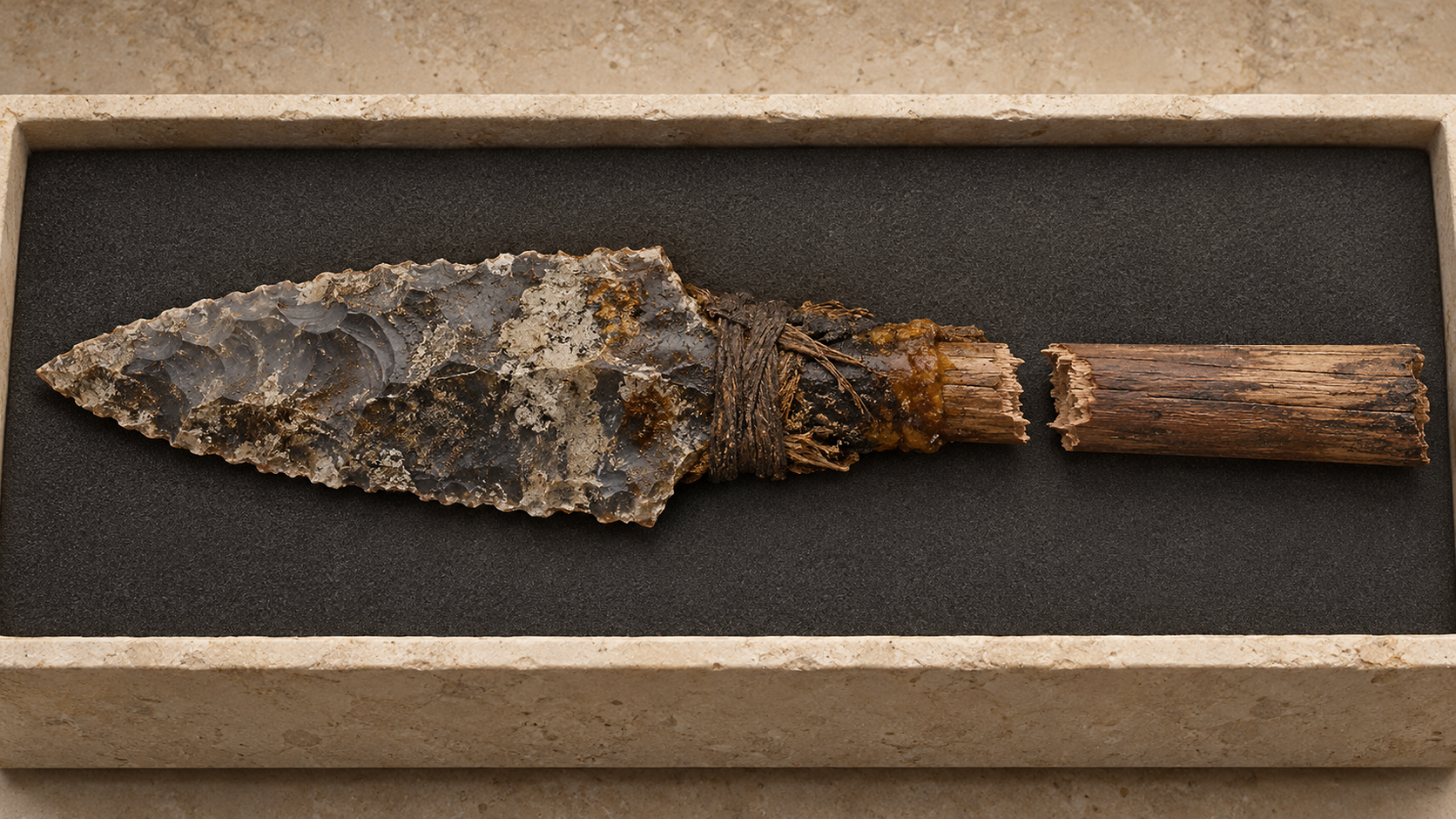
Most organic artifacts from Classic Maya battlefields dissolved centuries ago in the acidic forest soils. The great exception lies in the Sacred Cenote of Chichén Itzá, a massive natural limestone sinkhole that served as a pilgrimage center and votive repository for centuries. When Edward H. Thompson dredged the dark waters and silt between 1904 and 1911, he recovered an extraordinary assemblage of martial gear that had been ritually cast into the depths. Preserved in the anaerobic, waterlogged mud were hundreds of stone weapon points, wooden shaft fragments, flexible hide shields, and atlatl components that survived in startling physical detail.
The Cenote collections, conserved at Harvard University's Peabody Museum and institutions in Mexico, include massive chert bifaces, some still bearing remnants of resinous hafting mastic and vegetable cordage around their basal tangs. Several recovered wooden shafts demonstrate carefully shaved tapers, showing how craftsmen reduced the diameter toward the butt to improve handling balance. Many points recovered from the cenote bear deliberate transverse fractures, indicating that weapons offered to the water deities were ritually broken or killed prior to deposition, neutralizing their lethal capacity before sending them into the underworld realm of the rain god Chaac.
Distinguishing the Thrusting Spear from the Dart and Javelin
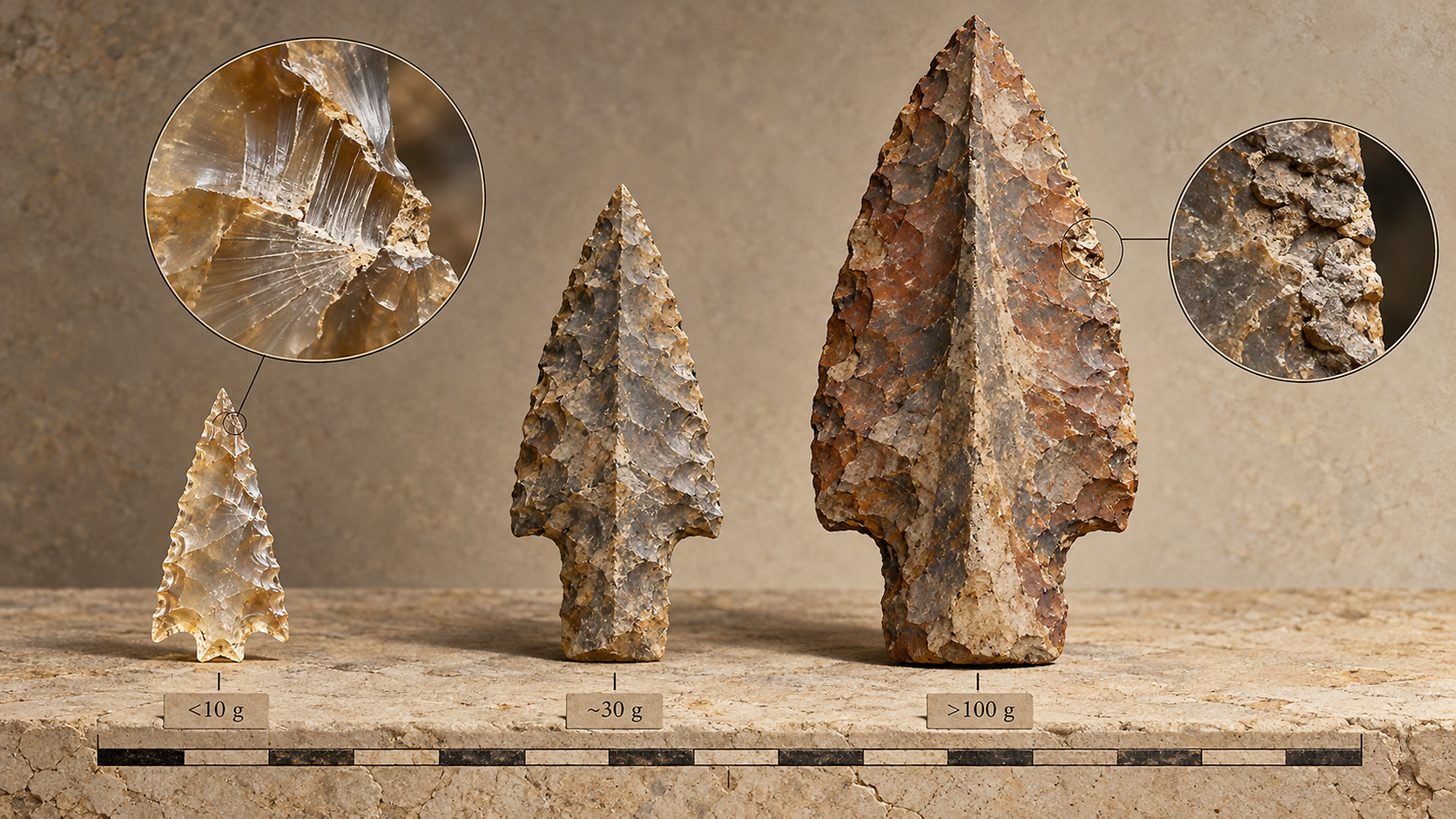
A recurring challenge in Mesoamerican lithic archaeology is distinguishing between the stone heads of heavy thrusting spears, propelled javelins, and the smaller darts thrown with an atlatl. Because all three weapon categories utilized bifacially worked stone, researchers rely on metric analysis, particularly neck width, overall mass, and tip angle. Extensive studies by lithic specialists demonstrate that projectile tips designed for atlatl propulsion must remain below strict weight limits, typically under fifteen grams, to prevent the dart from dropping nose-heavy in flight.
In contrast, the stone heads intended for hand-held thrusting spears regularly exceed fifty to one hundred grams, featuring thick cross-sections, wide basal stems, and broad shoulders. A spearhead did not need to be aerodynamic; its mass added destructive momentum to the thrust, while its wide cutting profile created large, incapacitating wounds that penetrated deep into the abdominal cavity. Furthermore, microscopic analysis of edge wear provides critical clues: atlatl points display violent, asymmetric impact fractures at their tips caused by high-velocity flight, while heavy chert spear points show extensive lateral micro-chipping, crushing, and edge polish caused by grinding against bone and shield rims during sustained hand-to-hand engagement.
Heraldic Dressings: Feathers, Textiles, and Weapon Identity
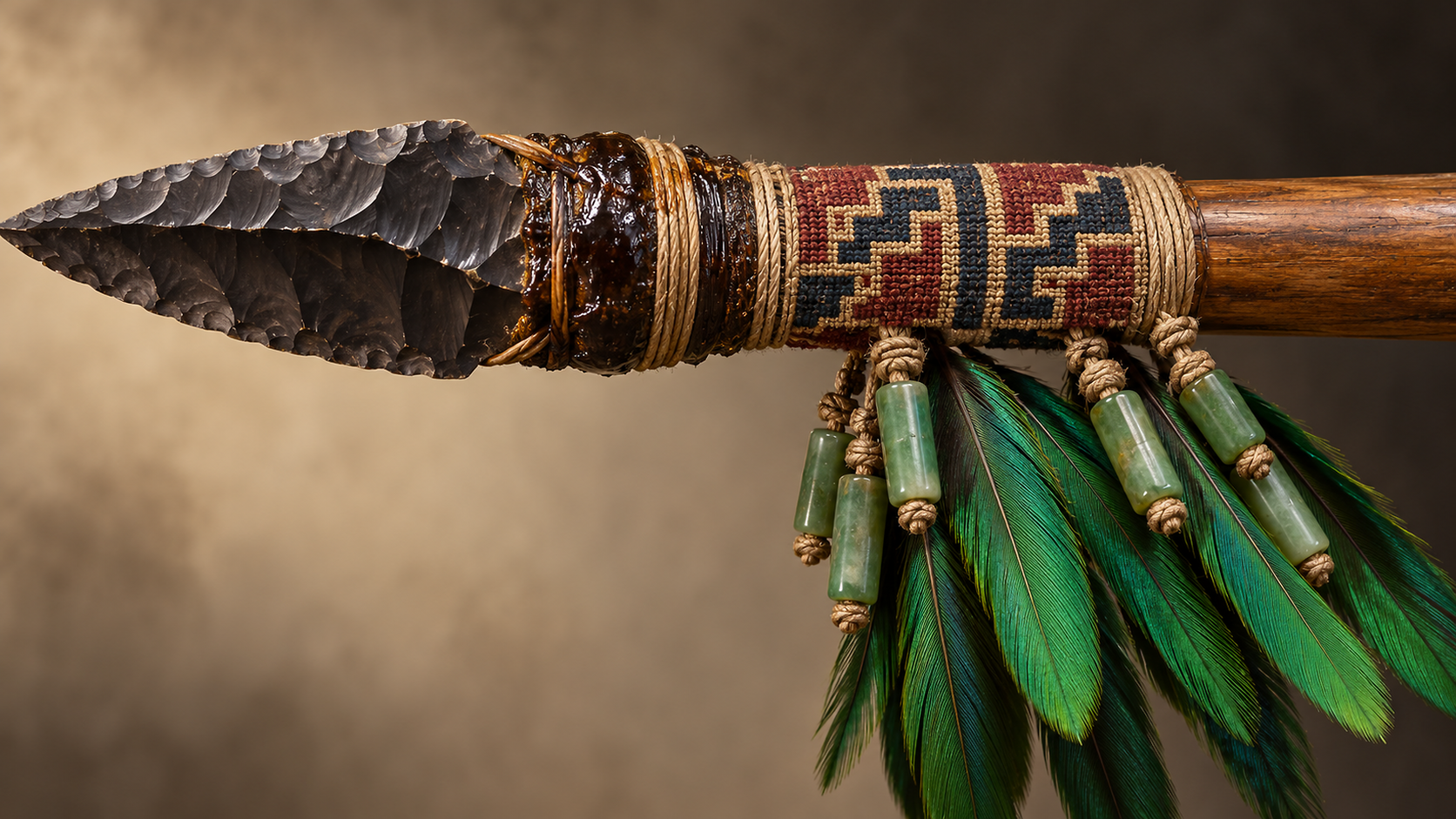
In Classic Maya society, a spear reflected the warrior's lineage and social rank as well as its martial function. On carved stelae from Piedras Negras and Yaxchilán, royal figures hold lances encased in elaborate fabric sleeves, known from epigraphic contexts as martial standards. Long strips of woven cotton cloth dyed with geometric step-fret motifs were wound down the upper third of the shaft, tied off with knotted tassels and clusters of green quetzal tail plumes. These feathers fluttered with every movement, creating a distracting visual display designed to obscure the exact line of an incoming thrust.
These elaborate dressings also carried practical battlefield value. The textile wraps and cordage sleeves just beneath the stone head provided an auxiliary handhold if a warrior needed to choke up on the weapon for close-in stabbing when lines pressed tight. The bindings also caught blood that would otherwise run down the polished wooden shaft, keeping the pine or sapodilla pole from becoming dangerously slick in a fighter's sweating palms. The colors of the feathers and cloth signaled unit identity and city allegiance across the chaotic, dust-filled expanse of the battlefield, allowing commanders to track royal contingents through the smoke of burning ramparts.
Tactical Deployment: The Shield Wall and Noble Captures
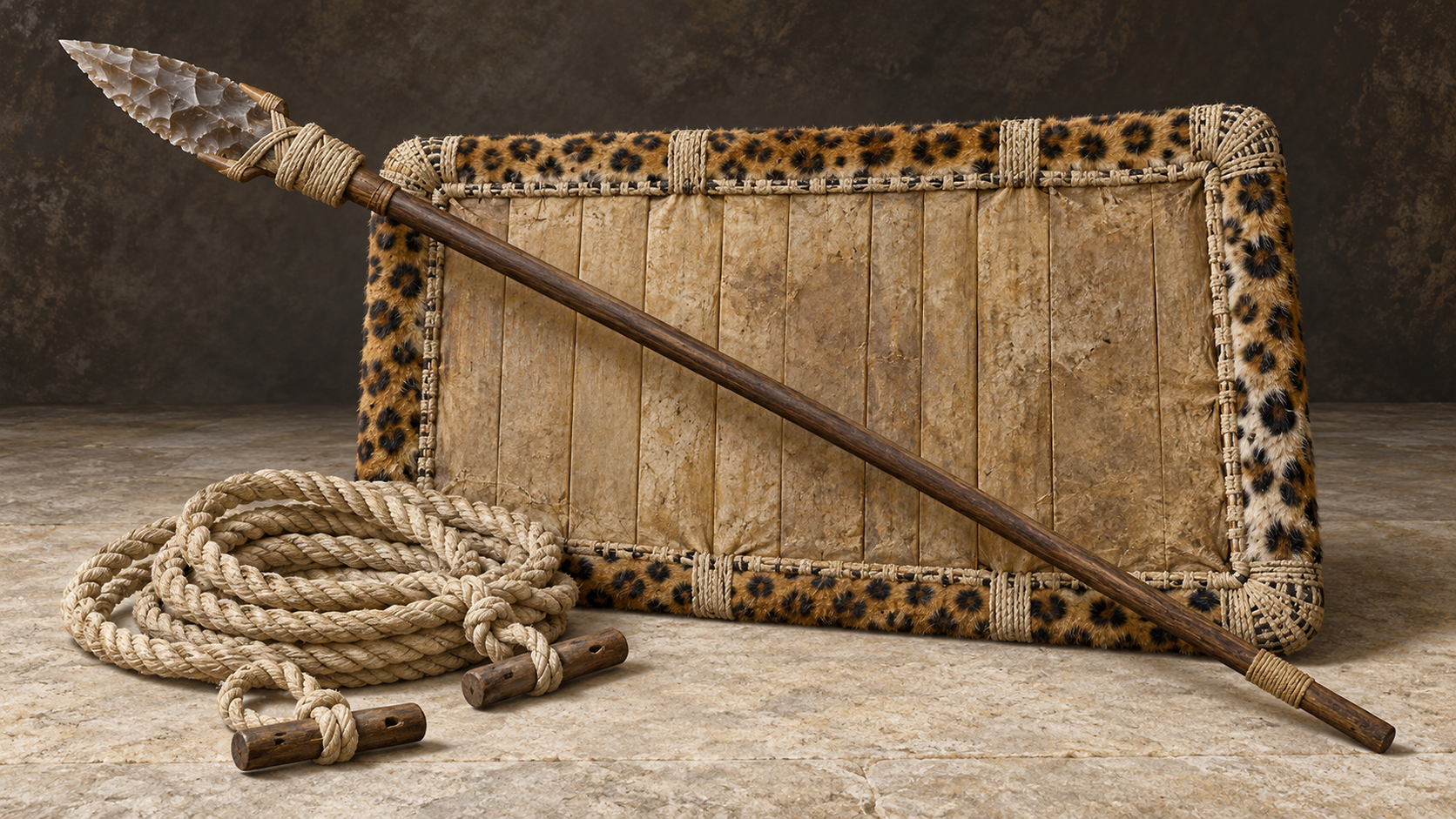
The tactical reality of Maya warfare was shaped by two competing imperatives: collective defensive cohesion and the elite pursuit of high-value captives. For common levies and line warriors, the thrusting spear was the core component of defensive formations. Arrayed behind rectangular shields made of wood, stiff woven reeds, or jaguar pelts stretched over light frames, spearmen formed tight defensive fronts capable of turning back charging skirmishers. These formations sheltered archers and atlatl throwers who delivered preliminary volleys before the spear wall closed to deliver coordinated, crushing thrusts.
Yet the ultimate measure of martial success for the Maya aristocracy was the live capture of rival nobles, an achievement that brought personal prestige and provided royal victims for sacrifice. A heavy thrusting spear was lethal, but in the hands of an expert it could be used with calculated restraint. Painted vessels show spearmen striking at an opponent's thighs, knees, or weapon arms, disabling the adversary without inflicting immediately fatal wounds to the torso or neck. Once an enemy king or lord was disarmed and grounded by a leg puncture, attendants moved in to bind the victim's arms with cotton ropes, securing the prisoner for triumphant transport back to the victor's capital.
Epigraphy and Iconography: The Flint-and-Shield Metaphor
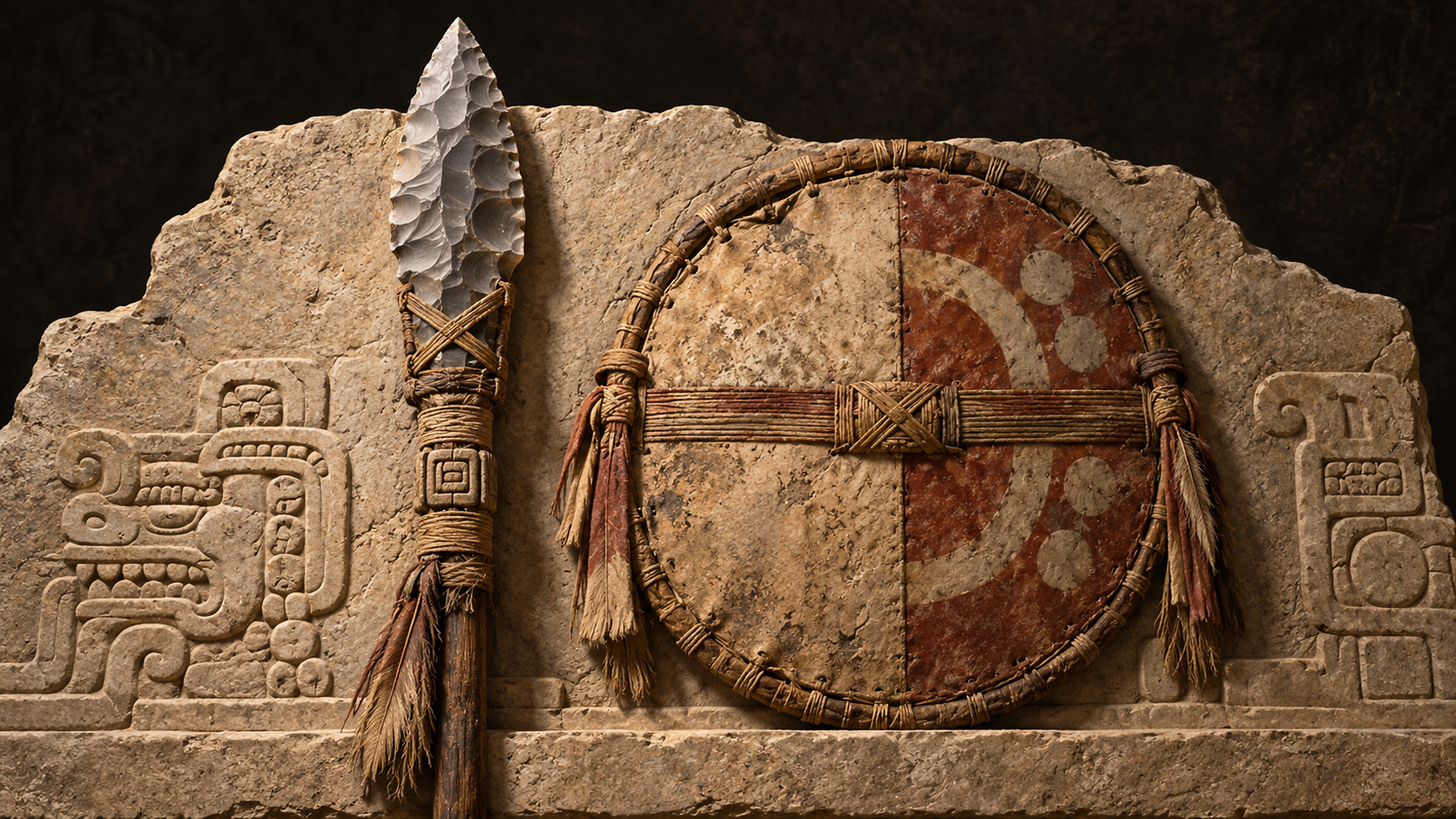
The spear and its companion shield were so central to Maya concepts of sovereignty that they formed one of the primary royal metaphors in Classic epigraphy. In hieroglyphic texts, the paired glyphs tok' pakal, literally translating as flint and shield, represent the king's military power, the army of the polity, and the sovereign defense of the realm itself. The tok' component is explicitly depicted as a flaked chert point, often drawn with concentric wavy lines indicating the ripple marks left by percussion flaking, sometimes adorned with eccentric barbs or divine eccentric curls.
When a Maya city was defeated in war, scribes recorded that the ruler's tok' pakal had been lowered, broken, or cast down. To overturn the flint and shield was to dismantle the state's defensive ward and strip its monarch of sacred protection. On monuments celebrating martial victory, such as Stela 11 at Piedras Negras, the ruler stands triumphantly clutching a massive, cloth-wrapped spear that towers above his headdress, while bound captives cower at his feet. The weapon is held vertically like a scepter of state, anchoring the composition and declaring that royal authority rested squarely upon the disciplined strength of the flint-tipped spear.
Cache Deposits and the Cult of Eccentric Chert Weapons
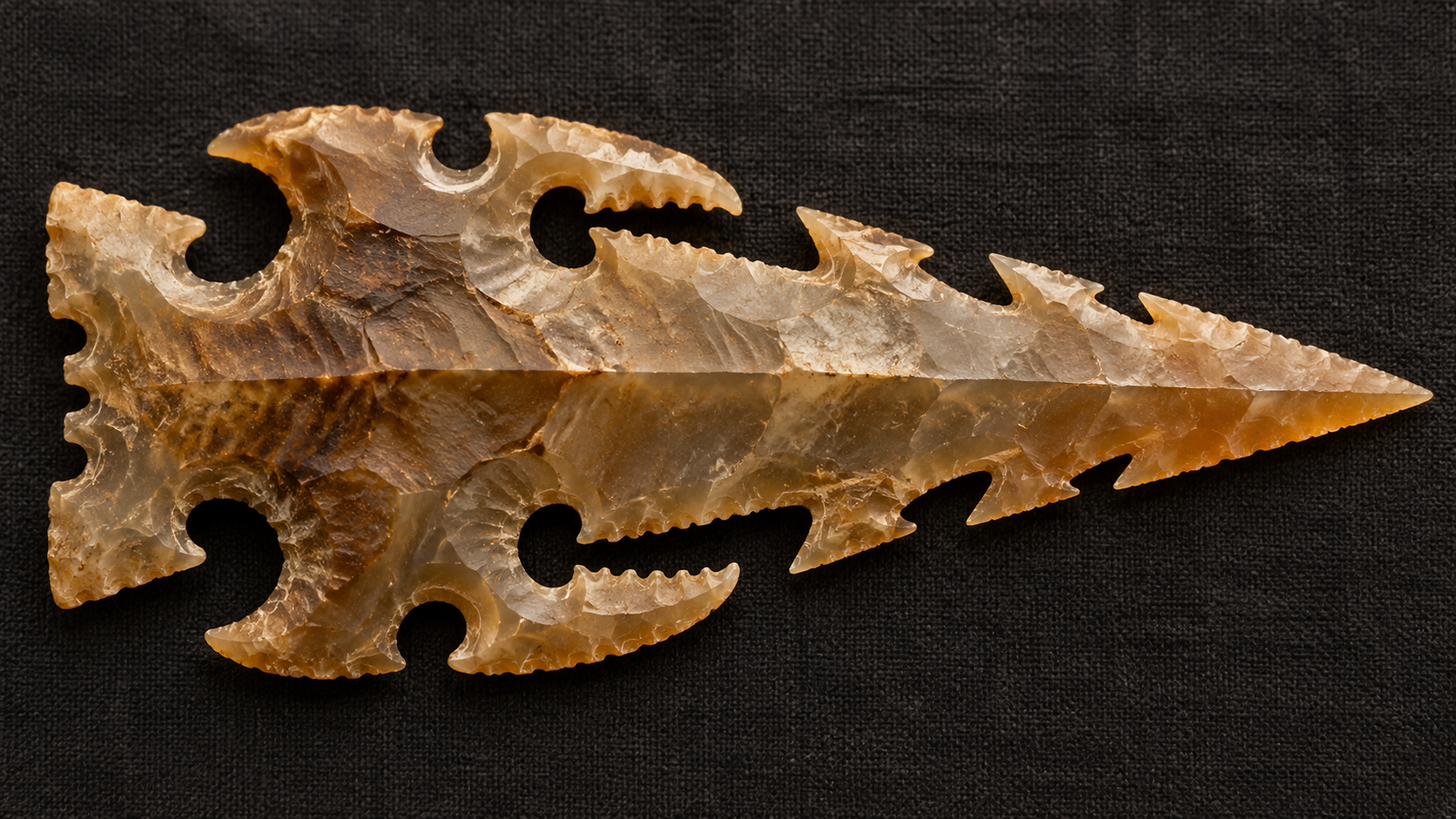
Beyond the functional weapons carried into battle, the Maya elevated the flint spearhead into an astonishing medium of sacred art. Throughout the Classic period, elite tombs, stela foundations, and temple staircases were consecrated with caches of eccentrically flaked cherts. Craftsmen of transcendent skill used fine antler or bone pressure flakers to sculpt chert blades into serrated, sinuous silhouettes representing deities, lightning bolts, and stylized human profiles branching out from the edges of an otherwise functional lance point.
These eccentric flints, discovered in great numbers at Copán, Tikal, and Quiriguá, demonstrate that the spearhead was perceived as an animate vessel of divine energy, particularly associated with K'awiil, the god of royal lineages, lightning, and fertility. In Maya thought, chert and obsidian were born when lightning struck the earth, embedding celestial fire into the stone. By knapping a spearhead, whether a functional point destined for war or an intricate eccentric for a temple cache, the artisan worked a material culturally linked to lightning and divine royal power.
Experimental Archaeology and Breakage Patterns
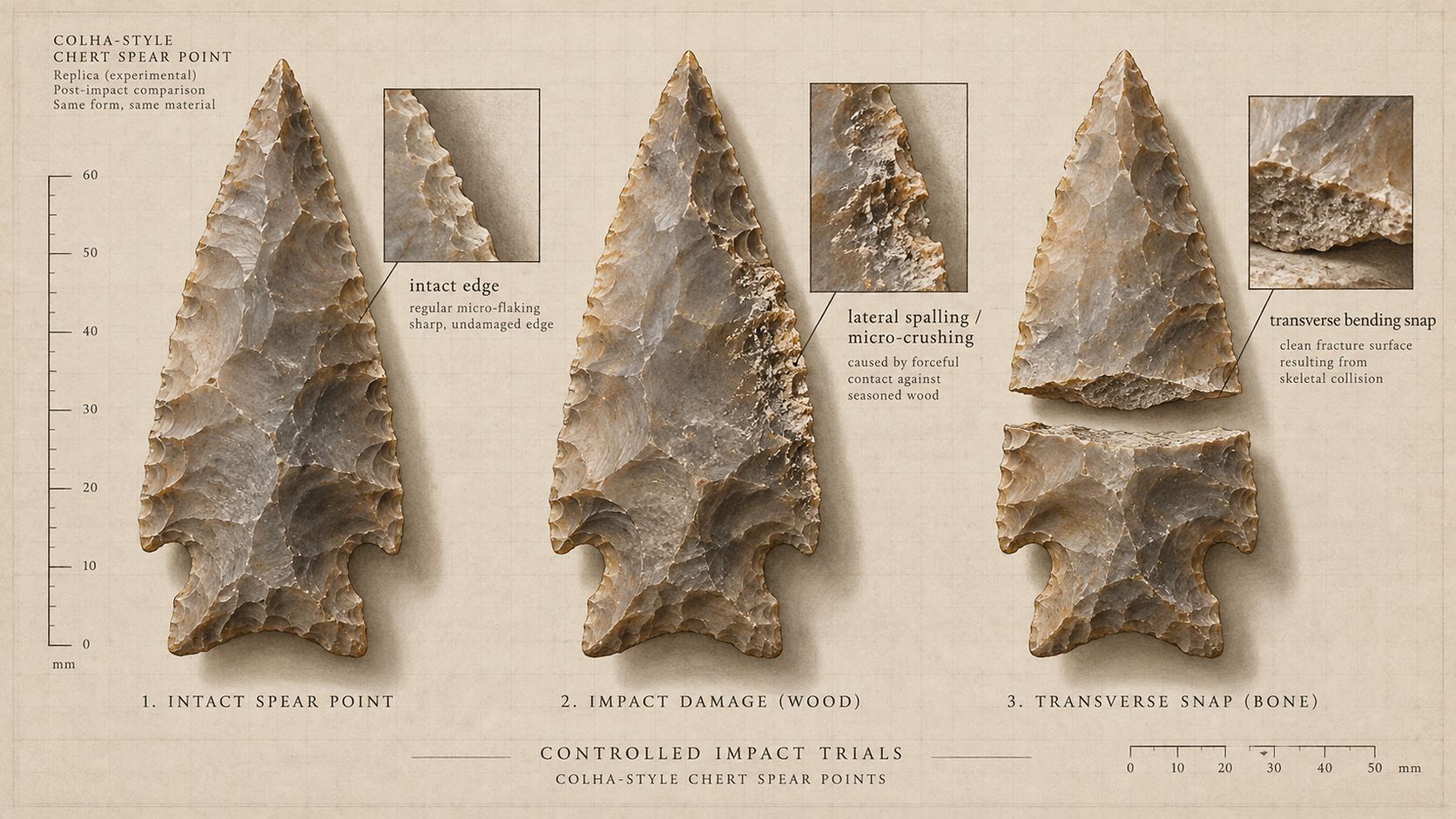
Modern experimental archaeology has provided rigorous insights into the operational life and mortality of Maya chert spears. Researchers knapping replica Colha-style stemmed macroblades and mounting them onto seasoned pine shafts with resin-and-rawhide bindings have subjected these reconstructions to controlled impacts against animal carcasses, ballistic gelatin, and simulated hide armor. The findings corroborate the visual evidence from Bonampak and the physical remains recovered from archaeological trenches.
The broad chert points exhibit tremendous forward penetration, easily punching through multiple layers of quilted cotton that routinely stopped or deflected atlatl darts. When a chert blade strikes heavy bone, such as a pelvis or humerus, it rarely shatters completely. Instead, it suffers characteristic burin-like spalls along its lateral margins, or snaps cleanly across the midsection in a transverse bending fracture. These experimental fracture patterns match precisely the damaged points recovered from the ditch systems of fortified settlements like Becán and the silt deposits of the Sacred Cenote. Even when broken, a snapped chert spearhead could be rapidly re-knapped into a shorter, functional point, highlighting the rugged resilience and enduring utility of Mesoamerica's quintessential polearm.
Further reading
Follow the sources to examine the object and its historical context.
Peabody Museum of Archaeology and Ethnology, Harvard University: Cenote of Sacrifice CollectionExternal reference · Opens in a new tab Hester, T. R., & Shafer, H. J. (1984). Exploitation of Chert Resources by the Ancient Maya: A Summary of Studies at Colha, Belize. World Archaeology, 16(2), 157-173.External reference · Opens in a new tab Schele, L., & Miller, M. E. (1986). The Blood of Kings: Dynasty and Ritual in Maya Art. Kimbell Art Museum.External reference · Opens in a new tab