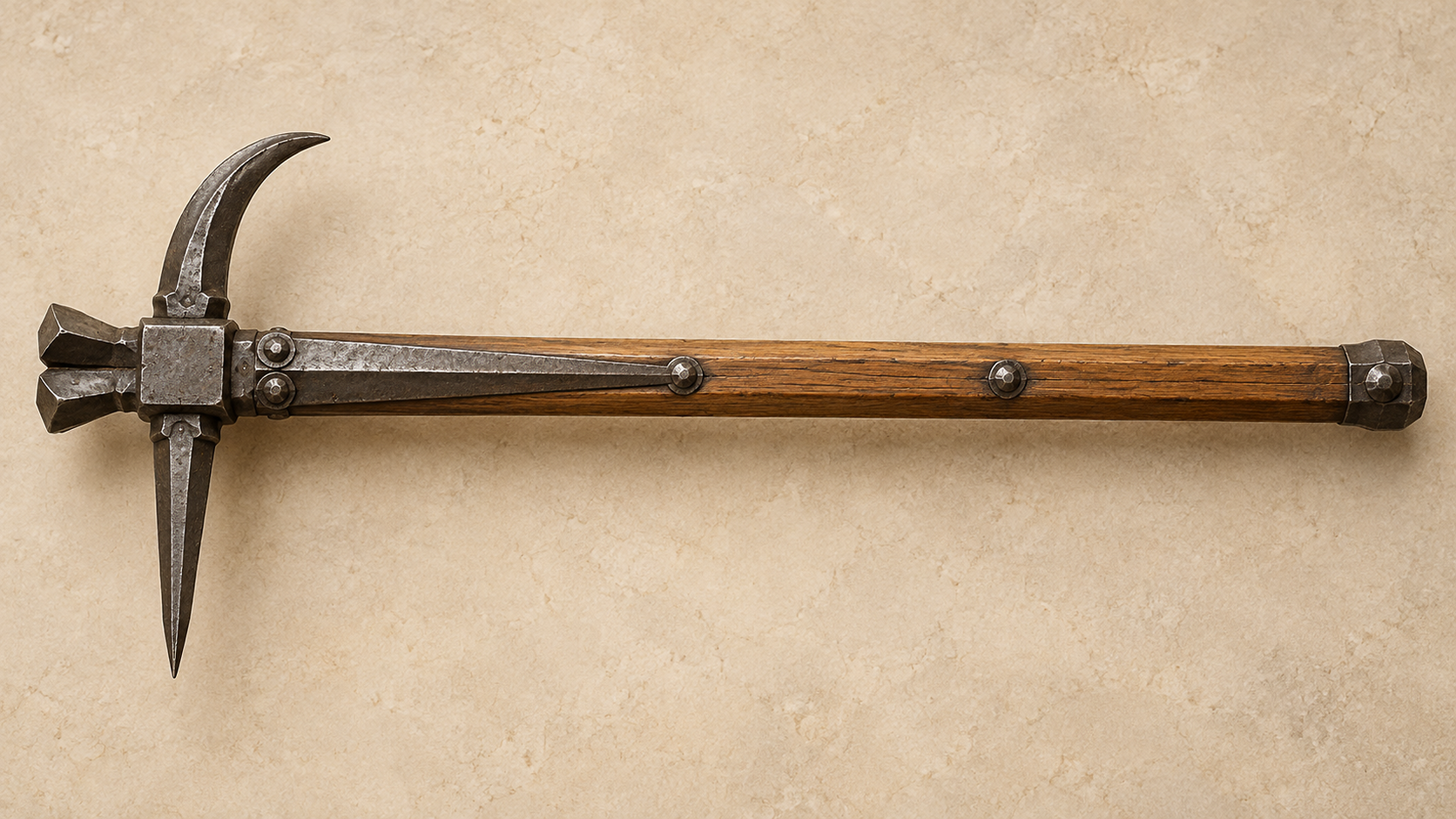
In the armories of the Swiss Confederation and the surrounding German-speaking lands, long-shafted war hammers occupied a lethal niche between the infantry pike and the short knightly poleaxe. Known commonly in modern scholarship as the Lucerne hammer, this weapon fused three distinct offensive geometries upon a single forged socket: an extended terminal thrusting spike, a rearward curving beak, and a forward face crowned with four distinct, hardened prongs. Rather than relying on a broad cutting edge that slid harmlessly off heat-treated plate armor, the hammer concentrated the mechanical energy of a two-handed swing into tiny points of contact designed to grip steel, crush underlying bone, or punch through iron plates outright.
The Evolution of Anti-Harness Head Geometry
During the fourteenth century, the rapid metallurgical transition from mail coats reinforced with iron plates to articulated, heat-treated plate harness presented infantry with a tactical crisis. Edged weapons like broadswords and traditional sweeping axes lost much of their primary cutting utility against continuous, curved steel surfaces designed to deflect downward blows. In response, weapon smiths across Central Europe sought to focus kinetic energy into minimal surface areas. By replacing a broad blade with concentrated impact heads, arms makers produced tools capable of breaching or deforming articulated defenses.
The Lucerne hammer emerged from this developmental arc as an infantry adaptation of the shorter knightly war hammer and the French bec de corbin. While judicial poleaxes designed for single combat on foot rarely exceeded the height of their wielder, infantry formations required substantial reach to engage mounted men-at-arms or push past opposing spear lines. The head evolved into a tripartite assembly featuring a long thrusting blade, a curved reverse pick, and a box-like cluster of four pointed tines. This arrangement granted the rank-and-file foot soldier options for thrusting, crushing, and hooking within a single implement.
Surviving examples preserved in the municipal armory of Lucerne (Historisches Museum Luzern) and the Swiss National Museum in Zurich demonstrate that these weapons were standardized infantry gear rather than luxury commissions. The head served as a direct mechanical answer to the hardened steel armor worn by late medieval cavalry and dismounted men-at-arms.
Anatomy of the Four-Pronged Impact Face
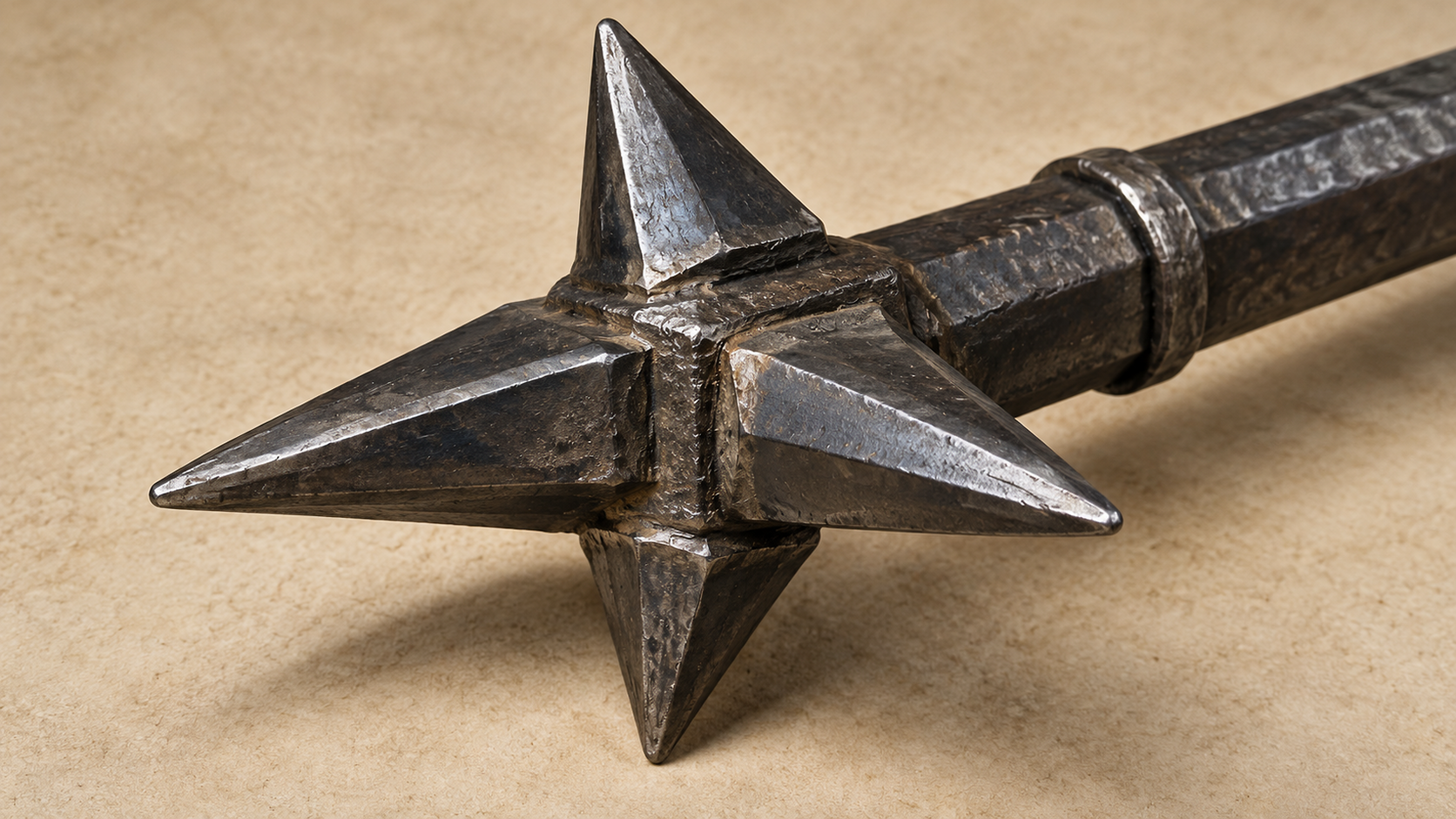
The defining feature of the classic Lucerne head is its four-pronged hammer face, often referred to in German accounts as the Luzerner Hammer or Reitersporn. Unlike modern carpenter hammers that feature a flat or gently domed striking face, the forward projection of this polearm terminates in four tapered, pyramidal teeth arrayed in a square pattern. These tines were intentionally shaped to solve a central problem of hand-to-hand combat against curved plate: glancing blows.
When a smooth hammer face strikes an articulated breastplate or rounded pauldron at an oblique angle, the blow tends to skid off the polished surface, shedding much of its kinetic energy into empty air. The four prongs counter this deflection by biting instantly into the outer surface of the metal. Even if the blow strikes at an angle of thirty or forty degrees from normal incidence, at least one of the hardened teeth seats into the steel. This initial purchase holds the head in place, ensuring that the remaining momentum of the heavy wooden haft and the soldier's shoulders discharges directly into the plate rather than glancing wide.
The pronged configuration concentrates impact force across several distinct points rather than spreading it across a broad patch of steel. Metallurgical examination of original heads indicates that smiths specifically fire-welded high-carbon steel tips to the four teeth while forming the central neck of the hammer head from softer, shock-absorbing wrought iron. This composite construction prevented the teeth from blunting rapidly while protecting the assembly from catastrophic brittle failure under severe impact.
The Mechanics of the Curved Reverse Fluke
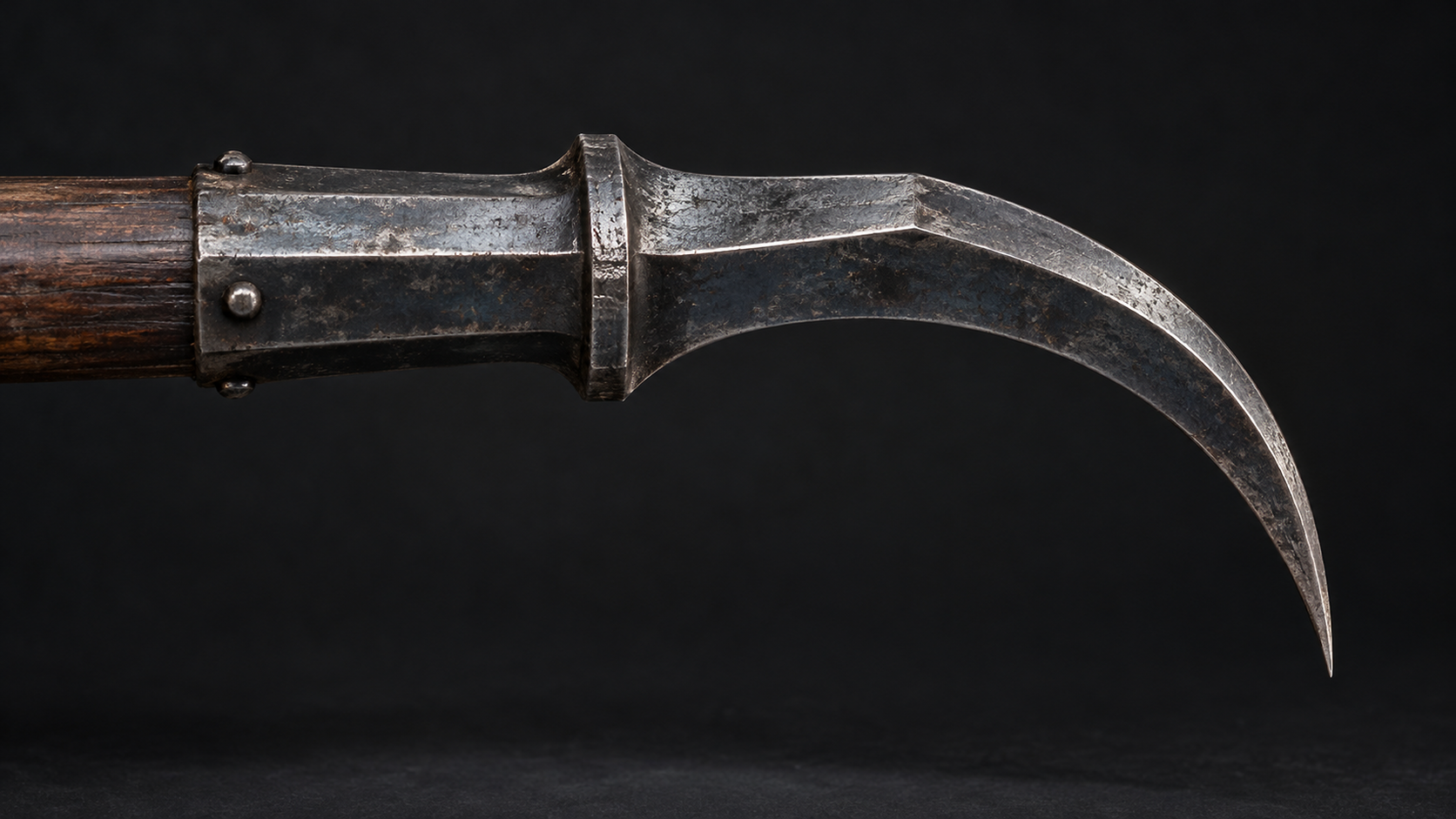
Opposite the four-pronged hammer head sits the rear fluke, known historically as the beak (bec de corbin) or rabenschnabel. In Swiss and South German specimens, this element is rarely straight; instead, it describes a pronounced downward curve resembling the beak of a predatory bird. Its cross-section is typically thick, transitioning from a stout octagonal base at the socket block into a reinforced diamond or square cross-section at the terminal point.
The curved profile served two distinct mechanical functions. First, when swung in an overhead arc, the curve aligns the terminal point perpendicular to the struck surface at the moment of deepest impact. A straight horizontal spike would glance upward if swung in a downward trajectory, but a downward-drooping fluke meets the target plate flush at the nadir of the swing. The entire mass of the polearm drives the sharp diamond point through the plate, shearing an open wound channel or punching clean holes through breastplates, helmet bowls, and shoulder defenses.
Second, the hooked geometry turned the rear fluke into an efficient entangling tool. Contemporary manuals and municipal records mention foot soldiers using the beak to snag the rims of shields, hook behind the knees of mounted riders, or catch the articulated neck lames of a visor. Once seated in a gap between plates or behind a leather harness strap, a violent backward pull from a two-handed grip could unseat a mounted knight or drag an opponent off balance into the mud, exposing unarmored joints to companion spearmen.
The Extended Thrusting Spike and Forward Reach
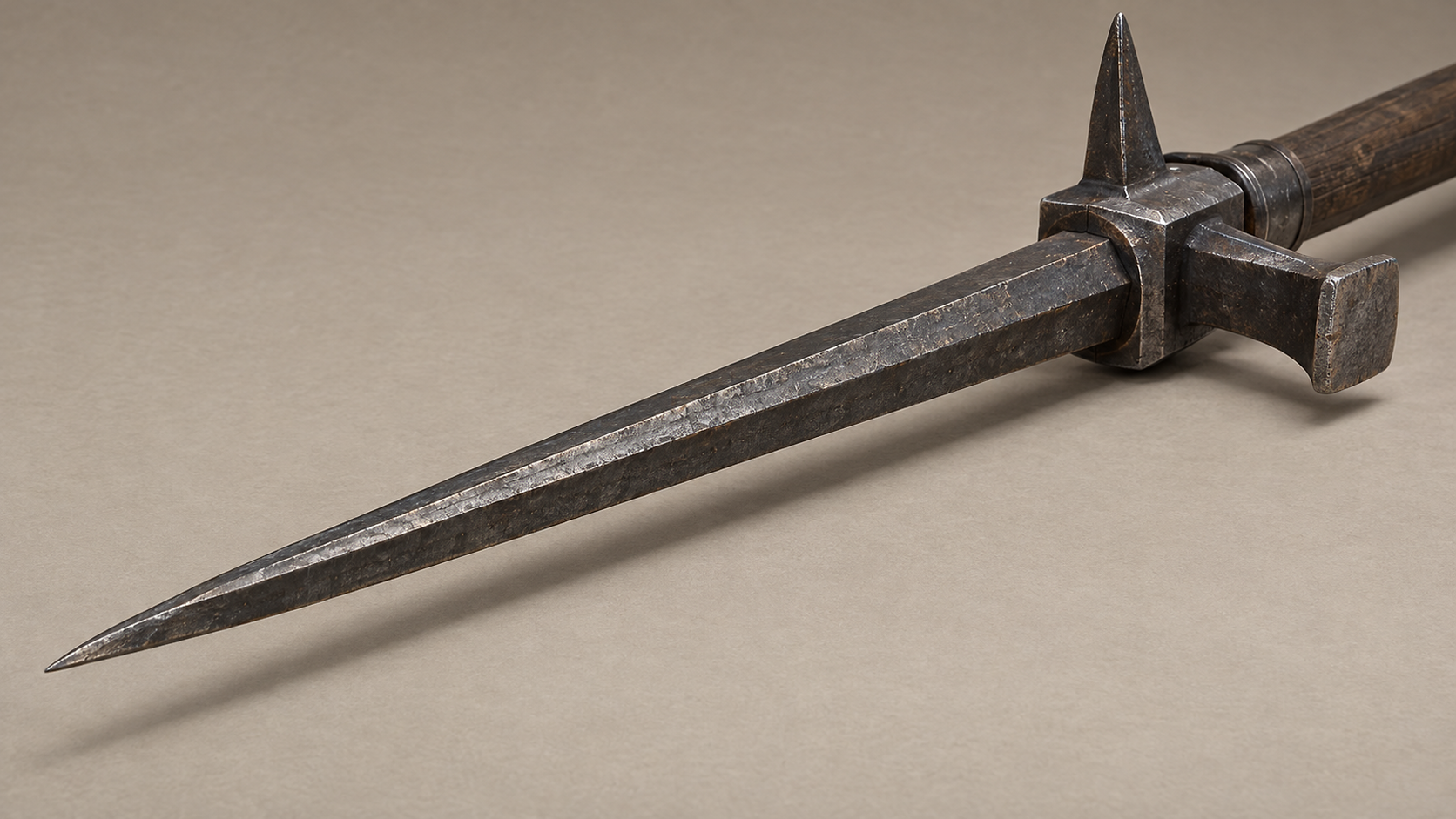
Crowning the top of the Lucerne hammer is an elongated, quadrangular thrusting spike, sometimes measuring upwards of forty to sixty centimeters on its own. Far longer than the short daggers fitted to judicial poleaxes, this terminal spike turned the Lucerne hammer into an effective anti-cavalry spear when held stationary or braced against foot pressure. Its reinforced square or diamond cross-section was engineered specifically to prevent buckling when thrust into heavy targets.
The spike possessed the stiffness necessary to search out the narrow apertures of contemporary armor: the eye slits of sallets and armets, the gaps beneath the besagews protecting the armpits, and the joints of the couters and poleyns. Unlike a broad, flexible sword blade, the rigid rod-like section of the hammer's top spike did not bend when it met the edge of an iron plate. Instead, its tapered facets guided the point into the seam, wedging open overlapping lames and transmitting the full forward drive of the wielder's legs and torso.
In dense tactical formations, this long apical spike allowed front-rank infantry to maintain an active threat profile even when space did not permit a wide, sweeping hammer stroke. Soldiers held the weapon in two hands like a modified spear, delivering rapid direct thrusts to disrupt incoming cavalry or deter advancing infantry before transitioning to crushing horizontal or downward blows as the melee compressed.
Socket Construction and Langet Reinforcement
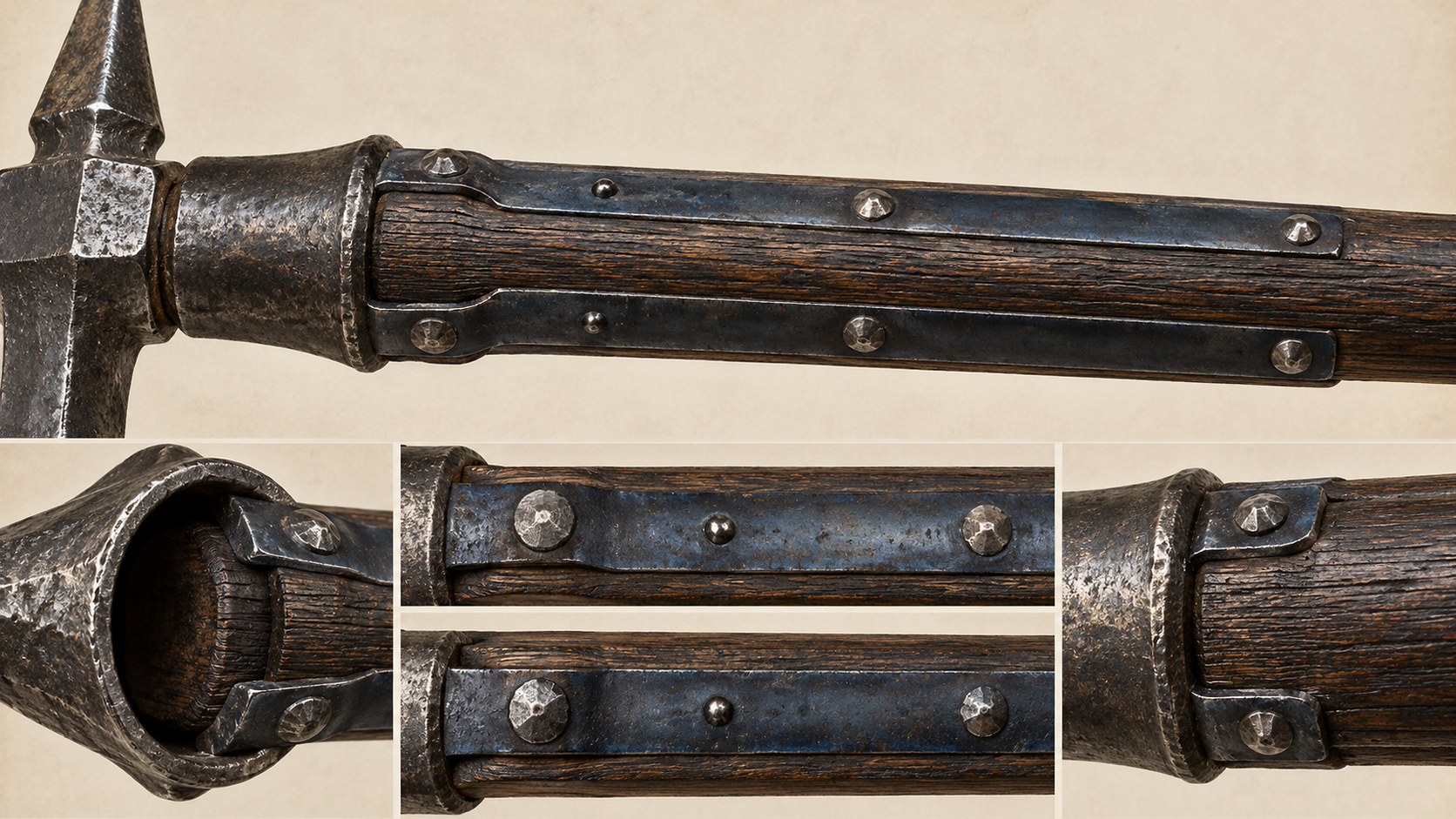
The immense leverage generated by a long polearm striking hard steel targets placed extraordinary physical stress on the junction between the metal head and the wooden haft. To survive repeated combat impacts, Lucerne hammers relied on sophisticated mounting techniques developed in alpine armories. The primary head was rarely cast or forged as a hollow socket alone; instead, it was built around a solid eye block or a deep central socket secured by long lateral iron straps known as langets.
Langets were forged directly onto the head or riveted securely across the socket shoulders, extending down the wooden shaft for thirty to ninety centimeters on opposite sides, and occasionally along all four faces of the timber. These iron bands were secured through the wood using cross-rivets hammered flush over washers. This construction bound the ash shaft into a unified composite beam, distributing the severe bending moments generated by sudden decelerations along the upper third of the pole rather than concentrating them at the vulnerable neck just beneath the iron head.
Beyond structural integrity, the langets acted as indispensable defensive armor for the haft itself. In the press of combat, opposing swordsmen, billmen, or halberdiers routinely attempted to shear through the wooden poles of outreach weapons to disarm their opponents. The iron-sheathed shaft of a Lucerne hammer resisted cutting strikes, preserving the weapon's reach and preventing the head from flying off if the underlying wood splintered or developed longitudinal grain cracks.
Haft Timber Selection and Shock Absorption
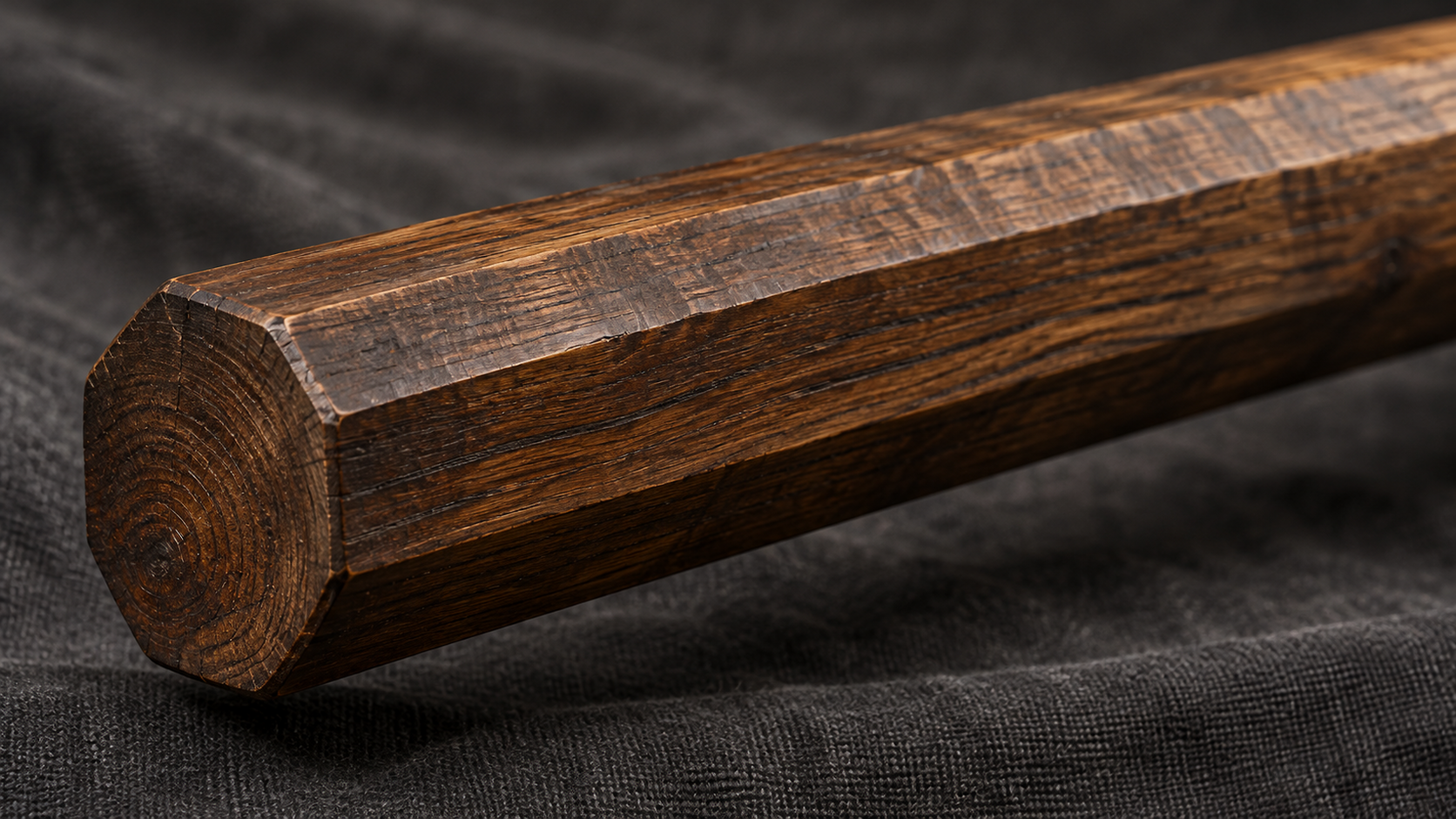
The performance of a Lucerne hammer depended as much on forestry and woodworking as it did on metallurgy. Swiss and German weapon makers favored straight-grained ash (Fraxinus excelsior) for the fabrication of polearm hafts, occasionally employing seasoned mountain hornbeam or beech where local availability dictated. Ash was prized across medieval Europe for its rare combination of high tensile strength, elastic flexure, and remarkable resistance to sudden shock.
A rigid, unyielding wood like oak would transfer the brutal vibration of an armor strike straight into the wielder's hands and wrists, causing numbness, loss of grip, or joint trauma, while also proving prone to brittle failure along radial rays under dynamic bending. Ash, conversely, flexes slightly upon impact, acting as an internal shock absorber that cushions the user's palms while absorbing the rebound energy of an arrested swing. This mechanical resilience allowed soldiers to swing repeatedly with full power without the weapon shattering in their grasp.
The cross-section of original hafts was rarely turned into a smooth circle. Armorers shaped the shafts into octagons, rounded rectangles, or tear-drop profiles. This non-circular geometry gave the wielder tactile awareness of the weapon's planar orientation in low light or amidst dust and chaos. By feel alone, a foot soldier knew instantly whether the head was aligned to strike with the four-pronged face, the hooked fluke, or the lateral flat of the socket.
Impact Dynamics: Blunt Force Versus Plate Hardness
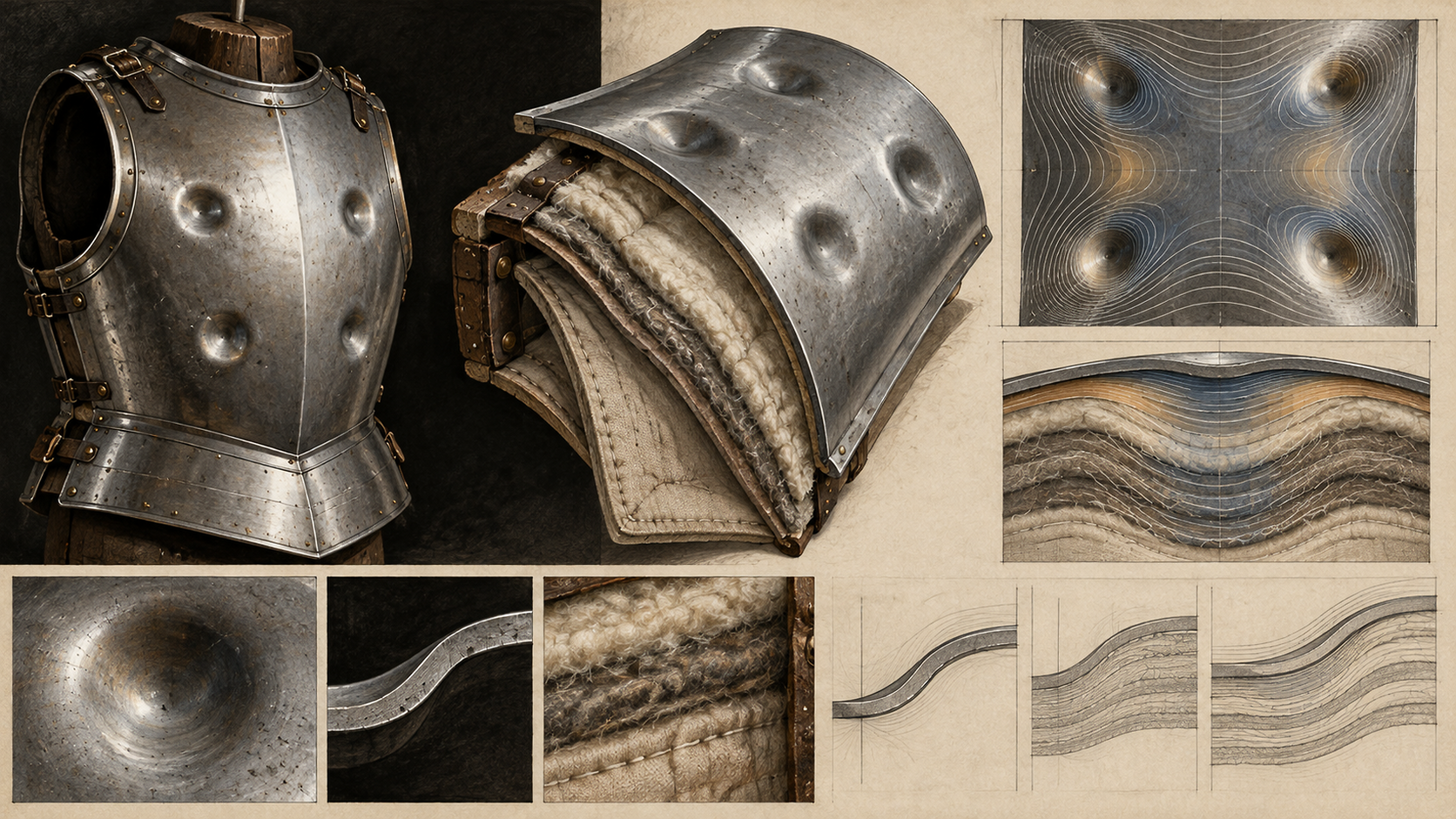
The physics governing the Lucerne hammer differ substantially from those of cutting swords or slashing axes. Late medieval plate armors, particularly those produced in major centers like Milan, Augsburg, and Nuremberg, were frequently case-carburized and quenched, producing an outer surface hardness capable of turning sword blades with minimal scratching. The Lucerne hammer circumvented this surface hardness through raw dynamic impulse and local stress concentration.
When the four-pronged hammer impacts a steel breastplate, the deceleration of the heavy head generates a massive peak force over a fraction of a millisecond. While the hardened plate may resist shearing or gross tearing, the kinetic energy must go somewhere. Much of that energy deforms the underlying plate, dishing the metal inward against the wearer's torso. The blunt shock wave passes directly through the steel, the interior lining, and the padded arming doublet, delivering concussive trauma to the thoracic cavity, fracturing ribs, and collapsing lungs without necessarily penetrating the armor shell.
Against helmets such as sallets, kettle hats, and bascinets, the effect was even more decisive. Even if the four prongs failed to pierce the crown of the helmet, the torque delivered to the cervical spine by an off-center strike was frequently catastrophic. The violent rotational acceleration induced severe concussions, rendered soldiers instantly unconscious, or fractured neck vertebrae, neutralizing the most heavily armored combatant without requiring the weapon to slice through a single square millimeter of iron.
Penetration Physics of the Raven's Beak
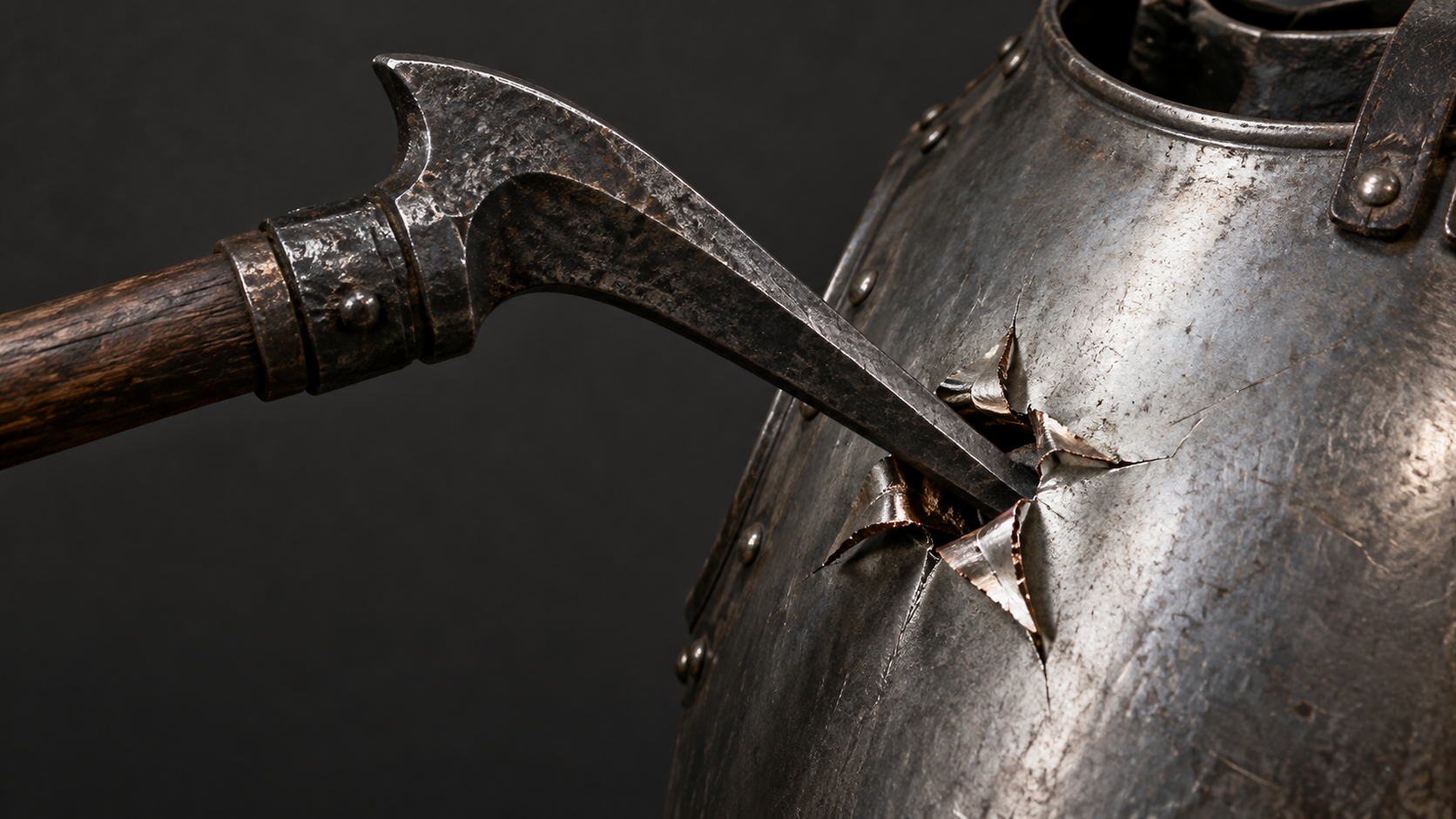
While the four-pronged face excels at blunt energy transfer and anti-slip grip, the rear fluke was engineered for outright structural rupture. Modern mechanical testing and experimental archaeology have demonstrated that the sharp diamond cross-section of the bec de corbin creates an extreme concentration of mechanical stress at its initial point of contact. While a sword edge spreads its force over several inches of blade length, the point of the fluke concentrates the entire momentum of the weapon into an area smaller than a few square millimeters.
Upon striking an iron or mild steel plate, the stress exceeds the ultimate tensile strength of the target material almost instantaneously. The fluke penetrates via shear punching: it forces a localized plug or star-shaped tear through the metal plate. Once the initial puncture occurs, the widening diamond cross-section acts as an inclined wedge, peeling back jagged triangular flaps of steel as the beak drives deeper under the momentum of the shaft.
This wedging action was particularly lethal against helmet visors, gorgets, and pauldrons. Even when the pick encountered high-grade, heat-treated spring steel that resisted clean perforation, the concentrated impact frequently punched through the weaker rivets, leather suspension straps, or hinge assemblies holding the harness together. A single well-placed beak strike could shear the hinge of an armet or split open an articulated shoulder lame, leaving the joint beneath exposed to subsequent attacks.
Swiss Tactical Formations and Combined Arms
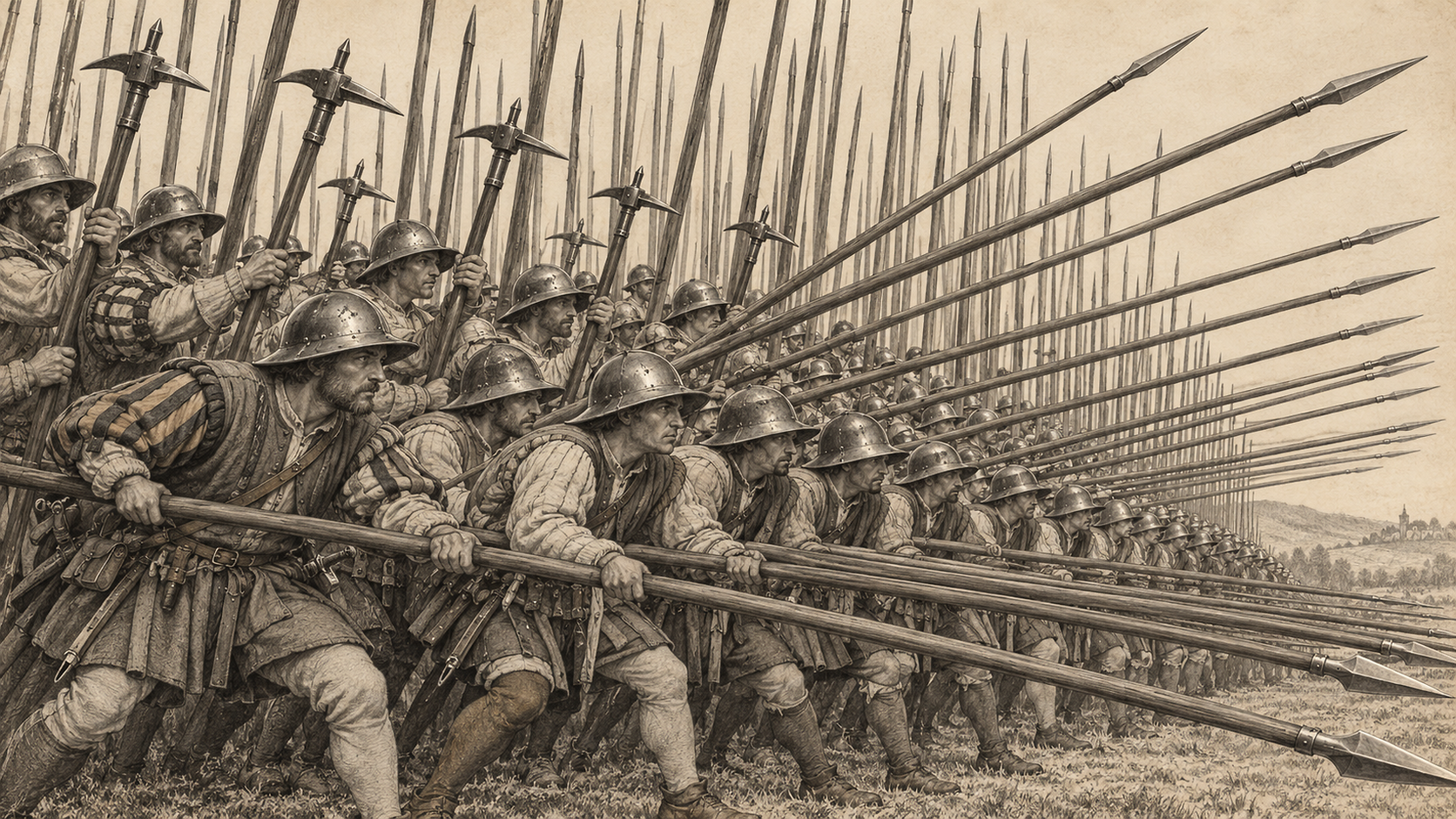
The Lucerne hammer was not a solitary dueling sidearm; its operational value was realized within the dense, disciplined tactical blocks (Gewalthaufen) of the Swiss Confederation during the fifteenth and early sixteenth centuries. In these formations, the frontline was dominated by massed eighteen-foot pikes intended to hold enemy cavalry at bay and create an impenetrable forest of iron points. Behind this initial barrier stood soldiers wielding secondary polearms, including halberds, two-handed swords, and Lucerne hammers.
When two opposing infantry formations collided and their pikes crossed, the battle rapidly dissolved into a cramped, close-range press where long pikes became unwieldy and useless. At this decisive juncture, the hammer wielders advanced through the lanes between pike shafts. With hafts measuring roughly seven to nine feet, Lucerne hammers could reach over the heads of friendly front-rankers, dropping heavy overhead strikes directly onto the helmets and shoulder harness of the stalled enemy formation.
The combination of weapons within the Swiss ranks created a devastating tactical synergy. Pikes prevented cavalry from charging cleanly through the ranks; halberds delivered broad, sweeping chops against lighter troops; and Lucerne hammers served as specialized armor-cracking implements targeted specifically at the elite, heavily protected men-at-arms anchoring the enemy's vanguard.
Comparison with the Knightly Poleaxe and Bec de Corbin
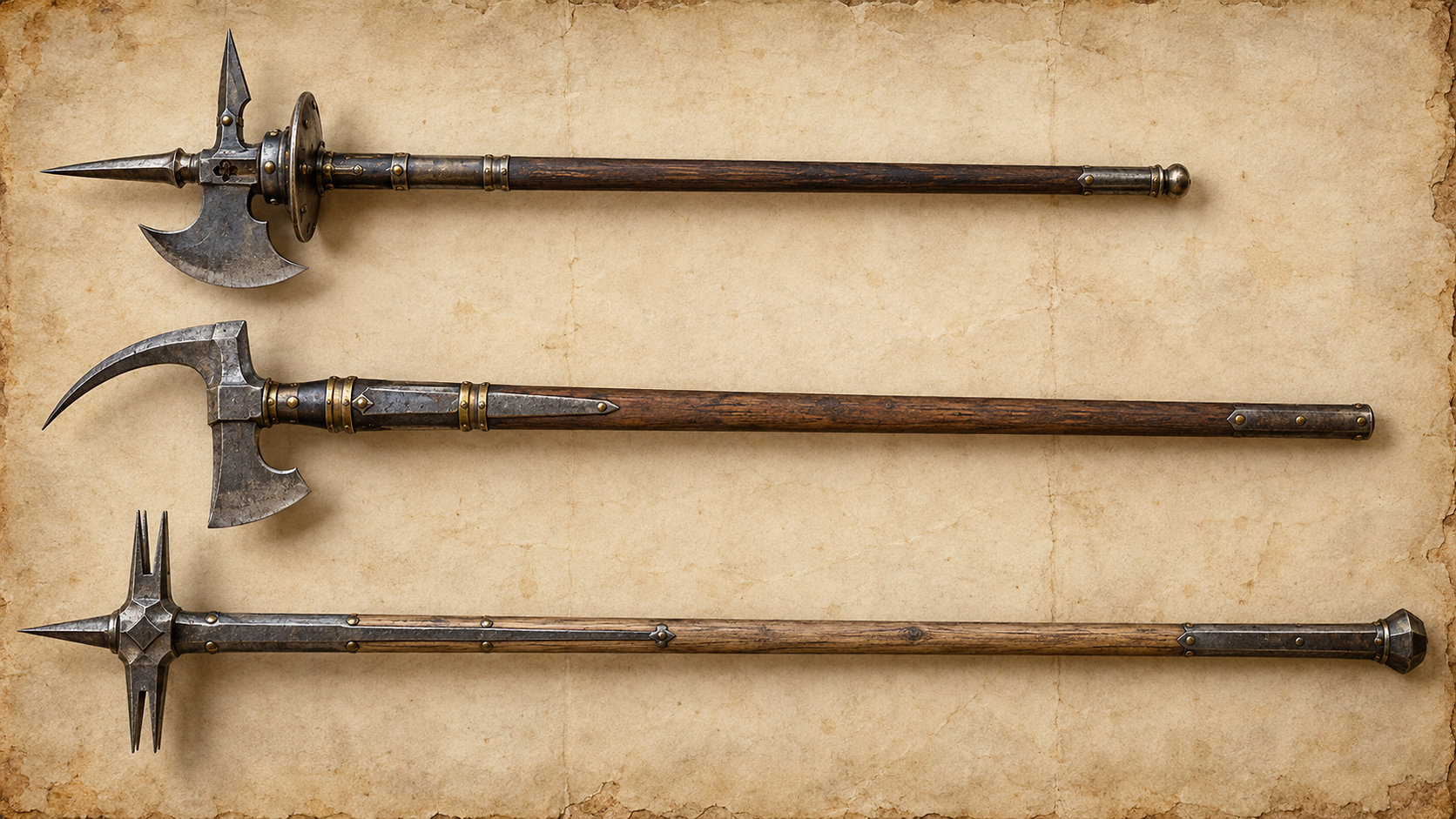
In both popular media and nineteenth-century armory catalogs, the names applied to late medieval impact weapons are frequently conflated. Distinguishing the Lucerne hammer from the knightly poleaxe (pollaxe) and the French bec de corbin requires a careful examination of haft length, metallurgical finish, and intended tactical context. While sharing family resemblances, these three weapons served divergent social and martial spheres.
The knightly poleaxe was primarily an individual dueling weapon and a foot-combat implement for armored aristocrats, prominent in judicial tournaments and formal challenges. It generally featured a shorter haft matched to the wielder's height, an elaborate head often assembled from multiple threaded or pegged components, and protective hand stops (rondels) along the shaft. The head might incorporate a broad axe blade, a hammer, or a pick, but the entire weapon was optimized for nimble, close-quarters fencing, hooking limbs, and parrying under the strict conventions of chivalric combat.
The bec de corbin ('crow's beak') referred specifically to weapons emphasizing the curved rear pick, used both on horseback with short hafts and on foot with mid-length hafts by elite retinues, such as the French royal guard (Gentilshommes du bec de corbin). The Lucerne hammer, by contrast, emerged as an austere, utilitarian infantry weapon. Its shaft was significantly longer, its four-pronged face was standardized for massed utility against cavalry and infantry alike, and its fittings lacked the luxurious gilding, brass inlays, and specialized fencing guards found on aristocratic tournament poleaxes.
Typological Variations and Regional Forms
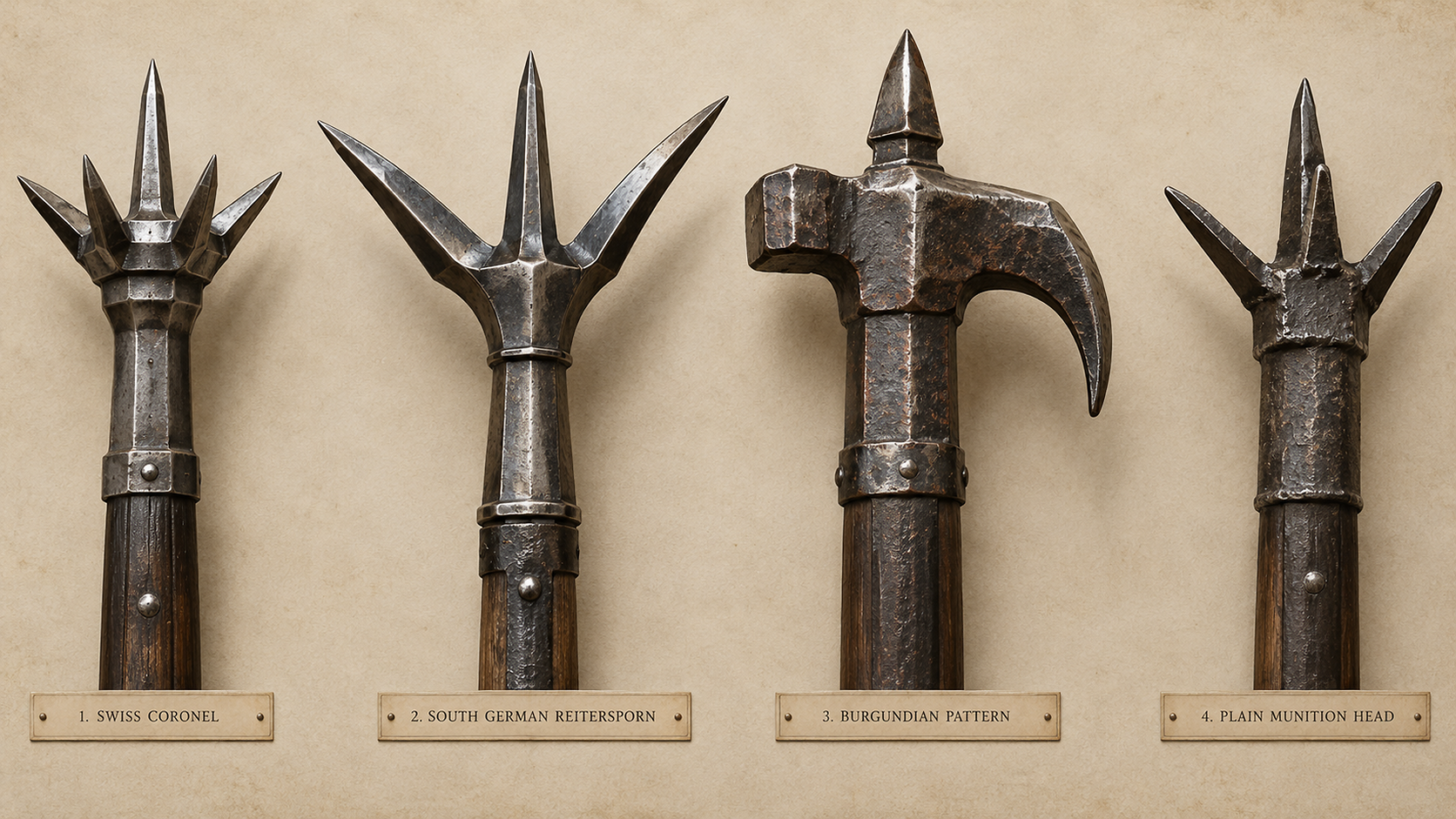
Although the quintessential Lucerne hammer is associated with the central cantons of the Swiss Confederation, variations on the pronged war hammer appeared throughout Germany, Austria, northern Italy, and Burgundy from the late 1300s into the sixteenth century. Arms collectors and curators identify several distinct stylistic lineages based on how the head components were joined and shaped.
In early variants dating to the late fourteenth and early fifteenth centuries, the head was frequently forged as a two-piece assembly: the long central spear spike passed through an eye forged into the combined hammer-and-fluke unit, with the components keyed or forge-welded together before being seated on the haft. By the mid-to-late fifteenth century, South German workshops increasingly hot-punched the entire head block from a single massive billet of iron, welding carbon-steel inserts into the four prongs and the beak tip to optimize production efficiency and mechanical strength.
Regional preferences also governed the profile of the hammer face:
The diversity of these heads demonstrates that regional armories continuously experimented with the balance between blunt shock delivery, armor piercing, and mechanical durability based on the prevailing armor quality of their immediate adversaries.
Surviving museum examples reveal distinct variations in head architecture across Central Europe:
- Standard Swiss type: A compact four-pronged coronel head paired with an exceptionally long, stout square-section top spike and a moderately curved beak, mounted with four long langets.
- German Reitersporn variants: Characterized by longer, more widely splayed prongs that resemble an exaggerated spur, prioritizing maximum surface purchase against highly fluted gothic plate.
- Burgundian and Low Countries styles: Often feature a shorter top thrusting spike and a heavier, more massive rear pick, reflecting encounters with heavily armored cavalry on open plains.
- Munition patterns: Produced in volume for municipal stores, displaying plain unadorned octagonal sockets, simple forge-welded seams, and roughly ground hammer teeth.
Surviving Artifacts in Swiss and European Collections
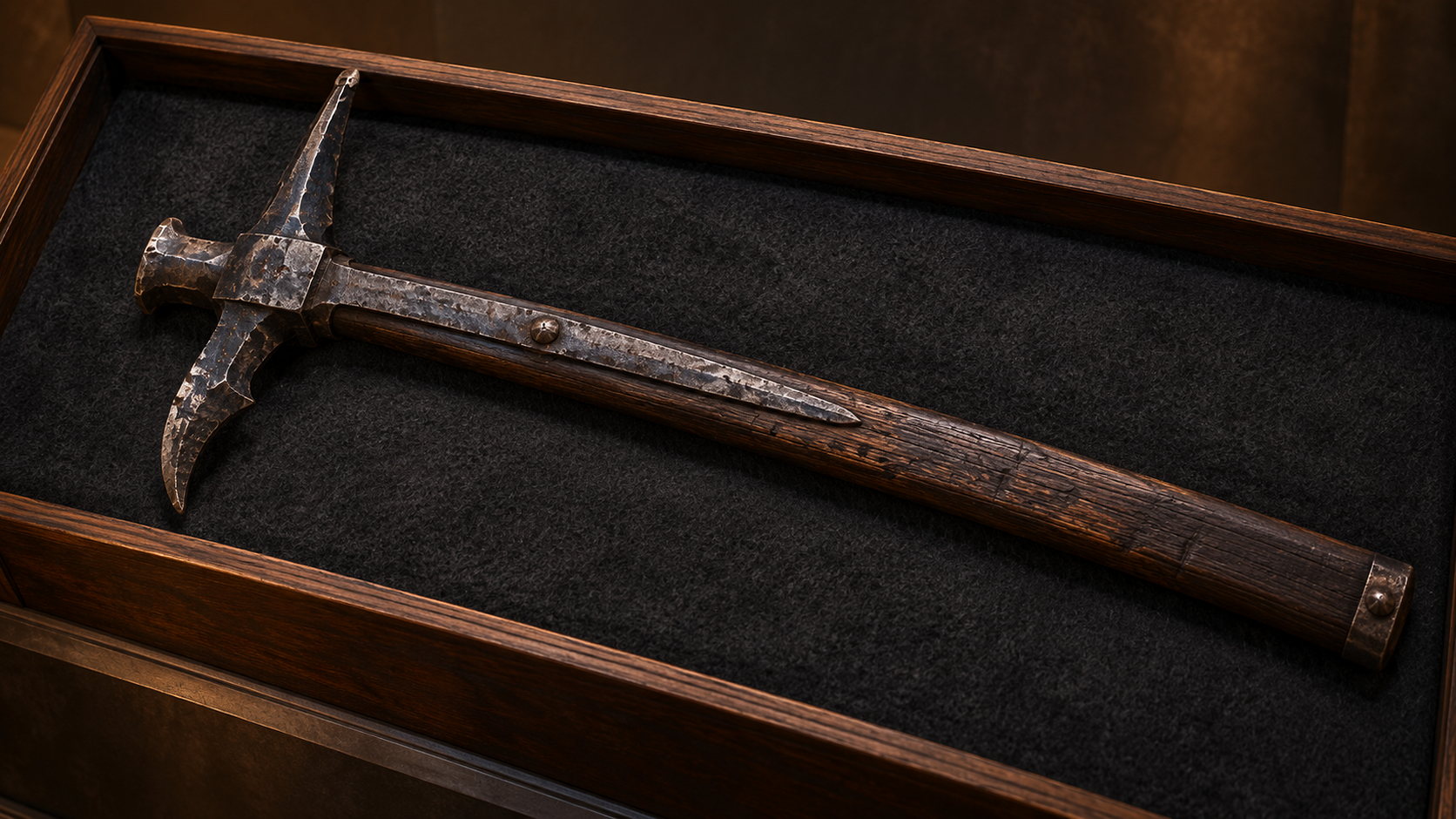
The primary repository for authentic Lucerne hammers remains the municipal and cantonal collections of Switzerland. The Historisches Museum Luzern, housed partly in the historic armory, preserves a remarkable series of these weapons dating from the fifteenth and early sixteenth centuries. These pieces display the characteristic dark patina of weapons kept in dry municipal storage for centuries, unpolished by modern sanders and retaining their original ash hafts, hand-forged cross-rivets, and langets.
Additional significant holdings survive in the Swiss National Museum (Landesmuseum Zürich), the Bernisches Historisches Museum, and the Zeughaus in Solothurn. Outside Switzerland, major dynastic collections such as the Imperial Armory in the Kunsthistorisches Museum in Vienna and the Royal Armouries in Leeds possess exceptional examples captured during regional conflicts or collected as military curiosities during the early modern era.
Careful physical examination of these surviving specimens reveals traces of harsh service that never appear in artistic depictions. Heads exhibit mushroomed prong tips from strikes against heat-treated plate, haft wood compressed and bruised by opposing blade impacts, and ancient repairs where langets were re-pinned after pulling loose. These wear patterns confirm that the Lucerne hammer was a working implement of infantry survival, subjected to dynamic stresses that pushed late medieval wood and iron to their absolute structural limits.
Pictorial and Documentary Evidence
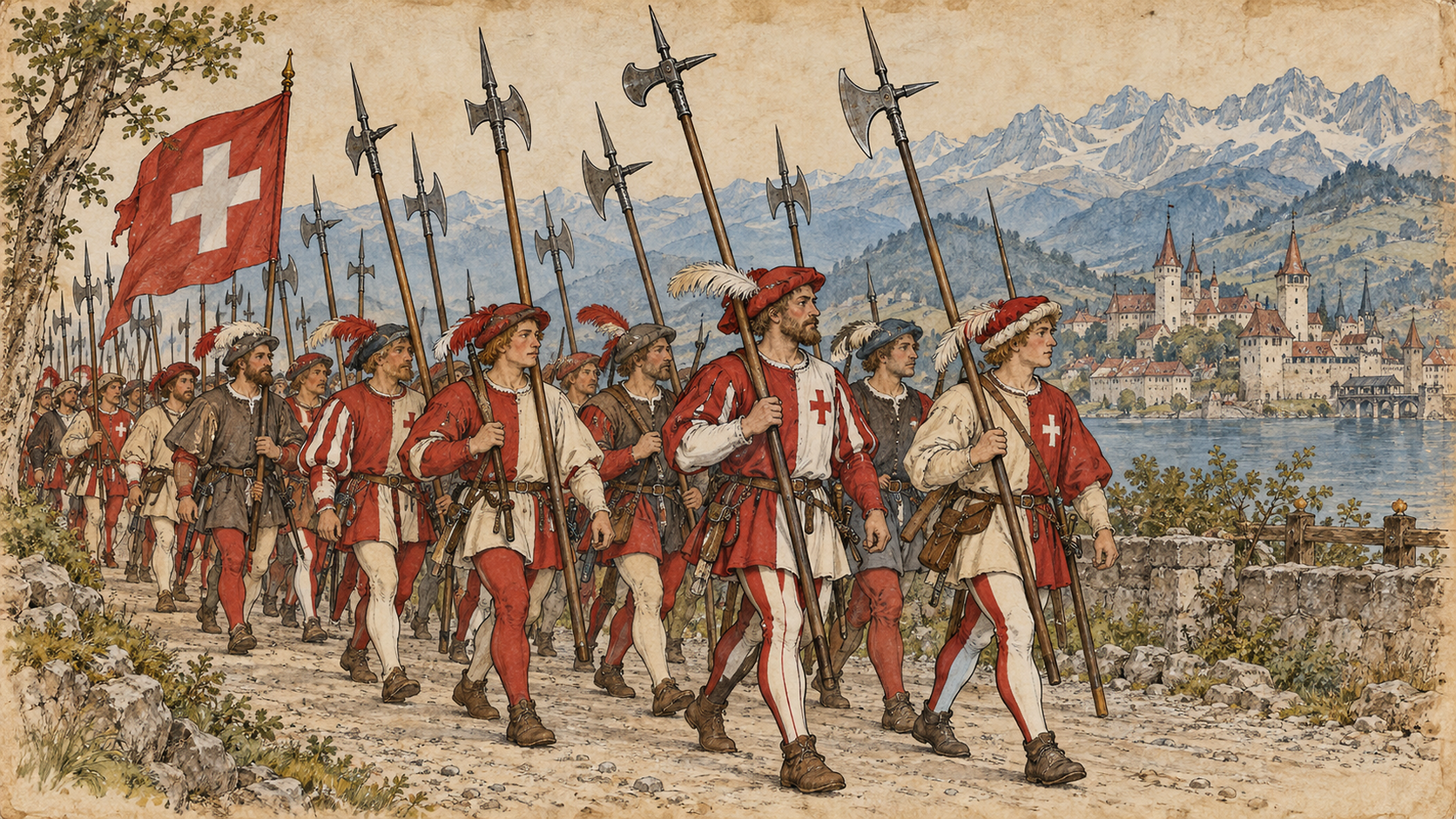
Because weapon terminology in late medieval documents was rarely uniform, historians rely heavily on contemporary visual records to corroborate how and when Lucerne hammers were deployed. The weapon appears consistently in Swiss illustrated chronicles (Bilderchroniken) produced during the late fifteenth and early sixteenth centuries, most notably the Tschachtlanchronik (1470) and the Spiezer Chronik of Diebold Schilling the Elder (mid-1480s).
In these vibrant, detailed illustrations, Swiss infantrymen are frequently depicted marching with long-hafted war hammers slung over their shoulders or wielding them in the melee of battles like Grandson (1476) and Murten (1476). The artists—many of whom were veterans of the campaigns they documented—carefully distinguished the four-pronged Lucerne hammer heads from the broad-bladed halberds carried in neighboring ranks. The weapons are consistently shown with exceptionally long hafts, often towering well above the heads of the soldiers holding them, reinforcing their identification as long-reach infantry weapons.
Documentary inventories from Swiss cantonal armories reinforce the pictorial record. Entries throughout the late fifteenth century enumerate Mordaxt, Hämmer, and Reitersporn stored in bundles alongside pikes and halberds. The weapon was procured in substantial numbers for civic levies, demonstrating that the Lucerne hammer was an official, recognized instrument of cantonal defense rather than an improvised peasant club.
The Decline and Renaissance Afterlife
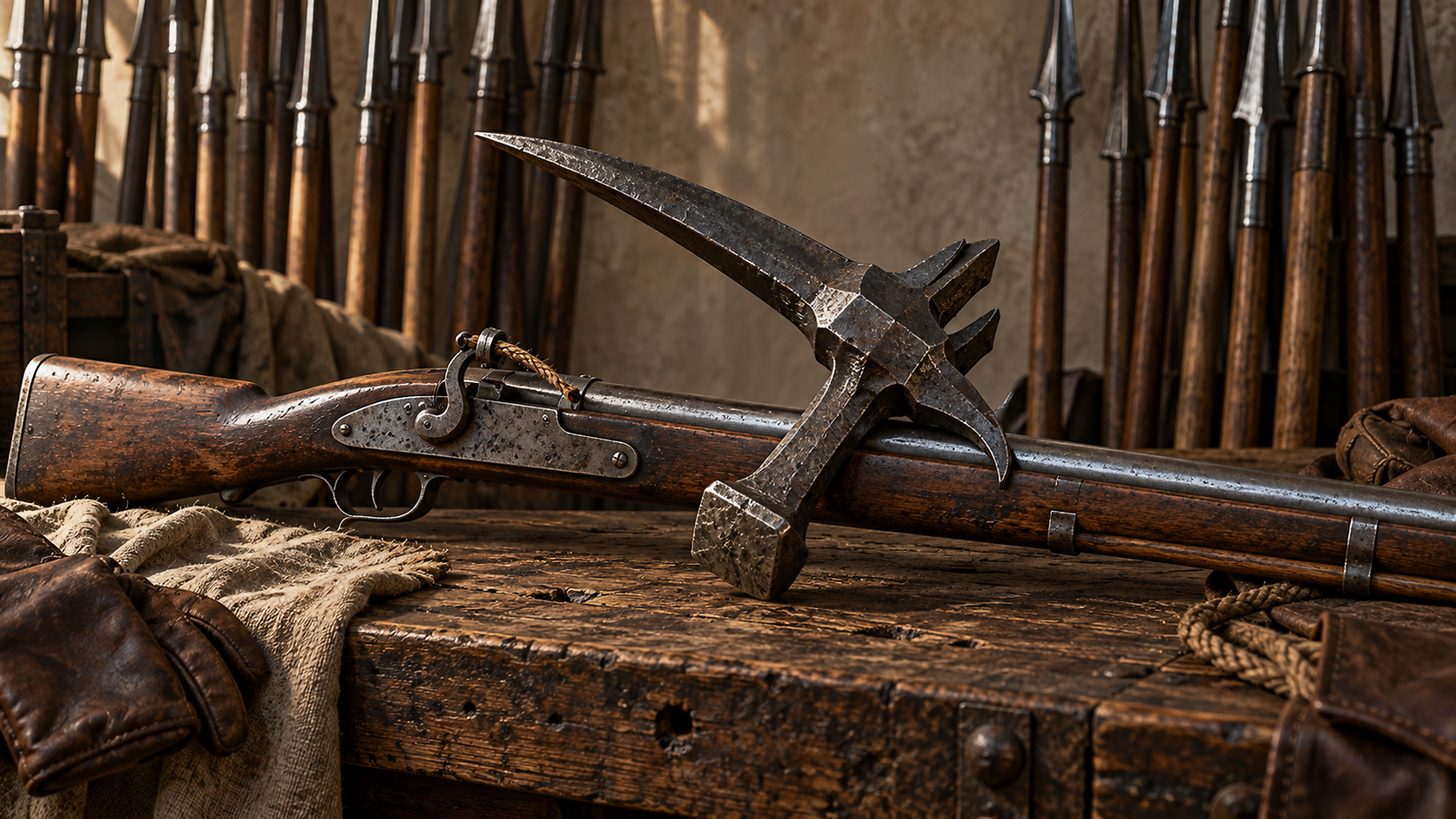
By the second quarter of the sixteenth century, the operational environment of European battlefields had transformed radically, precipitating the steady decline of the Lucerne hammer. The rapid proliferation of handheld gunpowder firearms—particularly the harquebus and early musket—altered infantry priorities. Formations could no longer afford to devote significant numbers of soldiers to specialized, short-range anti-armor melee weapons. Pike squares grew increasingly uniform, standardizing on twenty-foot pikes to resist cavalry and shot to deliver decisive armor penetration at distance.
Against an opponent thirty yards away firing a lead ball capable of piercing plate armor, the kinetic energy of a hand-swung four-pronged hammer was rendered tactically obsolete. As field plate armor adapted by thickening its breastplates and eliminating leg armor to retain mobility under shot, the complex set of hooks, prongs, and spikes on the Lucerne hammer lost its primary targets. By 1550, Swiss and German municipal armories had largely relegated their long hammers to reserve storage.
Nevertheless, the weapon enjoyed a prolonged symbolic afterlife. Throughout the late sixteenth and seventeenth centuries, stylized versions of the hammer, often embellished with etched steel, gilding, and decorative tassels, were carried by city night guards, court bodyguards, and municipal watchmen across Germany and Switzerland. In these ceremonial contexts, the weapon survived not as an active armor-piercing engine, but as an imposing badge of civic authority and an echo of the Confederation's martial triumphs.
Modern Misconceptions and Armory Archive Appraisal
In nineteenth-century romantic historiography and modern fantasy media, the Lucerne hammer is frequently subjected to gross mechanical exaggeration. Antiquarian catalogers often applied the name indiscriminately to any polearm with a pick, while Victorian novelists imagined the weapon as an impossibly heavy, clumsy cudgel swung exclusively by brute force. In modern role-playing games and cinema, it is routinely depicted as a ponderous maul capable of smashing whole buildings or crushing armored giants with slow, telegraphed swings.
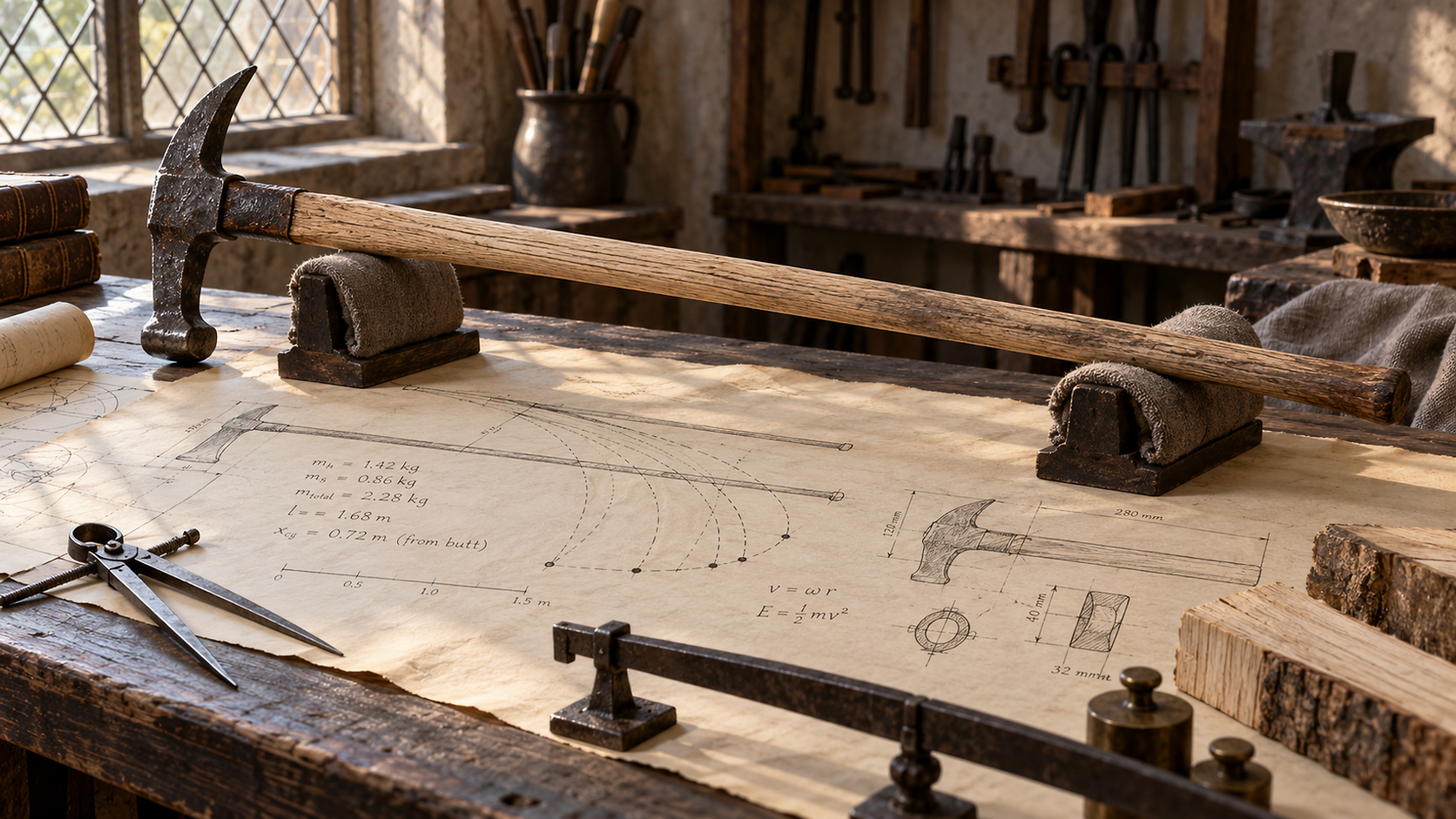
Physical analysis of original artifacts completely refutes this fantasy archetype. A genuine fifteenth-century Lucerne hammer is an agile, beautifully balanced instrument. Despite its intimidating array of spikes, the head typically weighs between 1.2 and 2.0 kilograms, rarely exceeding the mass of a contemporary executioner's sword. Mounted on a flexible, tapered ash shaft, the center of mass remains close enough to the hands to permit rapid directional shifts, parries, and recovery after a missed stroke. It was an implement of martial precision, designed to deliver its impact with surgical placement into the weak spots of a sophisticated defense.
Modern historical European martial arts (HEMA) practitioners and experimental archaeologists have further clarified the weapon's dynamics. High-speed kinematic studies demonstrate that the weapon generates substantial tip velocity through the leverage of its long haft, delivering its kinetic energy upon sudden deceleration. Rather than acting as a crude bludgeon, the Lucerne hammer served as an infantry weapon engineered specifically to defeat articulated plate harness.
Further reading
Follow the sources to examine the object and its historical context.
Wegeli, Rudolf. Inventar der Waffensammlung des Bernischen Historischen Museums. Bern, 1939.External reference · Opens in a new tab Blair, Claude. European Weapons and Armour: From the Renaissance to the Industrial Revolution. B.T. Batsford, 1968.External reference · Opens in a new tab Oakeshott, Ewart. The Archaeology of Weapons: Arms and Armour from Prehistory to the Age of Chivalry. Boydell Press, 1999.External reference · Opens in a new tab