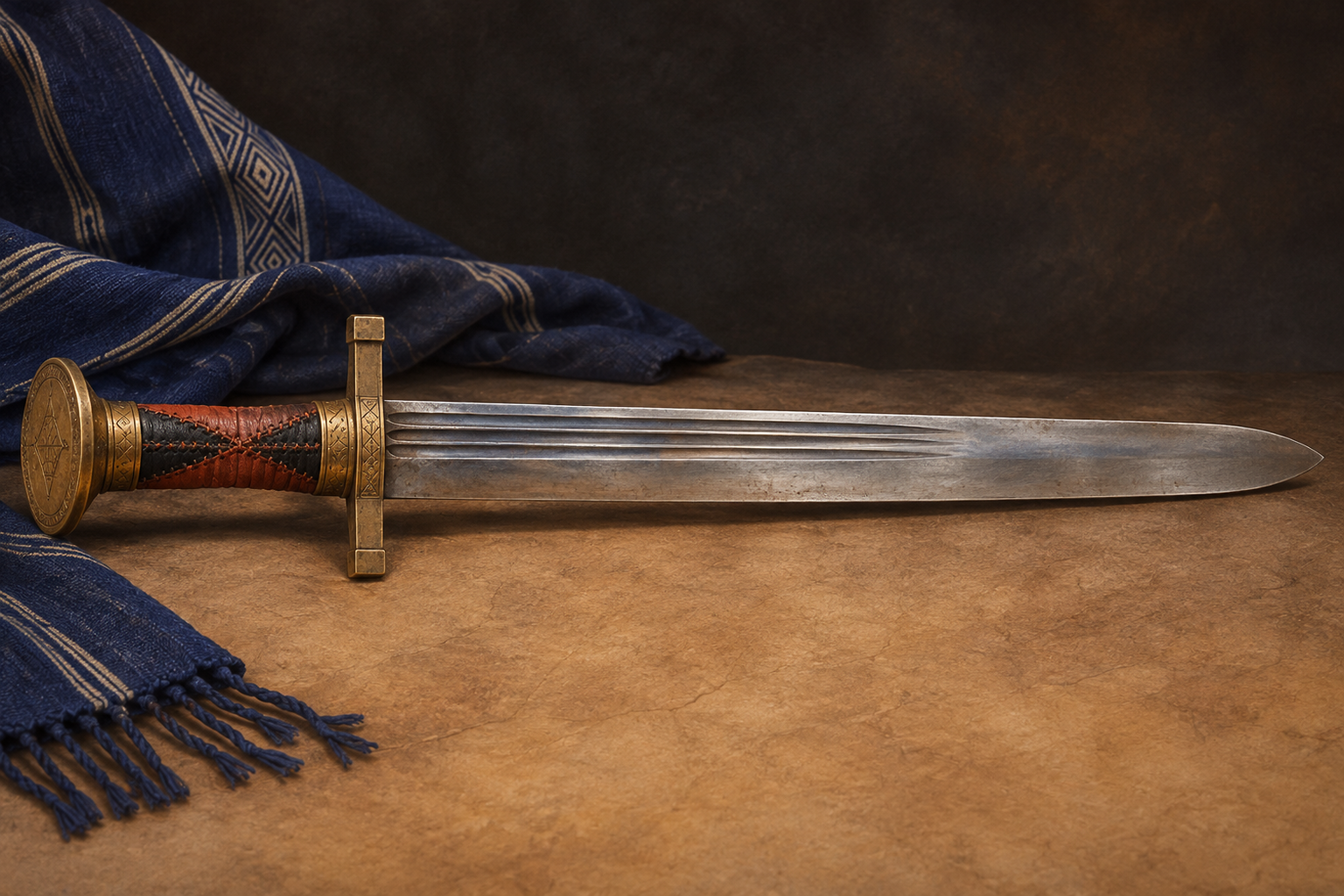
A surviving takouba often presents an immediate visual contradiction. Beneath a flared, leather-covered cross-guard and a flat, disk-shaped pommel sits a straight steel blade stamped with European crescent moons, Latin inscriptions, or the running wolf mark of Passau and Solingen. Across the central Sahara and the northern Sahel, Tuareg smiths and nobles built a distinct regional sword tradition by pairing imported European blades with local ironwork, dyed goat leather, and geometric brass mounts.
Anatomy of a Saharan Broadsword
Compared with the basket-hilted swords of early modern Europe or the curved sabers of North Africa, the takouba has a spare, geometric profile. It is a straight, double-edged broadsword designed primarily for one-handed use from camelback, horseback, or on foot. Its outline consists of a flat disk or rectangular pommel, a cylindrical grip that widens slightly toward the guard, a rectangular cross-guard with squared ends, and a broad blade tapering to a rounded or spatulate point.
This austere outline conceals careful construction tailored to an arid environment. Exposed iron and steel corrode rapidly when handled with sweaty hands, and bare metal can become uncomfortably hot under direct Saharan sun. Tuareg artisans solved both problems by encasing almost the entire hilt and scabbard in tightly stitched leather, punctuated by small panels of incised brass, copper, or white metal.
Unlike many European swords that rely on a heavy metal pommel cast in one piece to balance the blade, the takouba achieves its handling through a light hilt paired with a relatively thin, flexible blade. The center of balance generally sits well forward of the guard, giving the weapon authority in a downward or horizontal cut while keeping overall weight manageable during long desert marches.
Trans-Saharan Trade and the Flow of European Blades
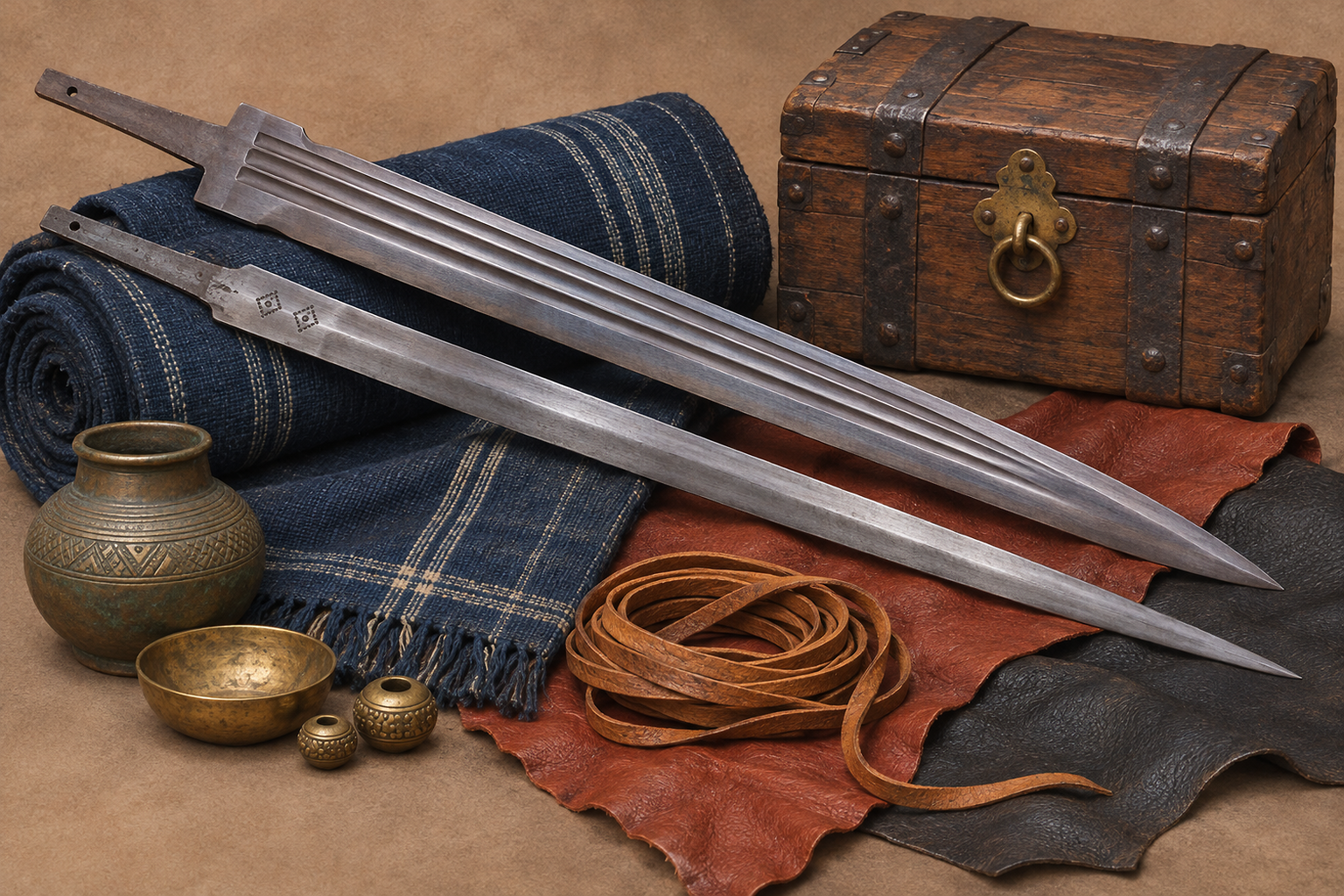
The presence of German, Spanish, and Italian blades deep in the Sahara reflects centuries of overland commerce linking Mediterranean ports with oasis towns such as Ghadames, Ghat, Agadez, and Timbuktu. European sword-making centers, particularly Solingen in the Rhineland and Passau on the Danube, produced blades in enormous quantities for export during the sixteenth, seventeenth, and eighteenth centuries. Merchants shipped unhilted blades across the Mediterranean to Tripoli, Tunis, and Algiers, where caravan traders carried them south across the desert.
In Saharan markets, a finished European hilt held little appeal. Local fighters preferred a hilt geometry suited to their own grip, clothing, and scabbard suspension, so blades traveled primarily as bare steel bars ready for local mounting. Trade records and nineteenth-century travel accounts note that European blades commanded high prices in pastoralist societies where good high-carbon steel was scarce.
Once a blade entered the Sahara, it became a durable family asset that could circulate for generations. A blade forged in seventeenth-century Germany might be re-hilted in nineteenth-century Air or Ahaggar, receiving new leatherwork and brass fittings each time the old mountings wore through. A single takouba therefore often combines two distinct historical layers: the European workshop origin of its steel and the Saharan or Sahelian craft tradition of its hilt.
Inadan Smiths and the Social World of Blade Mounting
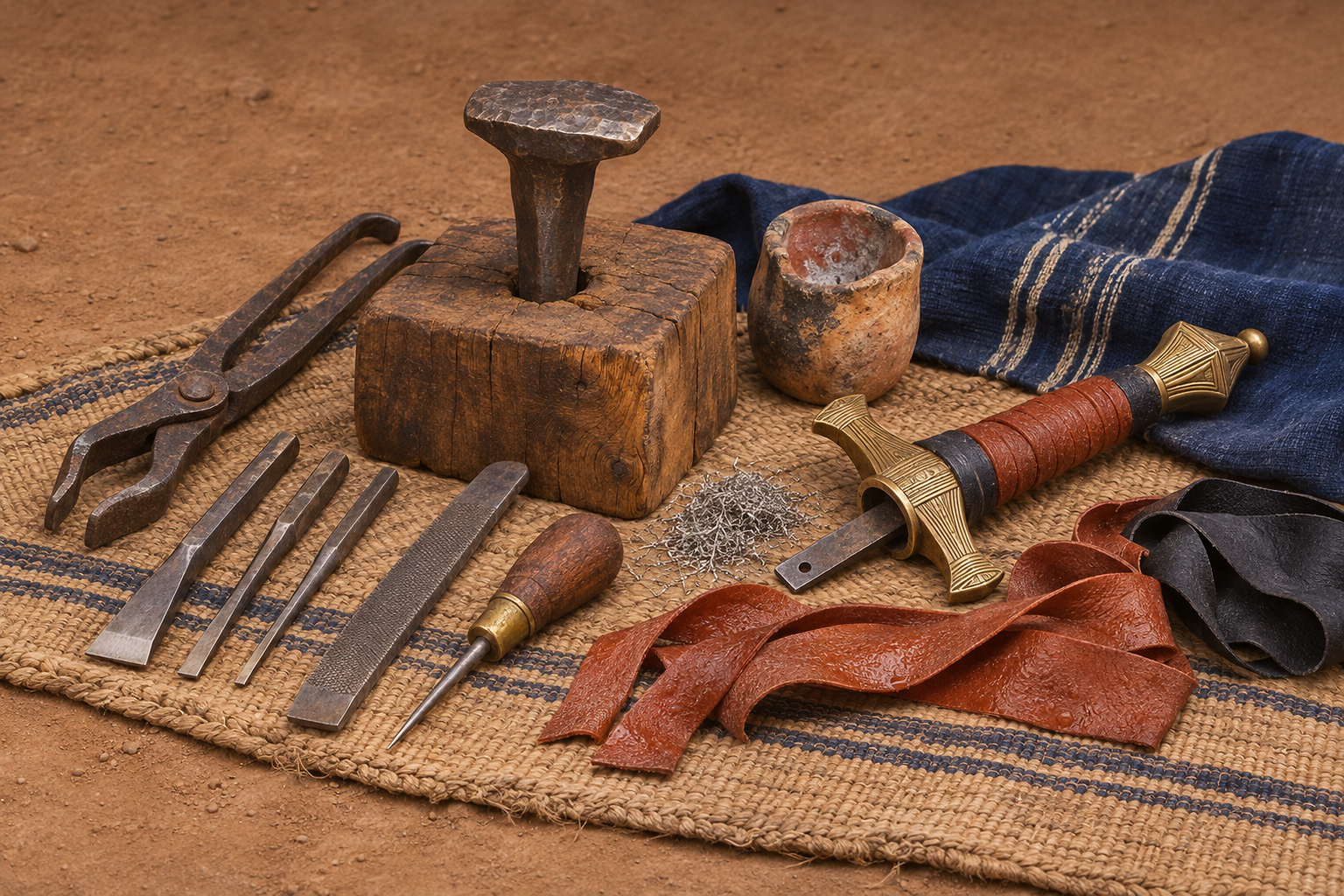
Within Tuareg society, the manufacture and repair of weapons belonged to the inadan, an endogamous caste of specialized artisans who worked iron, silver, brass, wood, and leather. While noble imajaghan warriors carried the sword as a marker of status and martial obligation, the inadan possessed the technical knowledge required to temper steel, solder non-ferrous inlays, and tool geometric patterns into damp leather.
The relationship between warrior and smith was governed by strict social etiquette and mutual dependence. A patron supplied raw materials, imported blades, or livestock in exchange for weapons, saddles, and jewelry, while the smith maintained the lineage's arms across decades. Because smiths frequently traveled between camps and oasis towns, technical ideas spread widely across Tuareg confederations from the Hoggar Mountains in southern Algeria to the Niger River bend.
Workshop practice relied on portable tools suited to a semi-nomadic life. Smiths used compact skin bellows, small stake anvils set into wooden blocks, chisels, files, and awls rather than fixed water-powered mills. Despite these modest tools, the precision of their leather stitching and sheet-metal folding equals that of urban guilds along the Mediterranean coast.
Reading the Triple Fullers
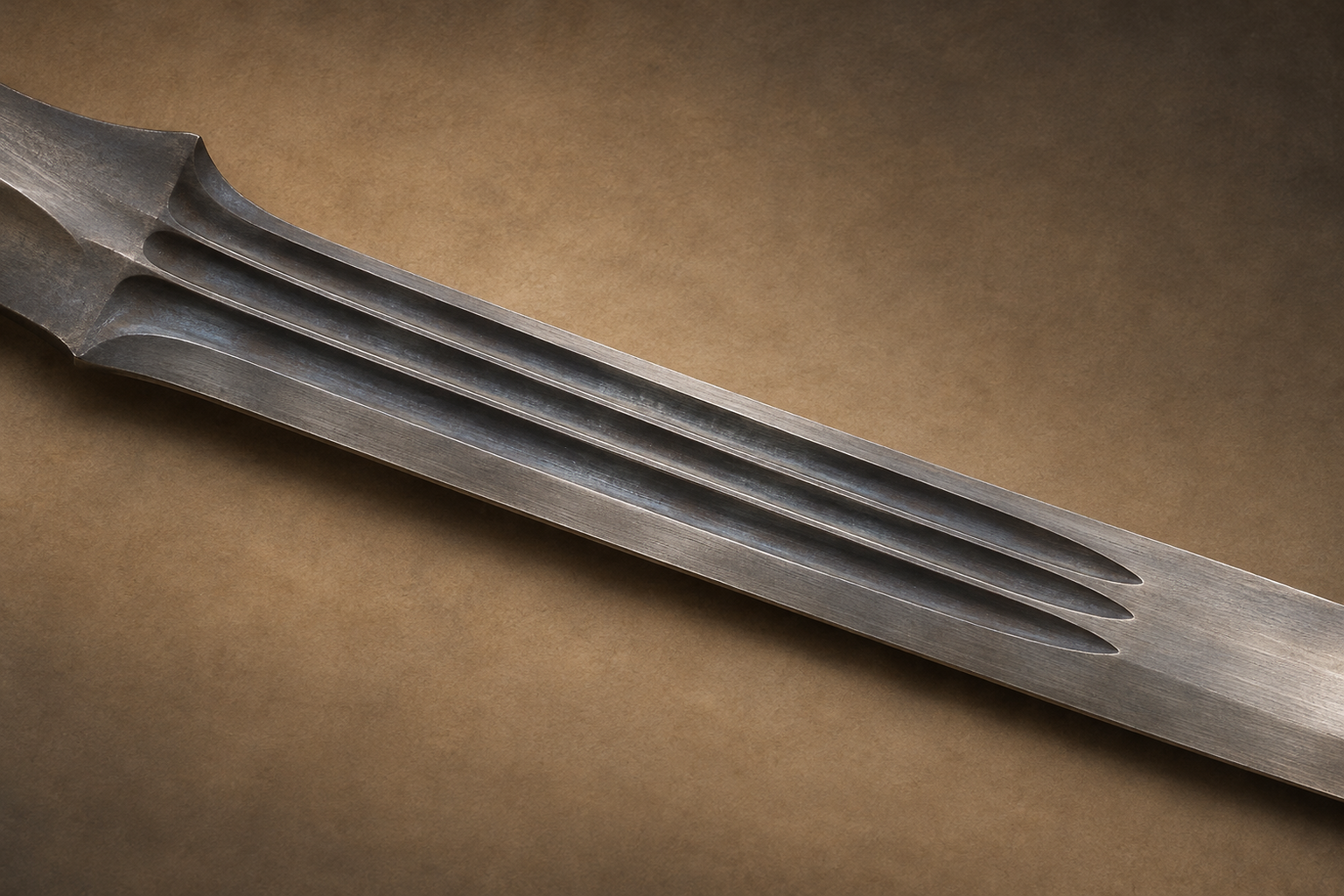
Among the many blade forms fitted to the takouba, blades bearing three narrow parallel fullers hold a special place in museum collections and Saharan oral memory. These channels typically run side by side down the upper third or half of the blade, separated by crisp central ridges, before terminating neatly near the mid-blade. In both European export blades and local African forgings, triple fullers served a clear structural purpose: they removed excess metal near the hilt without sacrificing stiffness across the width of the blade.
Fullering a thin broadsword blade requires careful control during forging and grinding. If the channels are cut unevenly, the blade can warp during heat treatment or develop weak spots along the central web. On high-grade European export blades, the three grooves are remarkably uniform, produced with specialized swages and grindstones before the steel was quenched and tempered.
In the Sahara, the visual pattern of triple fullers became closely associated with prestigious, older blades. Even when a blade lacked legible European lettering, three crisp fullers signaled quality steel to a prospective buyer. Local smiths noticed this preference and frequently ground or chiseled triple fullers into locally forged blades, sometimes pairing them with single central fullers or decorative notches near the ricasso.
European Marks and Saharan Counterparts
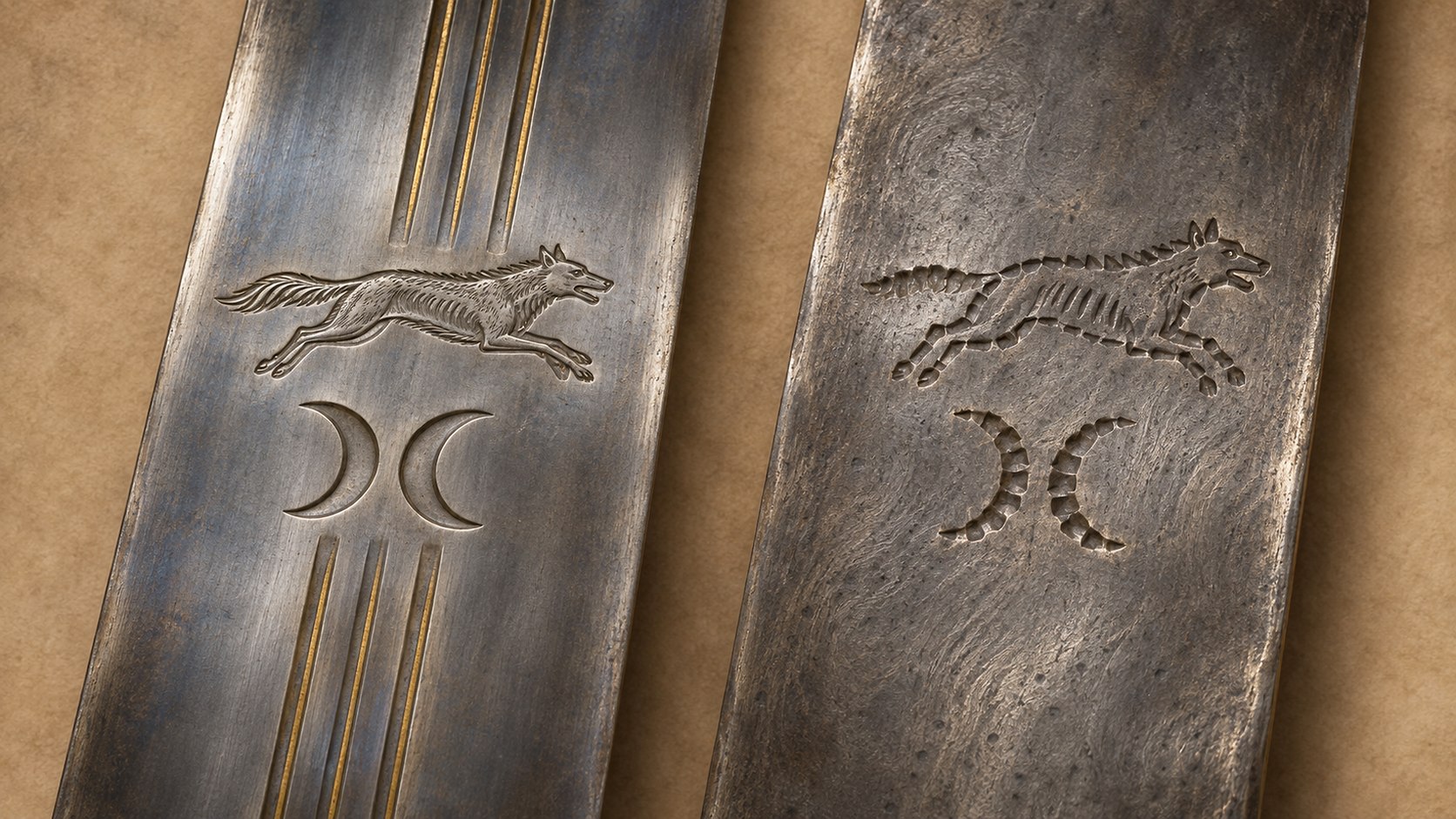
The upper flats of surviving takouba blades carry a wide range of stamped symbols. The best known is the running wolf, an elongated canine outline originally associated with Passau and later adopted widely by Solingen bladesmiths as a mark of quality. Alongside the wolf appear twin opposed crescent moons—often termed dukagjin or gurda marks in regional trade—as well as Maltese crosses, orbs, and garbled Latin mottoes.
Distinguishing a genuine European export stamp from a Saharan copy is one of the central challenges for curators and collectors. As demand for marked blades outstripped caravan supply, inadan smiths crafted punches to reproduce the wolf and crescent marks on locally forged steel. On authentic Solingen or Passau blades, the stamps were usually struck hot with finely engraved dies and sometimes inlaid with copper or brass wire. Saharan reproductions often show slightly broader chisel strokes, irregular spacing, or placement that ignores the geometry of the fullers.
Locally forged blades made by skilled inadan smiths were functional combat weapons rather than decorative copies, and their stamped marks worked much like a guild hallmark—signaling that the blade followed a recognized pattern.
Collectors and researchers typically look for several diagnostic features when evaluating stamped marks on a takouba blade:
- Sharp, continuous die impressions versus overlapping cold-chisel cuts
- Traces of non-ferrous copper or brass inlay inside the stamped grooves
- Alignment between the stamps and the termination of the triple fullers
- Consistent carbon distribution and fine grain structure compared with heterogeneous bloomery iron
Cross-Guard Construction and Layered Ironwork
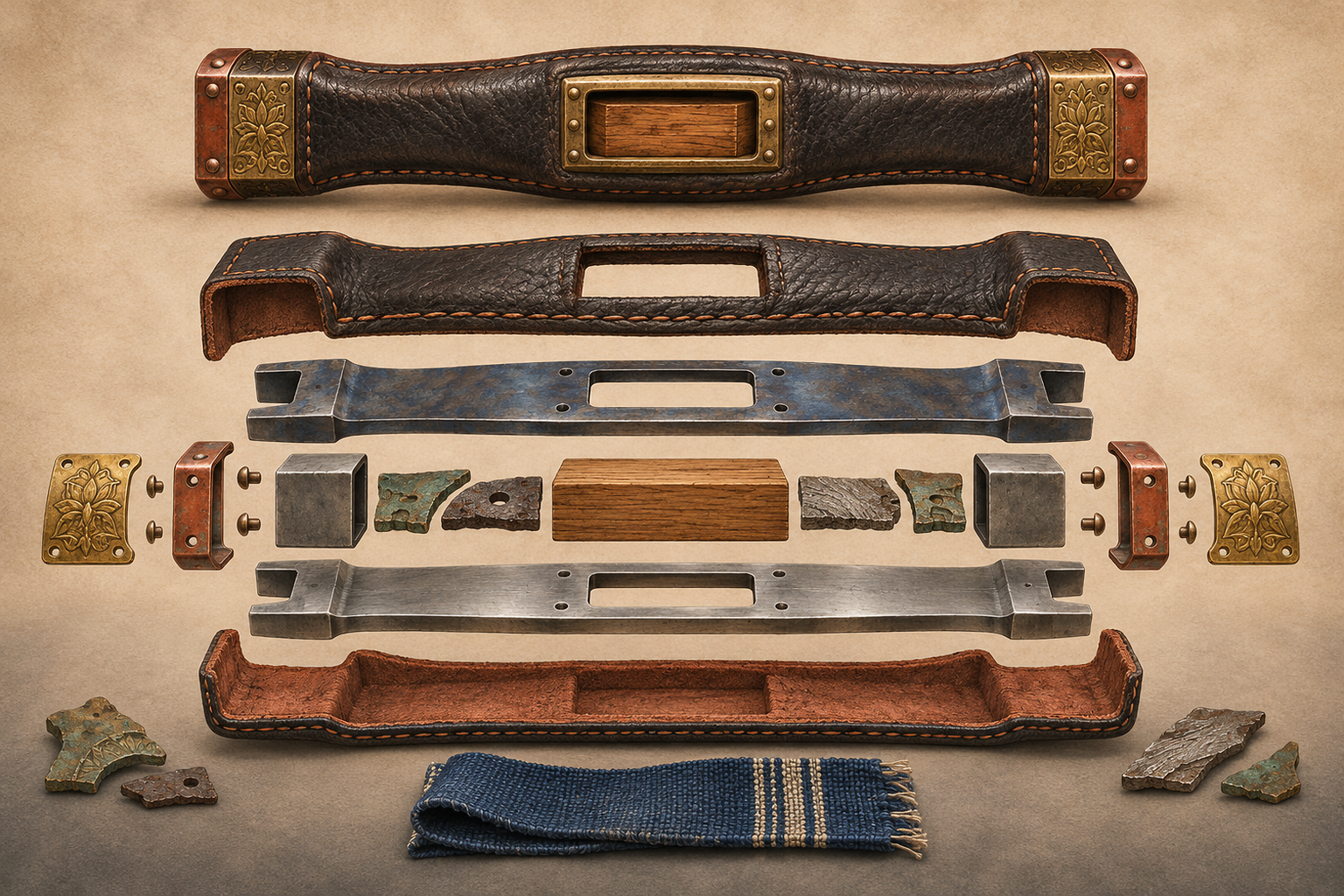
The cross-guard of a takouba is one of its most distinctive structural elements. Unlike medieval European cross-guards forged from a single solid bar of iron, a typical takouba guard is a composite assembly. Smiths often constructed it from an internal iron core or two parallel iron plates joined at the ends, creating a rectangular block that slides tightly over the blade's tang and shoulders.
This hollow or layered construction reduces weight at the base of the hilt while providing a broad, flat surface for leather wrapping. The ends of the guard are usually squared off or slightly flared, and the underside is shaped to fit snugly over the mouth of the scabbard. On higher-status swords, the inner faces or tips of the guard carry small plates of engraved brass, silver, or red copper secured with tiny rivets or folded tabs.
Because the cross-guard is almost completely covered in stitched leather, its internal structure rarely becomes visible unless an antique hilt suffers damage. X-radiography and conservation examinations of damaged museum examples have confirmed that smiths routinely recycled scrap iron, old European blade fragments, and sheet metal inside the guard assembly, reserving their finest steel for the cutting edge.
Grip Geometry, Pommel Disks, and Leatherwork
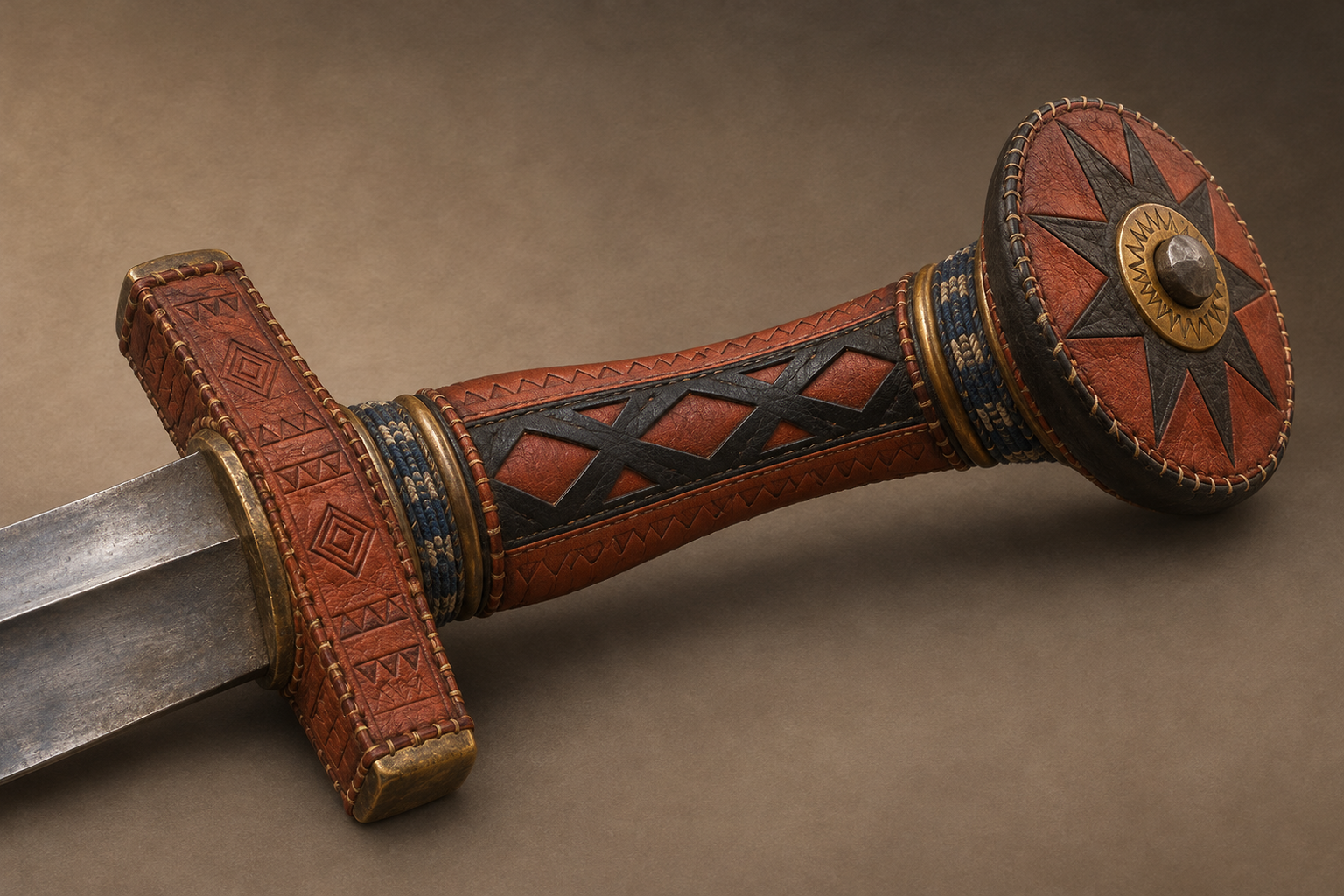
Moving upward from the cross-guard, the grip of the takouba tapers slightly toward the center before flaring into a broad, flat pommel. Beneath the leather exterior lies a wooden core, carved to accept the iron tang and shaped to prevent the sword from twisting in the hand during a cut. The tang passes all the way through the wooden grip and the iron pommel plate, where it is peened over a small metal washer or brass boss.
Artisans covered this wooden and iron core in supple goat or sheep skin dyed deep terracotta red with sorghum leaf extracts, black with iron-tannin solutions, or occasionally green. They stretched the leather wet over the hilt, stitched it tightly along the narrow edges with fine leather thongs, and burnished the surface smooth.
Geometric decoration is applied through blind tooling, cut-out overlays, and contrasting strips of dyed skin. Triangles, diamonds, and cross motifs mirror the protective patterns found on Tuareg leather cushions, camel saddles, and amulet cases. Far from being purely ornamental, these ridges and overlays improve grip traction when the user wears loose indigo-dyed cotton sleeves or handles the sword with dusty hands.
Blade Geometry and Cutting Mechanics
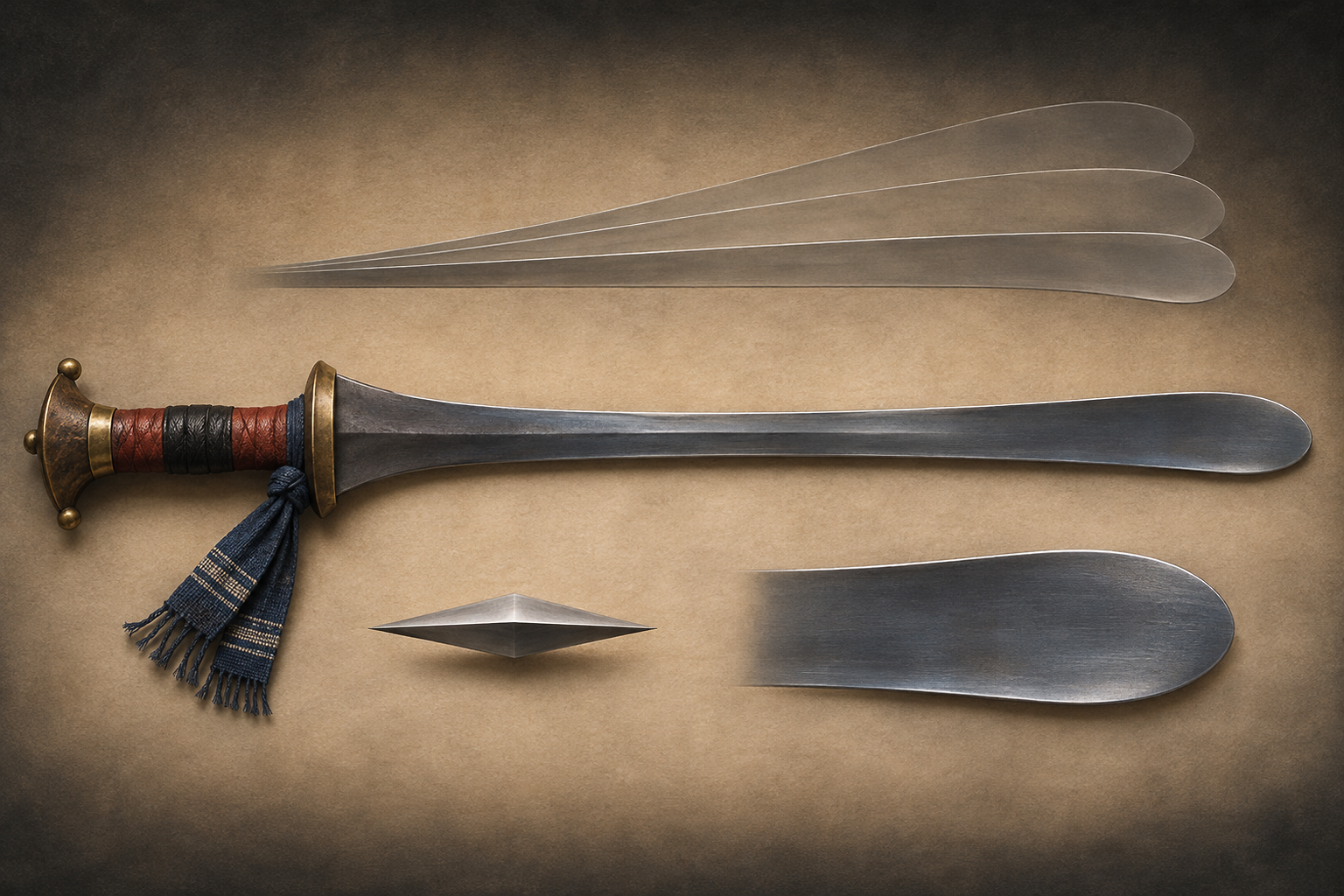
A typical takouba blade is thin in cross-section, broad across the forte, and remarkably flexible along its length. Rather than tapering sharply to an acute needle point for thrusting through mail or plate armor, most examples maintain considerable width until just before the tip, ending in a rounded or spatulate point. This geometry concentrates mass toward the center of percussion, optimizing the sword for sweeping, draw-assisted cuts.
The flexibility of the blade is a deliberate performance characteristic rather than a metallurgical flaw. European export blades tested in the nineteenth century were prized precisely because they could flex significantly under load and spring back to true without taking a permanent bend. In combat, a flexible blade absorbs the shock of striking a hardened rawhide shield or the wooden frame of a camel saddle without snapping.
Because the takouba lacks knuckle bows or complex side rings, the wielder's hand relies on the wide rectangular cross-guard and the flared disk pommel for security. The flat pommel braces against the heel of the palm, locking the wrist into alignment during a horizontal slash and helping the swordsman recover the blade quickly after a strike.
The Takouba Within the Tuareg Panoply
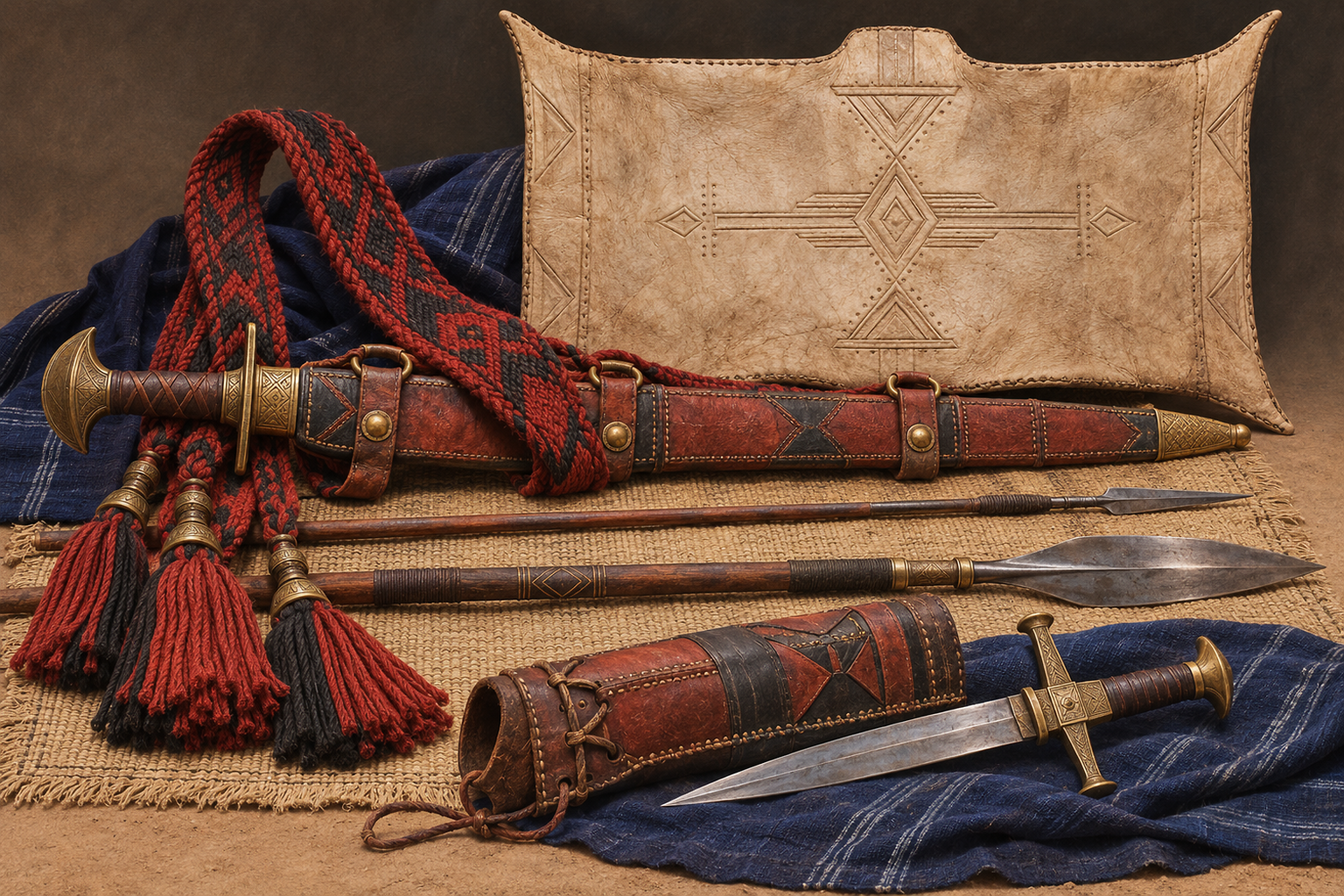
The takouba was never carried in isolation; it operated as part of an integrated system of personal arms suited to mobile desert warfare. A mounted warrior typically carried a long iron-headed throwing and thrusting lance (allagh), a heavy broad-bladed javelin, a large rectangular shield made of addax or oryx antelope hide (agher), and a distinctive arm dagger (telek) strapped in a leather sheath to the left forearm.
Within this panoply, the sword served as the primary close-quarters sidearm once lances had been cast or closed past. The large antelope-hide shield absorbed incoming projectiles and deflected downward cuts, while the takouba struck around the shield's edge at the opponent's limbs, head, or mount. If a fighter lost his sword or grappled at close range, the forearm dagger provided an immediate backup weapon.
Suspension methods reflected this layered readiness. The takouba hung nearly horizontally or at a shallow angle on the left side from a thick braided wool or leather baldric passed over the right shoulder, ending in large decorative tassels. This high carriage kept the scabbard clear of the camel's flanks while allowing the rider to draw the blade smoothly across the body.
Scabbards, Chapes, and Baldric Fittings
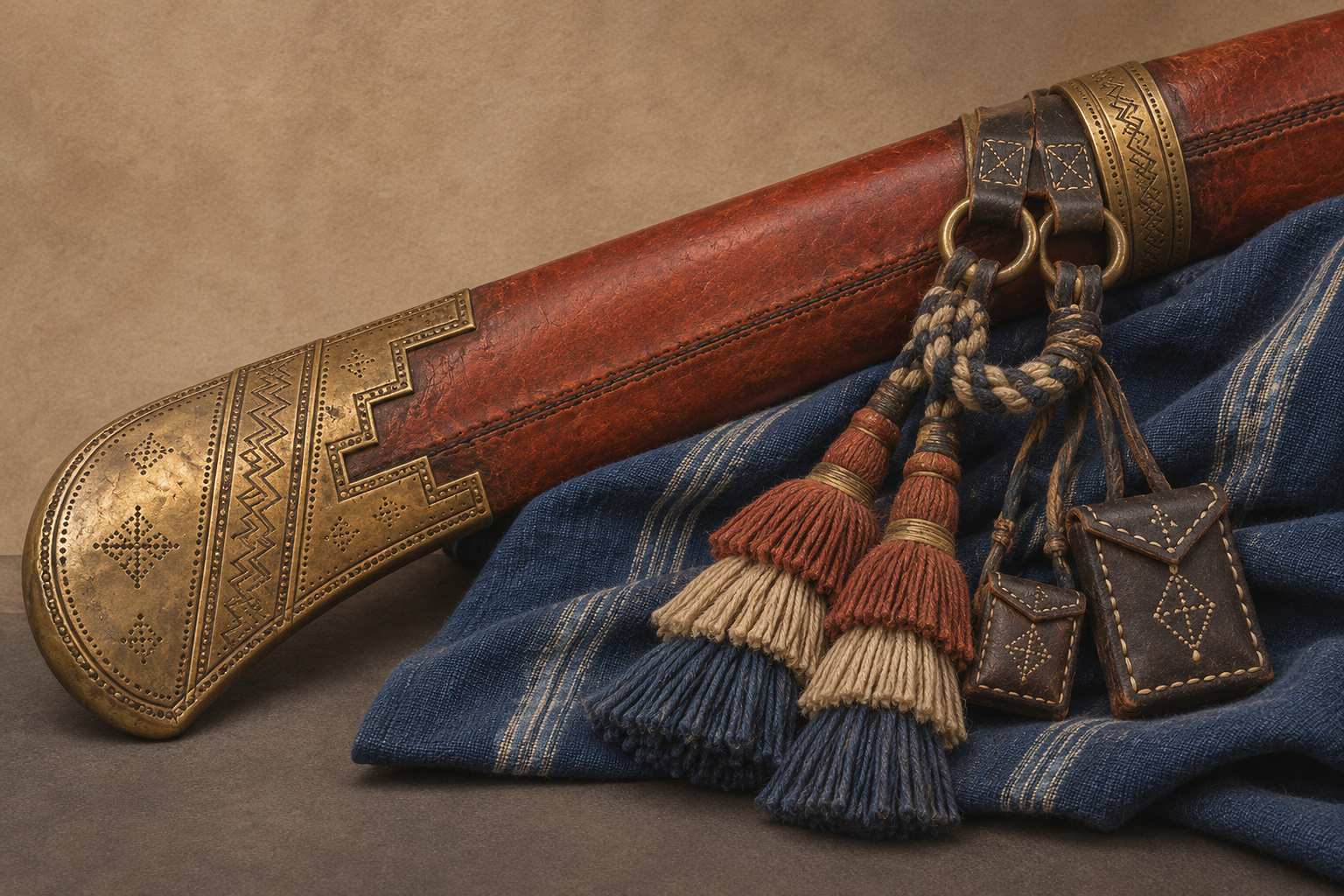
Built around two thin wooden slats shaped to the blade's profile, the scabbard is wrapped in dyed leather matching the hilt and reinforced with bands of sheet brass or copper. Near the throat, two leather loops or metal rings anchor the braided baldric cord so the sword hangs at a controlled tilt.
At the lower end, the scabbard terminates in a broad, flat or slightly flared brass chape, often decorated with punched dots, engraved zigzags, and stepped edges. This wide metal tip protects the fragile leather sheath when the wearer dismounts onto rocky ground or rests the scabbard against a saddle frame. Unlike European scabbards that taper to a narrow drag, the takouba chape echoes the rounded tip of the blade inside.
On ceremonial or high-status examples, the baldric is equally elaborate. Thick cords of red, green, or black wool are woven around core threads and finished with heavy, multi-tiered tassels and leather-covered amulet pouches containing protective verses. Worn over flowing indigo robes (tagelmust and gandoura), the bright leather and polished brass chape stood out sharply against the dark cloth.
Regional Variations Across the Sahara and Sahel
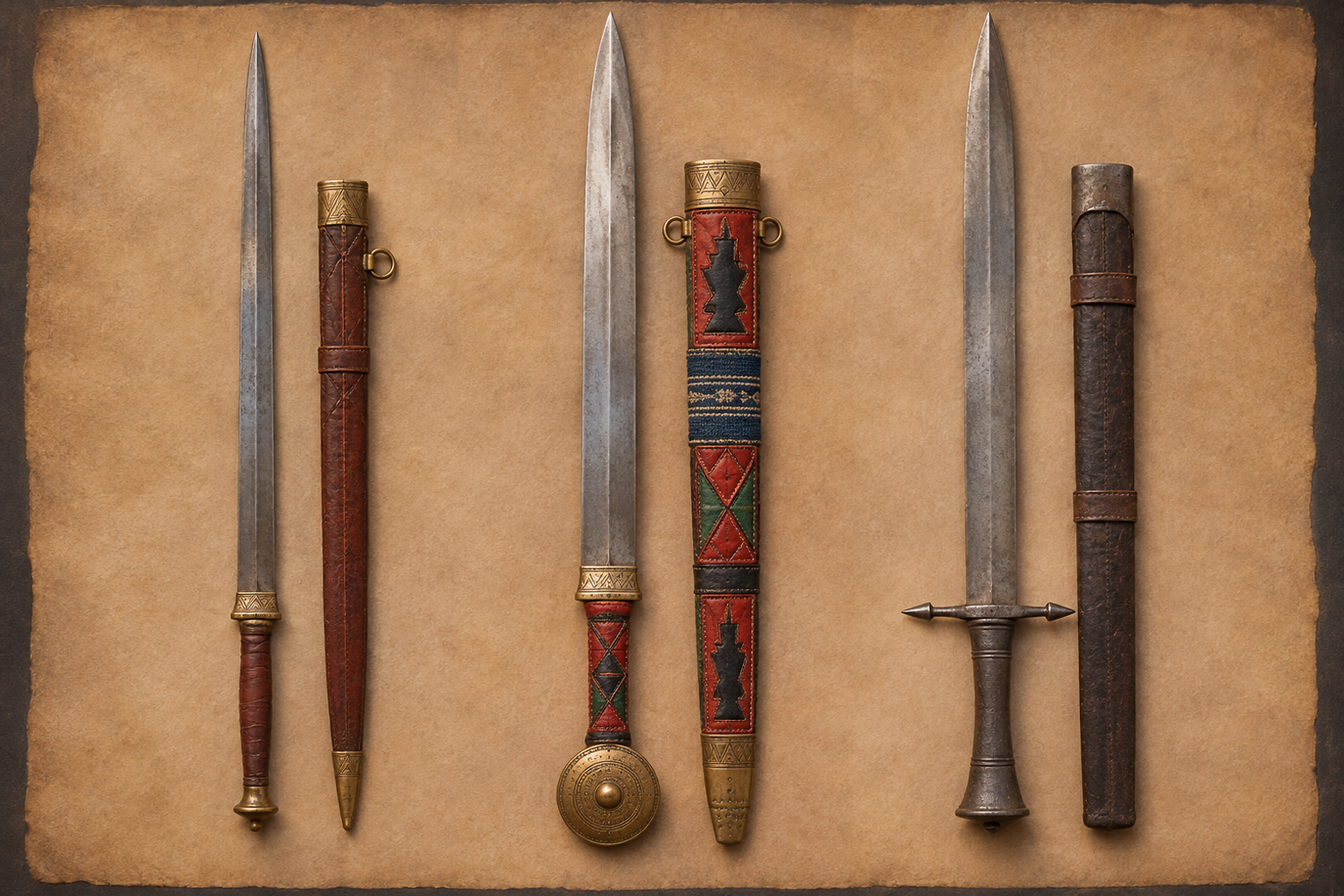
Although the takouba is most closely associated with Tuareg confederations, closely related straight broadswords circulated across a vast belt stretching from the Maghreb to the Lake Chad basin. Hausa, Fulani, Kanuri, and Songhai warriors in the Sahel adopted nearly identical swords, often purchasing blades and hilts from the same trans-Saharan trade networks and urban workshops in Kano, Katsina, and Agadez.
Subtle regional differences allow specialists to distinguish provenance among surviving examples. Northern takouba swords from the Ahaggar and Tassili n'Ajjer regions often feature leaner hilts, dark red or brown leatherwork, and restrained brass fittings. Examples from the Air massif and southern Niger frequently display bolder geometric leather appliques, wider pommels, and richer combinations of red, black, and green skin.
Farther east in Sudan and Chad, the kaskara represents a parallel tradition rather than a direct copy. While both swords descend from early medieval Islamic and Mediterranean straight broadswords and share imported European blades, the kaskara uses a bare iron cross-guard with pointed tips and a cylindrical grip flaring into a small pommel, lacking the takouba's signature leather-clad rectangular guard.
Martial Etiquette, Status, and Colonial Encounters
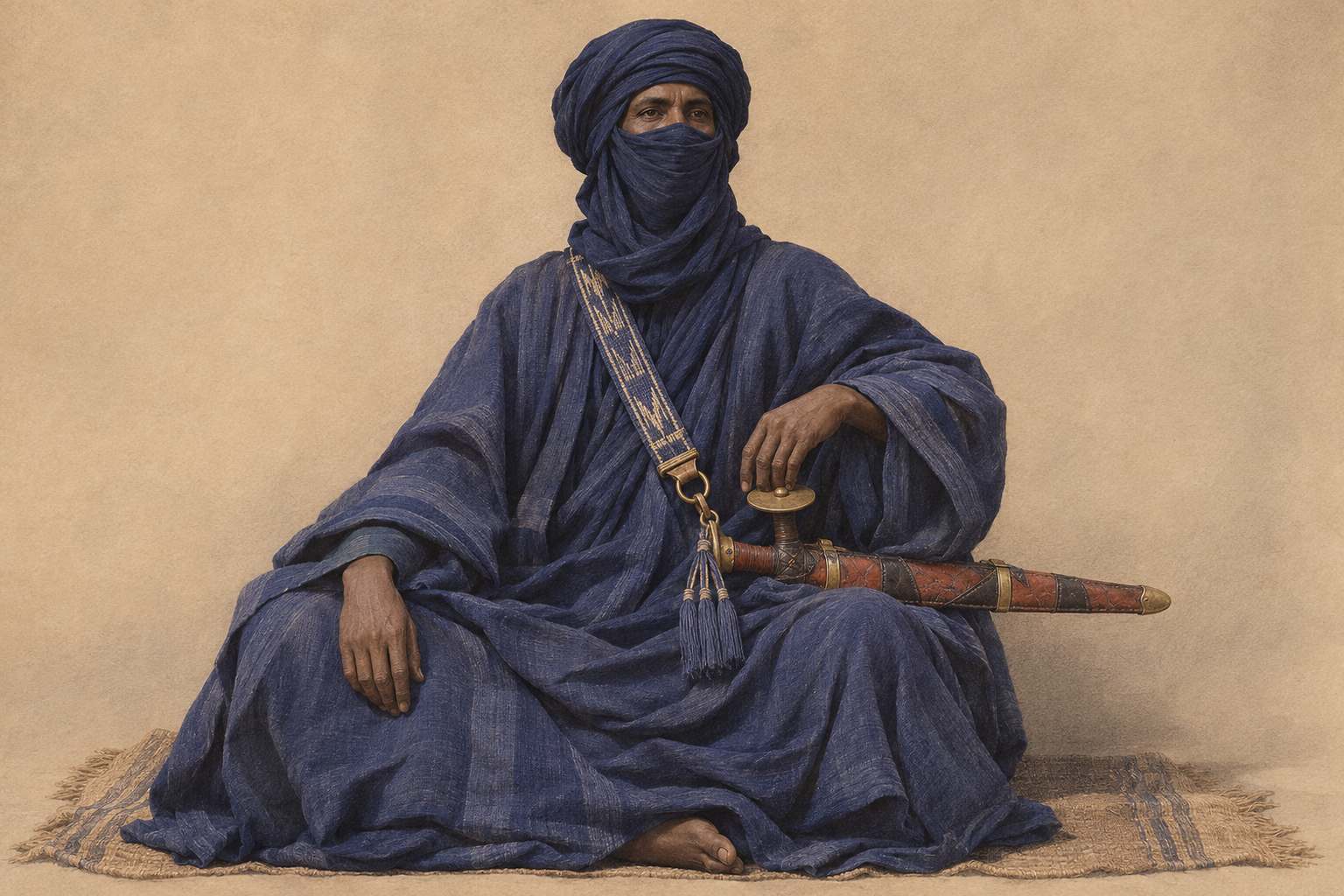
In pre-colonial Tuareg society, carrying a takouba signified adult male status, noble lineage, and adherence to a strict code of honor (asshak). Disputes between noble clans were governed by customary rules that emphasized composure, measured restraint, and individual prowess. Contemporary nineteenth-century travelers such as Heinrich Barth and Henri Duveyrier observed that Tuareg men rarely appeared in public without their swords, treating the weapon as an essential part of formal dress even during peaceful councils.
During the late nineteenth and early twentieth centuries, Tuareg forces confronted French colonial columns advancing across the Sahara and Sahel. In engagements such as the battle of Tit in 1902 and the Kaocen revolt of 1916–1917, warriors armed with takouba swords, lances, and hide shields faced magazine rifles and machine guns. Colonial officers recorded the shock effect of mounted charges at close quarters while noting the severe disadvantage of edged weapons against modern firearms.
Following French pacification, the takouba gradually transitioned from a primary battlefield sidearm to an emblem of cultural identity and ceremonial prestige. Throughout the twentieth century and into the present, Tuareg leaders, dancers, and participants in annual festivals such as the Cure Salée have continued to wear ancestral swords as visible links to their history.
Survival, Conservation, and Modern Collecting
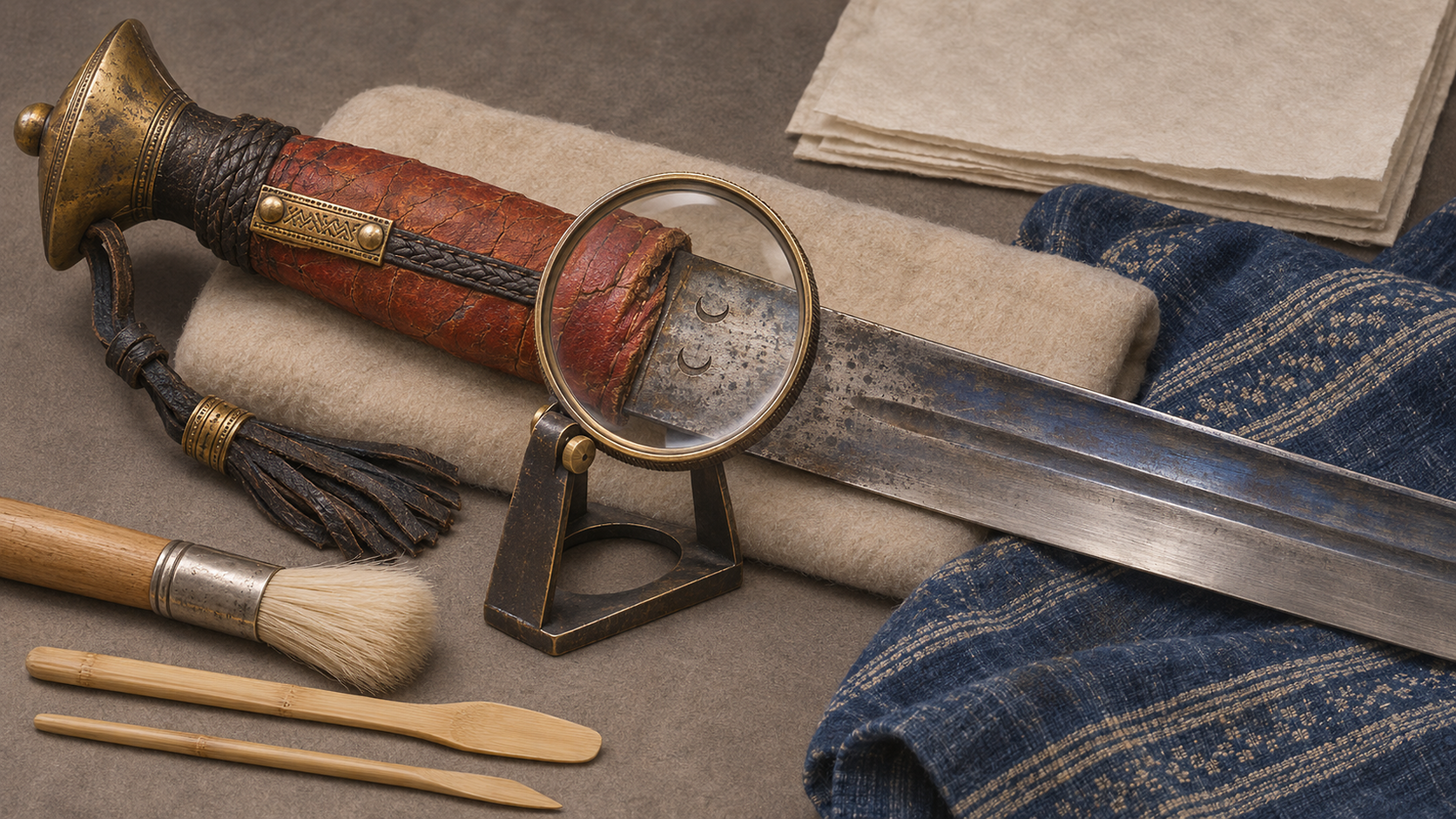
Museum collections in Europe, North America, and North Africa hold hundreds of takouba swords, yet relatively few survive in untouched early condition. Because leather dries, cracks, and suffers insect damage in arid climates, many older blades were repeatedly re-hilted before entering collections. When evaluating a museum piece, conservators routinely find a seventeenth- or eighteenth-century European blade paired with late nineteenth- or twentieth-century leatherwork.
Conserving a takouba requires balancing the needs of incompatible materials in close contact. Acidic vegetable-tanned leather and residual tanning salts can accelerate rusting along the iron cross-guard and tang, while aggressive mechanical cleaning of the steel can erase faint stamped marks or damage surrounding leather edges. Standard museum practice favors dry cleaning, stable low-humidity storage, and minimal intervention so historical repairs remain readable.
In the modern collector market and in historical video games, the takouba is occasionally mislabeled as a generic 'Saracen' or 'crusader' relic—a misconception rooted in nineteenth-century romantic speculation that medieval European swords survived unchanged in the desert. Typological and archival research has overturned that myth, documenting an African craft tradition that adapted imported European steel to local hilt forms, metallurgy, and martial practice.
Further reading
Follow the sources to examine the object and its historical context.
Bibliographic references are being reviewed by the editors.