In the surviving armories of Venice, Mantua, and Florence, tall single-edged polearms rest beside partisan halberds and parade shields, their broad curved blades etched with scrolling foliage and civic crests. Modern English curators and collectors often group these weapons under the name Italian fauchard, borrowing a medieval French term for a long-hafted cutting blade to describe a distinct family of Renaissance staff arms. Beneath the gilt etching and velvet-wrapped shafts lies a practical iron architecture shaped by northern Italian urban militias, rural billhooks, and the visual demands of princely bodyguards.
The Problem of Naming an Italian Polearm
Walking through an arms gallery in Turin or Vienna, a visitor encounters long-shafted blades labeled variously as fauchard, glaive, falcione, or roncone. These names reflect two different traditions of classification. Modern English-speaking curators adopted the Old French word fauchard, originally linked to scythe-like war blades of the thirteenth century, to categorize single-edged European polearms with pronounced curvature and rear projections.
Contemporary Italian clerks and armorers rarely used a single standardized term. Sixteenth-century arsenal inventories from Venice and the Medici court in Florence describe similar weapons as falcioni inastati, ronconi, or spiedi da taglio, grouping them by blade profile or civic contract rather than modern typological charts. Because workshop patterns blended curved cutting edges with thrusting tips and rear hooks, a single surviving head can sit awkwardly across modern museum categories.
Recognizing this vocabulary gap clarifies how the weapon developed. Rather than descending from one rigid blueprint, the Italian fauchard represents a regional family of staff weapons united by a heavy single-edged cutting blade mounted axially on a long wooden pole, adapted over three centuries from militia field gear to courtly regalia.
Agricultural Roots and the Scythe Lineage
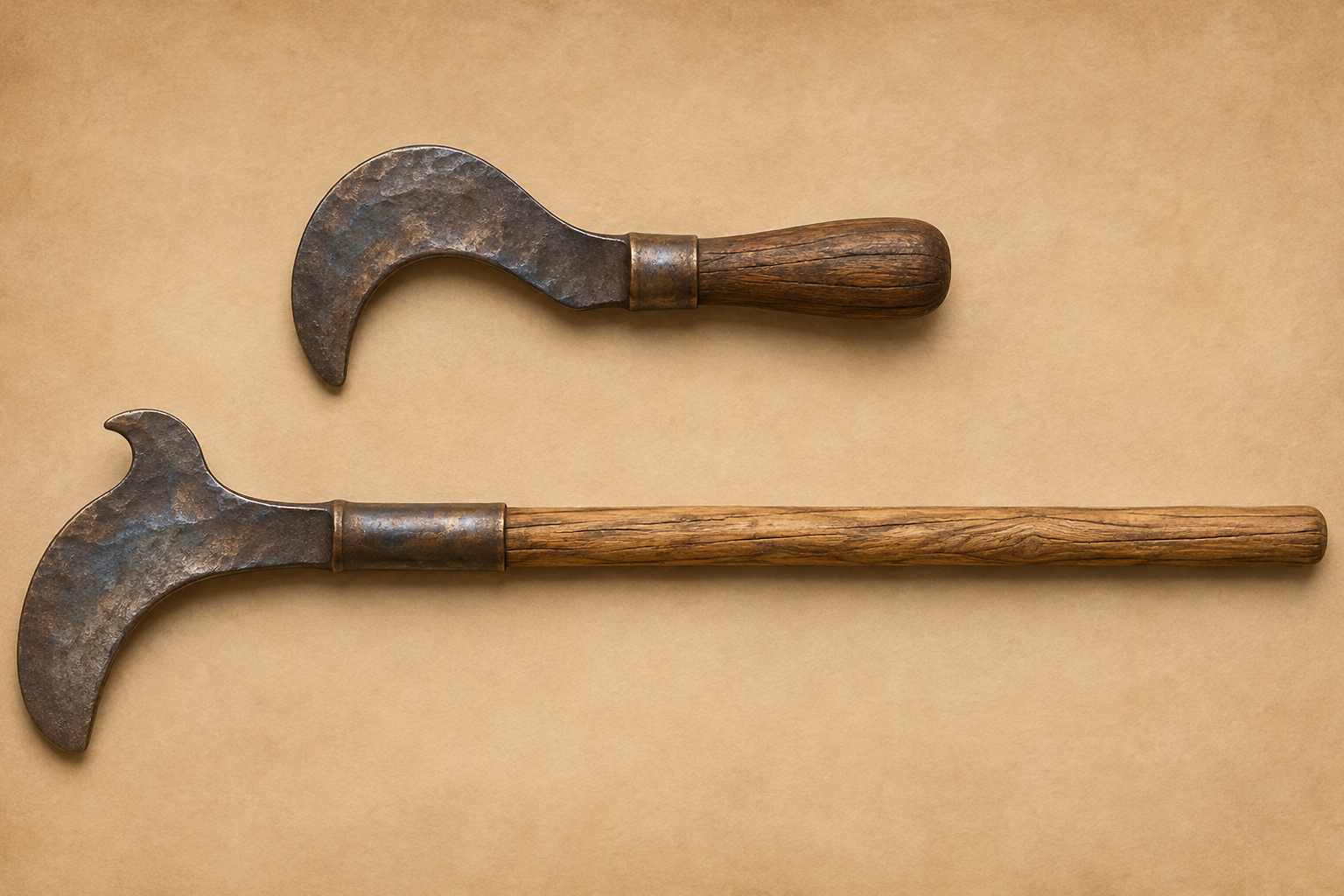
The basic mechanics of the fauchard emerged from rural tools familiar across the Po Valley and the Apennine foothills. Peasants pruning vines, clearing brush, and harvesting grain relied on curved iron blades set on wooden handles, such as the roncola and the falce. These implements concentrated the user's swing along a sweeping edge, severing woody stems with minimal effort.
When Italian communes mobilized urban and rural levies during the thirteenth and fourteenth centuries, blacksmiths adapted familiar agricultural forms for military service. Straightening the curve of a pruning hook and lengthening its socket allowed a foot soldier to strike from beyond sword reach. Unlike a standard farming scythe, whose blade sits at a right angle to the snath for mowing low grass, a martial fauchard aligned its blade lengthwise with the shaft.
This axial mounting transformed a harvesting tool into an offensive infantry weapon. A warrior could now deliver downward cleaving blows, sweep at the legs of advancing horses, or use the back of the blade to deflect a lance thrust while keeping both hands spaced along the haft.
Blade Geometry and the Cutting Edge
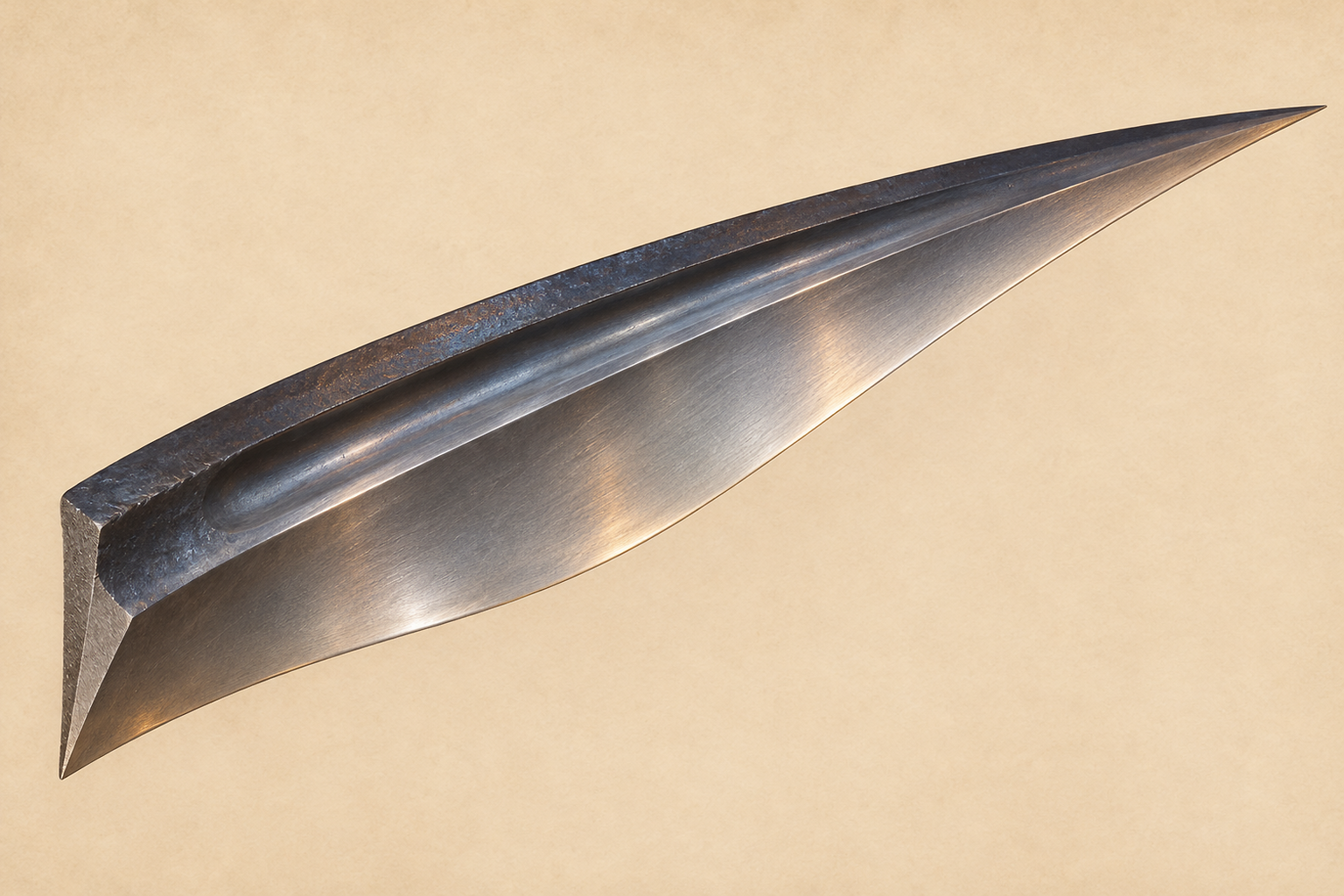
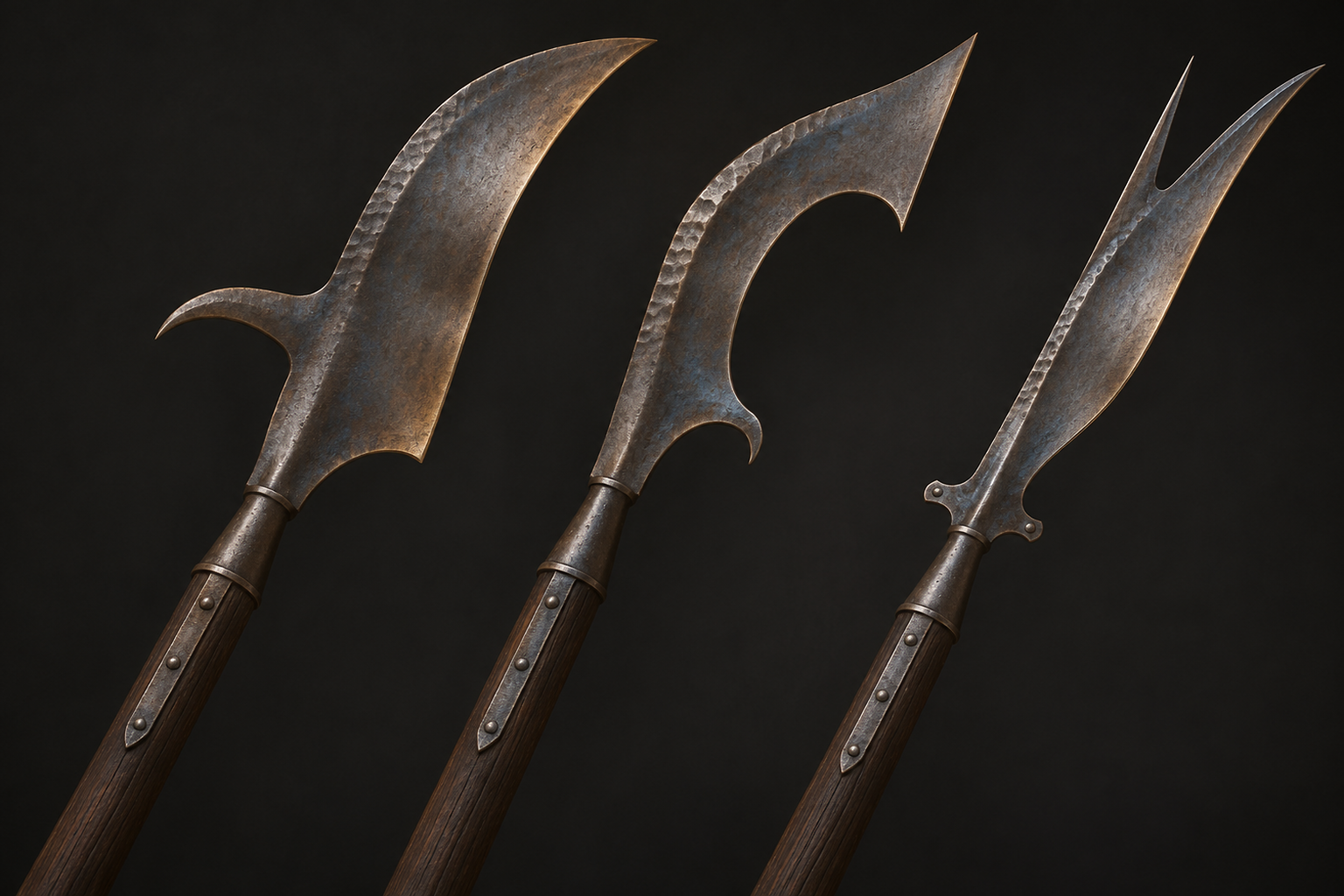
Surviving Italian fauchard heads display deliberate choices in curvature and cross-section that separate them from straight-bladed spears or axes. Many early and transitional examples feature a broad, slightly convex cutting edge that tapers toward an acute point, allowing the bearer to transition smoothly from a slashing cut to an inline thrust. Other variants invert this geometry, placing the primary sharpened bevel along a concave inner curve reminiscent of a large billhook.
In cross-section, most blades exhibit a sturdy triangular or wedge profile, thick along the spine to resist bending upon impact with mail or plate edges. Smiths frequently forged shallow fullers or raised medial ridges along the flat of the blade. These features reduced overall mass at the end of a two-meter lever without sacrificing stiffness during a hard parry.
The balance between blade length and weight demanded careful proportioning. If the iron head grew too heavy, the weapon became sluggish in recovery; if too thin, the edge risked rolling against iron helmets or wooden shields.
Dorsal Spikes, Flukes, and Basal Lugs
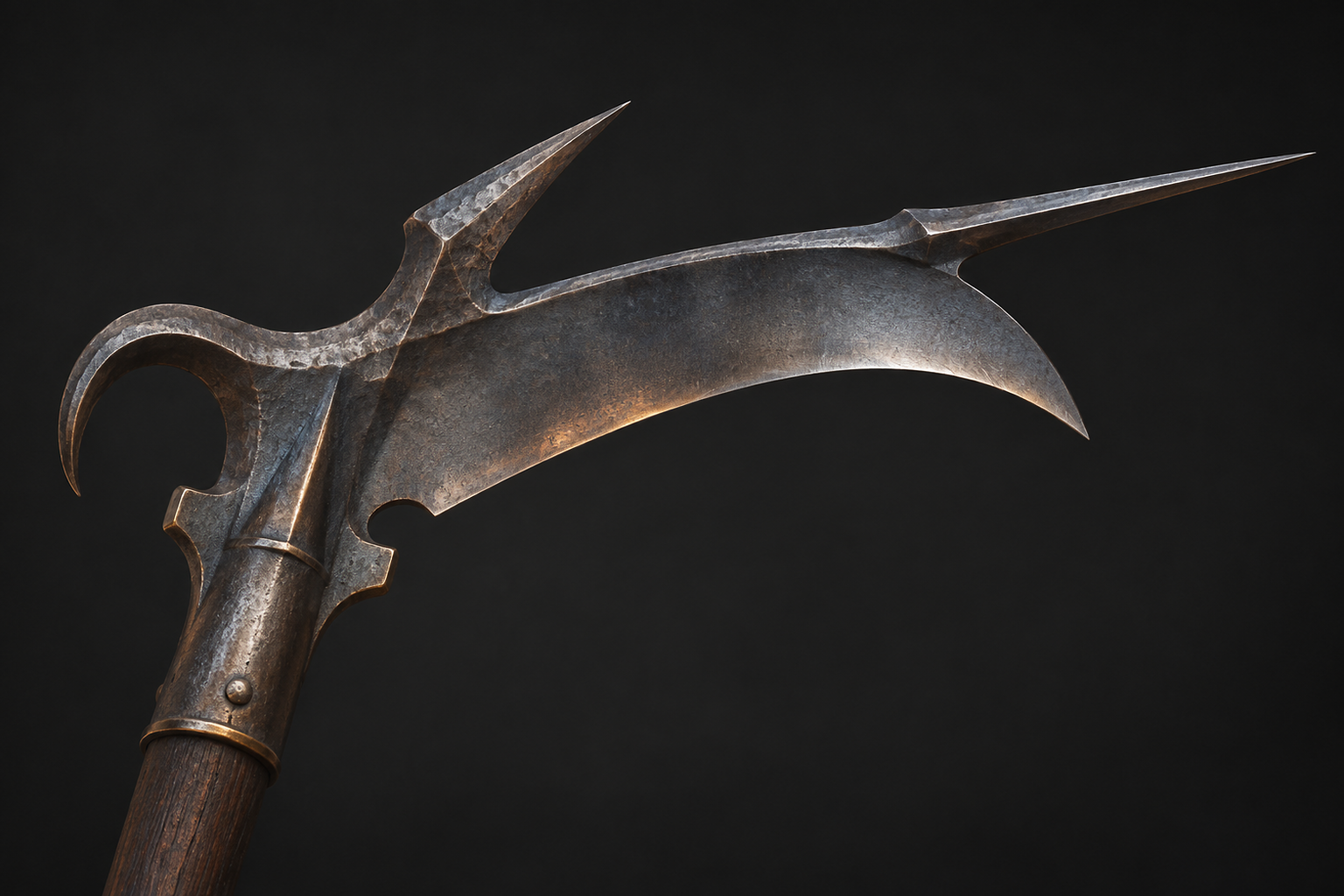
A defining feature of the mature Italian fauchard is the array of secondary projections forged along its spine and base. Plain single-edged blades could cut effectively, yet they struggled to control an opponent's weapon or penetrate articulated plate armor. Italian smiths addressed both limitations by adding auxiliary hooks, spikes, and lugs directly to the blade forging.
These additions served distinct tactical roles in close-order infantry combat:
Secondary iron projections on Italian fauchard heads performed specific mechanical functions:
- A sharp dorsal fluke angled toward the tip acted as a concentrated armor-piercing pick when swung with the back of the blade.
- A downward-curving rear hook allowed a foot soldier to snag a cavalryman's reins, stirrup, or mail skirt and unbalance the rider.
- Symmetrical or asymmetrical basal lugs projecting near the socket acted as physical stops to catch sliding blades before they reached the user's hands.
- An elongated terminal spike converted a broad cleaving head into a capable thrusting weapon for tight infantry formations.
Socket Construction and Langets
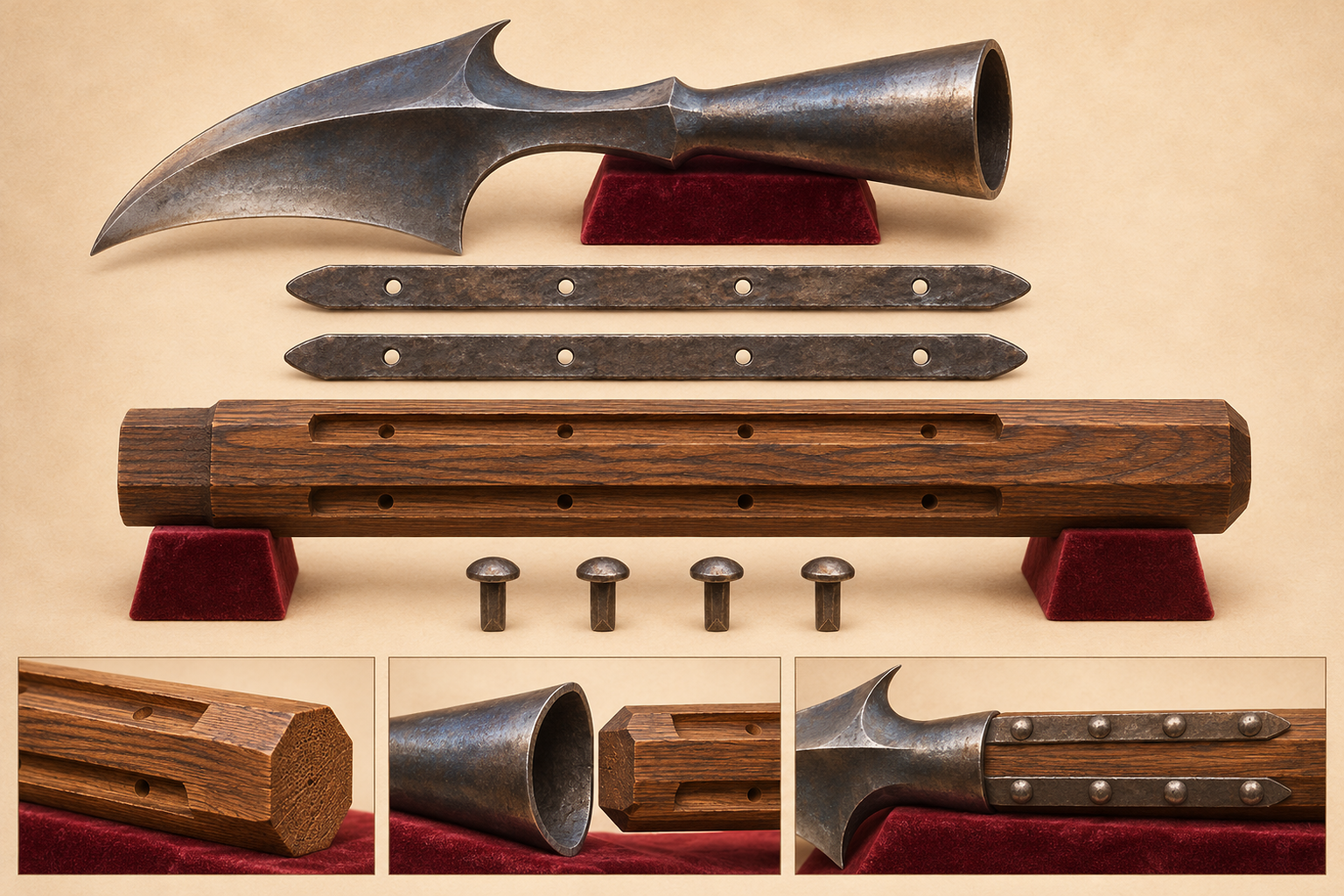
Securing a heavy cutting head to a wooden shaft posed a persistent engineering challenge. Every sweeping blow placed intense lateral stress on the joint where iron met wood, threatening to split the shaft or wrench the head loose in battle. Italian makers solved this problem through deep conical sockets reinforced by long iron straps known as langets.
Forged integrally with the socket or fire-welded to its lower rim, two or four langets extended downward along opposite faces of the wooden haft. Smiths countersunk these strips flush into shallow channels carved into the timber and fastened them with transverse iron rivets. Beyond anchoring the head against rotational torque, langets shielded the upper section of the shaft from being severed by an enemy's sword or polearm.
For the shaft itself, workshops favored tough, straight-grained hardwoods such as ash, hornbeam, or cornel wood. Many surviving examples retain octagonal or faceted cross-sections rather than simple round poles, giving the wielder an immediate tactile index of edge alignment without looking away from an opponent.
Northern Italian Ironworking and Guild Practice
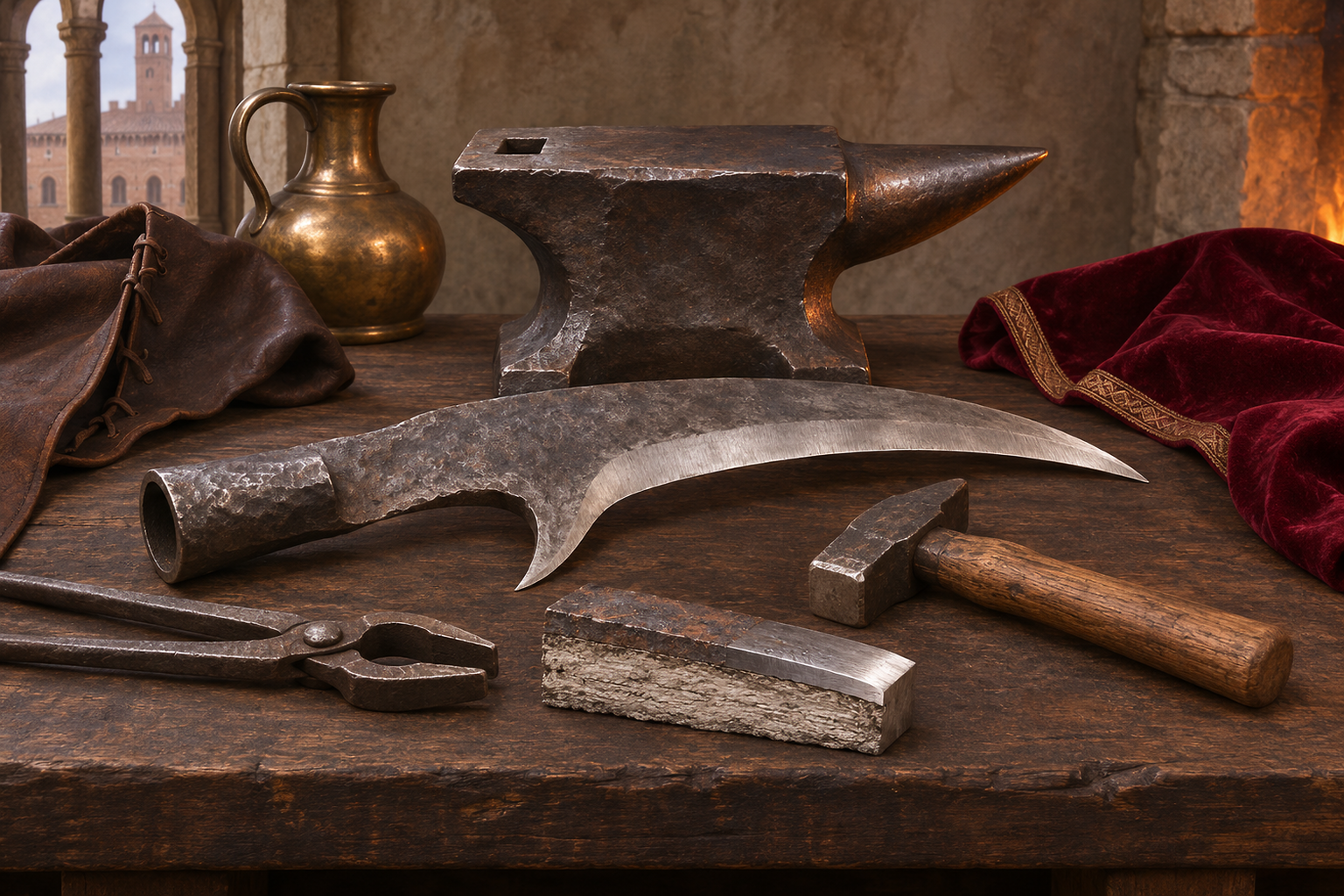
The production of fauchards relied on the specialized metallurgical networks of northern Italy, particularly in Lombardy and the Venetian hinterland. Cities such as Brescia and Milan operated water-powered trip hammers that drew out iron blooms into uniform bars, supplying urban blade-smiths with consistent stock. Within the guilds, heavy polearm heads were typically forged by spadai or specialized tool-and-weapon smiths rather than the master armorers who shaped articulated harnesses.
Constructing a complex fauchard head required controlled forge welding. A smith often began with a core of tough, low-carbon wrought iron to absorb shock, then welded a strip of higher-carbon steel along the intended cutting edge and into the tip of the dorsal spike. Careful heating and quenching hardened the edge while leaving the body and socket ductile enough to bend rather than snap under sudden impact.
Civic contracts from Venice and Bologna show that states ordered these polearms in batches of hundreds to stock public arsenals. Standardization remained practical rather than absolute; pieces from the same municipal order share general silhouettes and socket dimensions while showing subtle hand-forged variations in bevel angle and fluke placement.
Civic Militias and Infantry Tactics
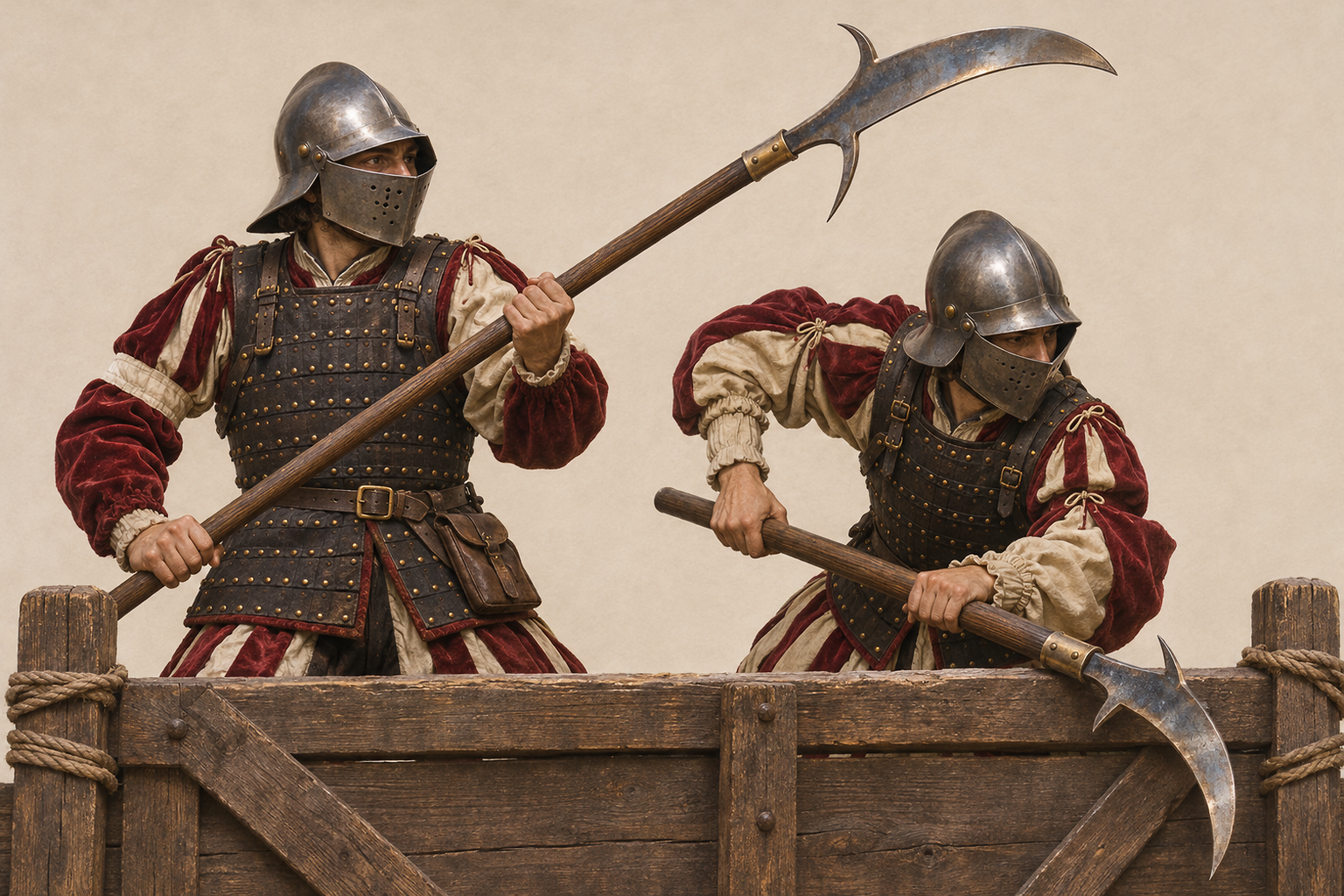
During the fourteenth and fifteenth centuries, single-edged polearms equipped the municipal militias and contracted infantry companies that defended Italian city-states. On battlefields dominated by heavily armored men-at-arms and crossbowmen, polearm bearers formed protective ranks around missile troops or guarded narrow urban streets, bridgeheads, and breach points.
In open formation, a warrior gripped the shaft with hands roughly shoulder-width apart, using the fauchard's reach to strike at exposed limbs, horse legs, and the gaps beneath a rider's pauldron or visor. When pressed by cavalry, the rear hook and dorsal spike offered leverage to pull a horseman off balance or lock onto a lance shaft. In street fighting and siege defense, the weapon's single-edged profile proved well suited to tight spaces where wide swinging arcs were restricted, allowing downward chops and short thrusts over barricades.
Contemporary chronicles from northern Italy frequently mention foot soldiers armed with ronconi and falcioni holding bridges or escorting supply trains, underscoring their role as reliable, versatile infantry tools rather than rare specialist weapons.
Evidence from Renaissance Painting and Frescoes
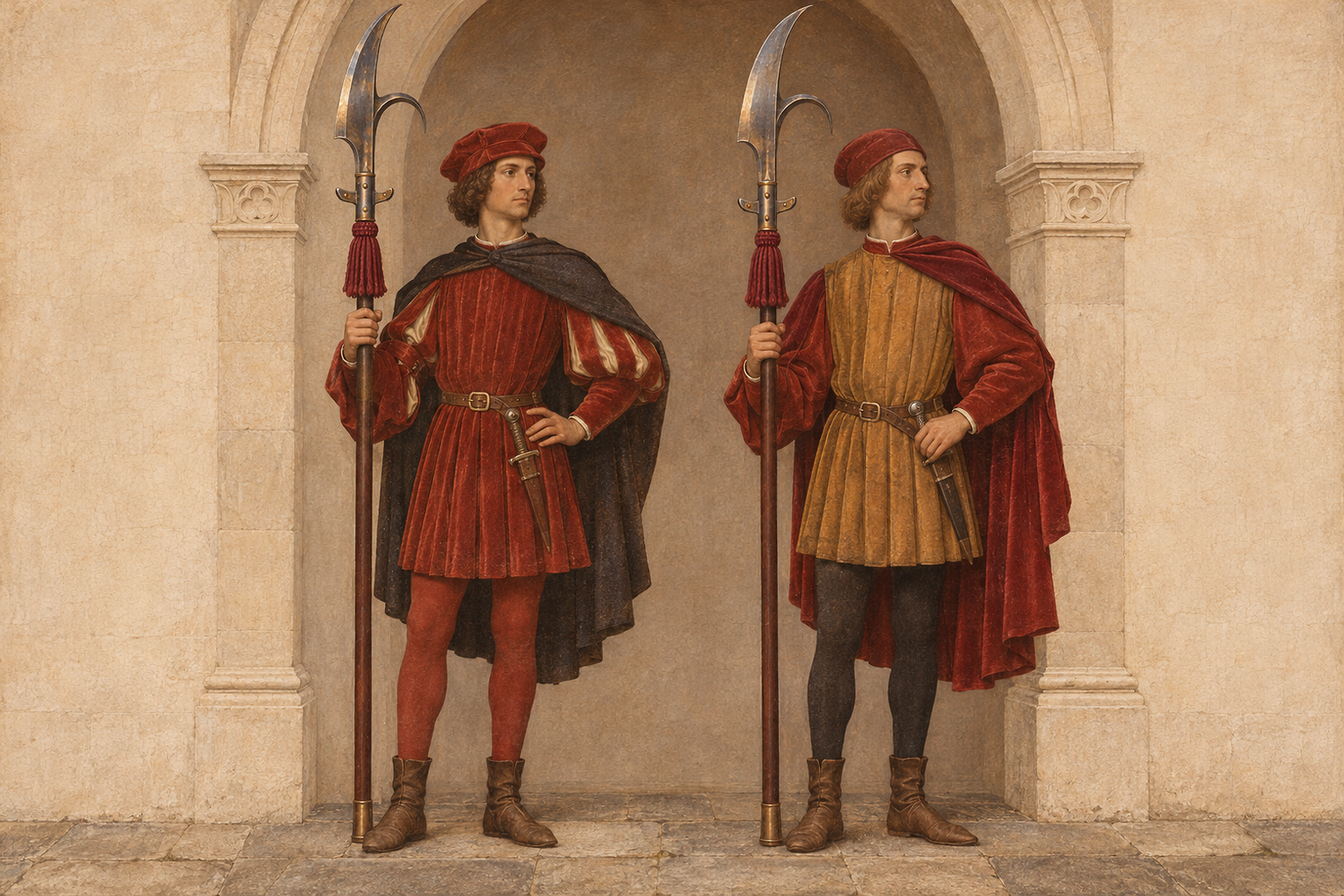
Visual depictions in fourteenth- and fifteenth-century Italian art provide crucial evidence for how these polearms were carried and used, though they require cautious interpretation. Frescoes depicting the Passion of Christ, civic justice scenes, and contemporary battle narratives frequently place curved, hooked polearms in the hands of guards and soldiers. Artists such as Spinello Aretino, Piero della Francesca, and Vittore Carpaccio painted identifiable single-edged staff weapons with prominent rear hooks and basal lugs.
Painters working in Florence, Siena, and Venice often modeled biblical soldiers on the local town watch or ducal guards they saw daily in the streets. As a result, their paintings preserve accurate details of shaft length, tassel placement, and how guards rested the butt of the weapon on the ground during civic assemblies.
At the same time, Renaissance artists sometimes exaggerated blade curves or multiplied ornamental spikes to signify foreignness or cruelty in narrative scenes. Comparing painted forms against surviving arsenal pieces allows historians to separate realistic workshop patterns from artistic invention.
Transition to Princely Guard Regalia
By the early sixteenth century, changes in European warfare steadily pushed the cutting fauchard off the primary battlefield. Massed pike squares, matchlock arquebuses, and field artillery left diminishing room for medium-length chopping polearms in major field engagements. Yet as its tactical utility declined, the weapon found an enduring second life in the courts of Renaissance Italy.
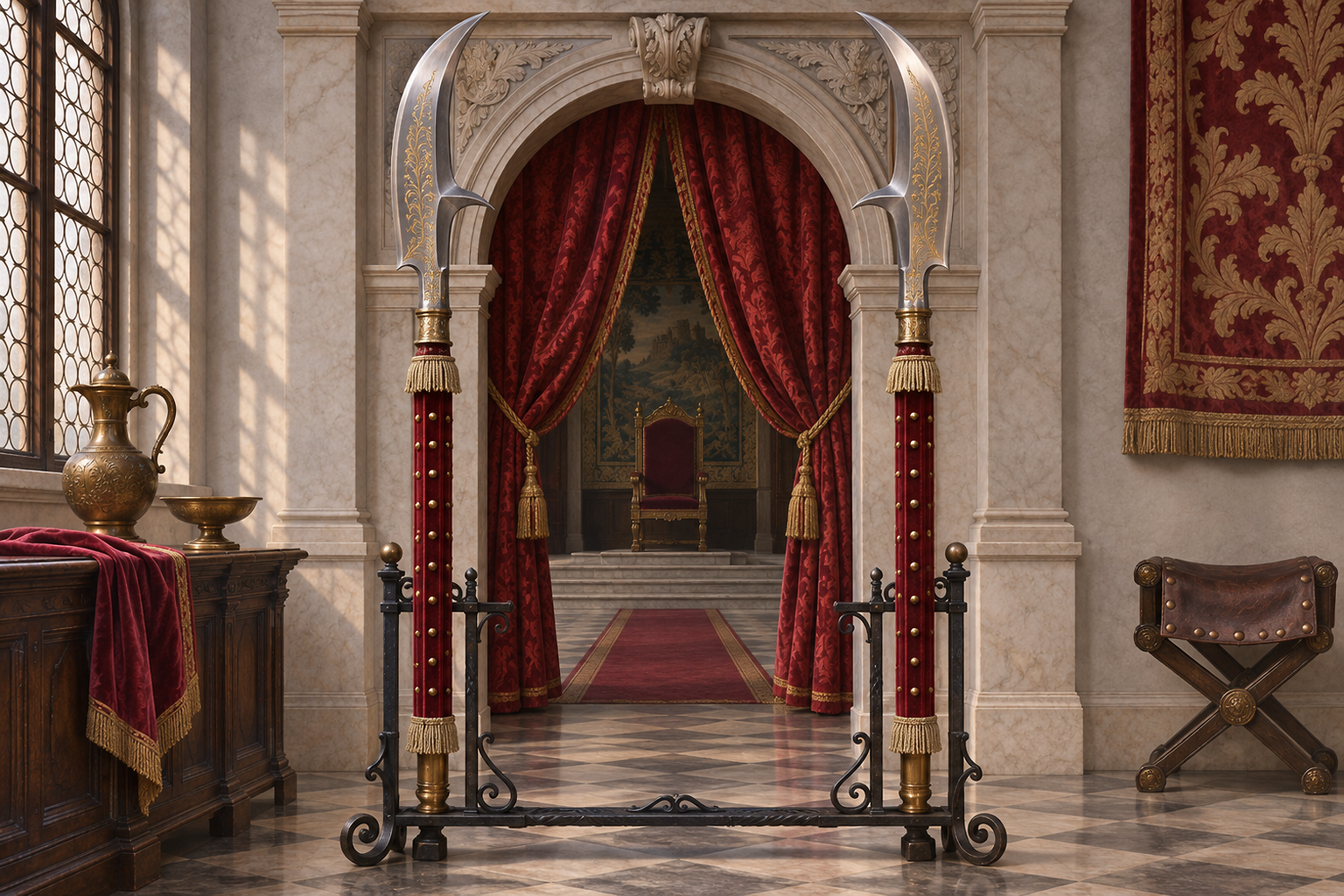
Princes, cardinals, and civic councils needed imposing, recognizable arms for their personal bodyguards and palace sentries. With its broad, flat blade faces and dramatic silhouette, the Italian fauchard offered an ideal canvas for decorative display. Guard units in Venice, Mantua, Parma, and Rome carried ornate versions during diplomatic receptions, religious processions, and courtroom proceedings.
In these ceremonial roles, the weapon communicated sovereign authority and historical continuity. A row of tall, gleaming blades flanking a throne room or cathedral doorway signaled that the ruler commanded both ancient civic tradition and immediate armed protection.
Acid Etching, Gilding, and Heraldic Decoration
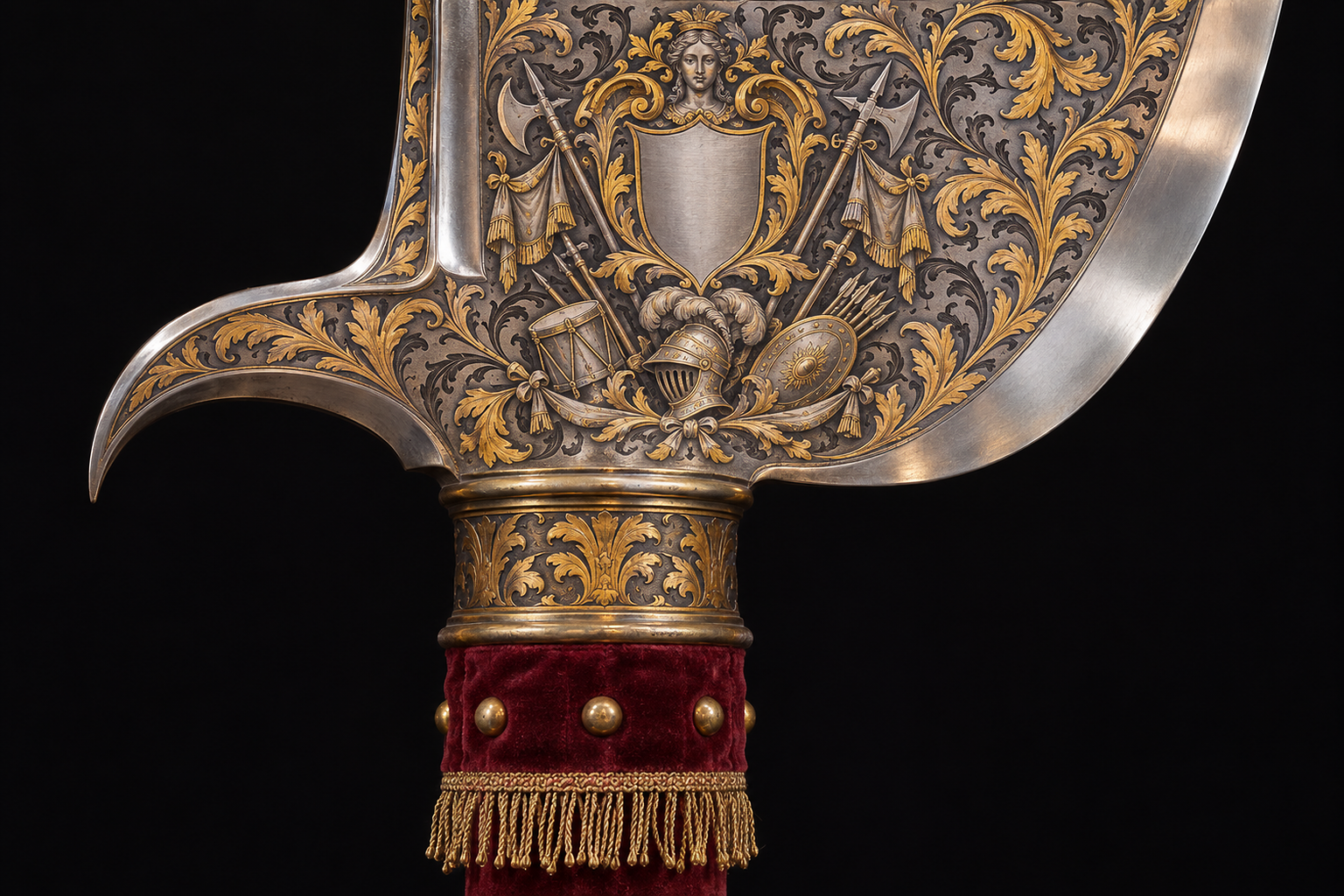
To transform a functional iron blade into court regalia, northern Italian workshops applied sophisticated surface decoration techniques. During the sixteenth and seventeenth centuries, decorators coated polished steel blades with an acid-resistant ground, scratched intricate designs through the wax with fine needles, and submerged the metal in vinegar-based acid baths to bite the pattern into the surface.
The resulting recessed motifs were frequently darkened with black pigment or inlaid with gold leaf through fire-gilding, creating high visual contrast against bright burnished steel. Common decorative themes included classical trophies of arms, scrolling acanthus leaves, mythological figures, and the personal emblems or coats of arms of the patron. Many surviving Venetian and Medici guard fauchards bear ducal crowns, heraldic shields, or mottoes prominently across the lower third of the blade.
Ornamentation extended down the shaft as well. Ceremonial hafts were covered in crimson, green, or blue silk velvet, secured by rows of gilt-brass dome-headed nails and crowned just below the socket with thick fringes of metallic thread.
What Survives in Modern Museums
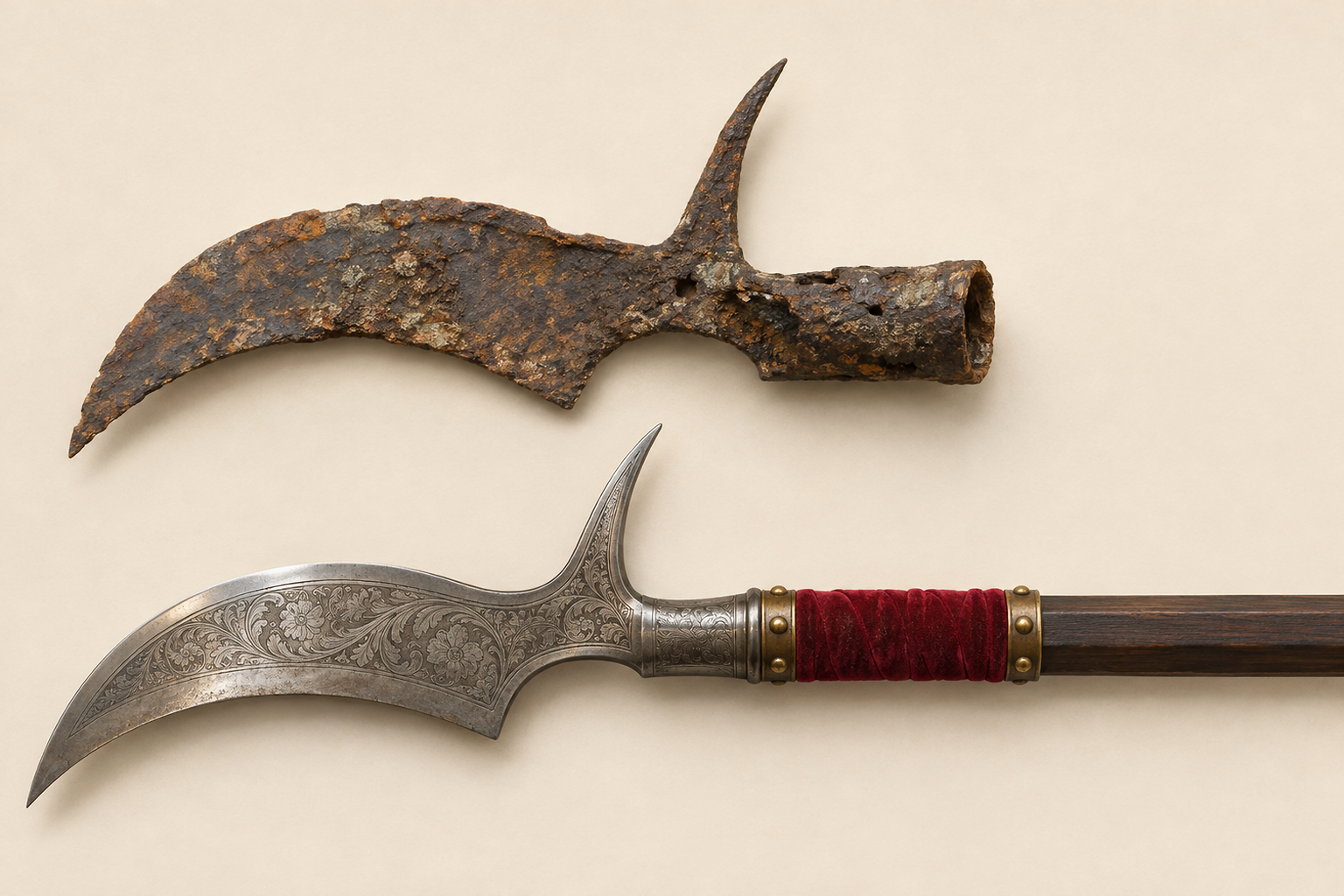
The surviving corpus of Italian fauchards preserved in public and private collections reflects a strong historical bias toward ceremonial prestige pieces. Munitions-grade blades issued to ordinary town watchmen were heavily used, repaired, melted down, or discarded once obsolete. By contrast, gilded and etched palace guard weapons were carefully stored in ducal armories and later transferred into state museums.
Major collections in Venice at the Palazzo Ducale, in Florence at the Museo Stibbert and Bargello, in Vienna at the Hofjagd- und Rüstkammer, and in New York at the Metropolitan Museum of Art hold well-preserved sixteenth- and seventeenth-century examples. Many of these pieces retain original velvet coverings, decorative nail patterns, and etched heraldry that allow curators to trace them to specific noble households or civic guard companies.
Genuine fourteenth- and fifteenth-century fighting examples are far rarer, often surviving as excavated river finds or heavily corroded heads stripped of their original wooden shafts and surface finish.
Conservation Challenges and Composite Restorations
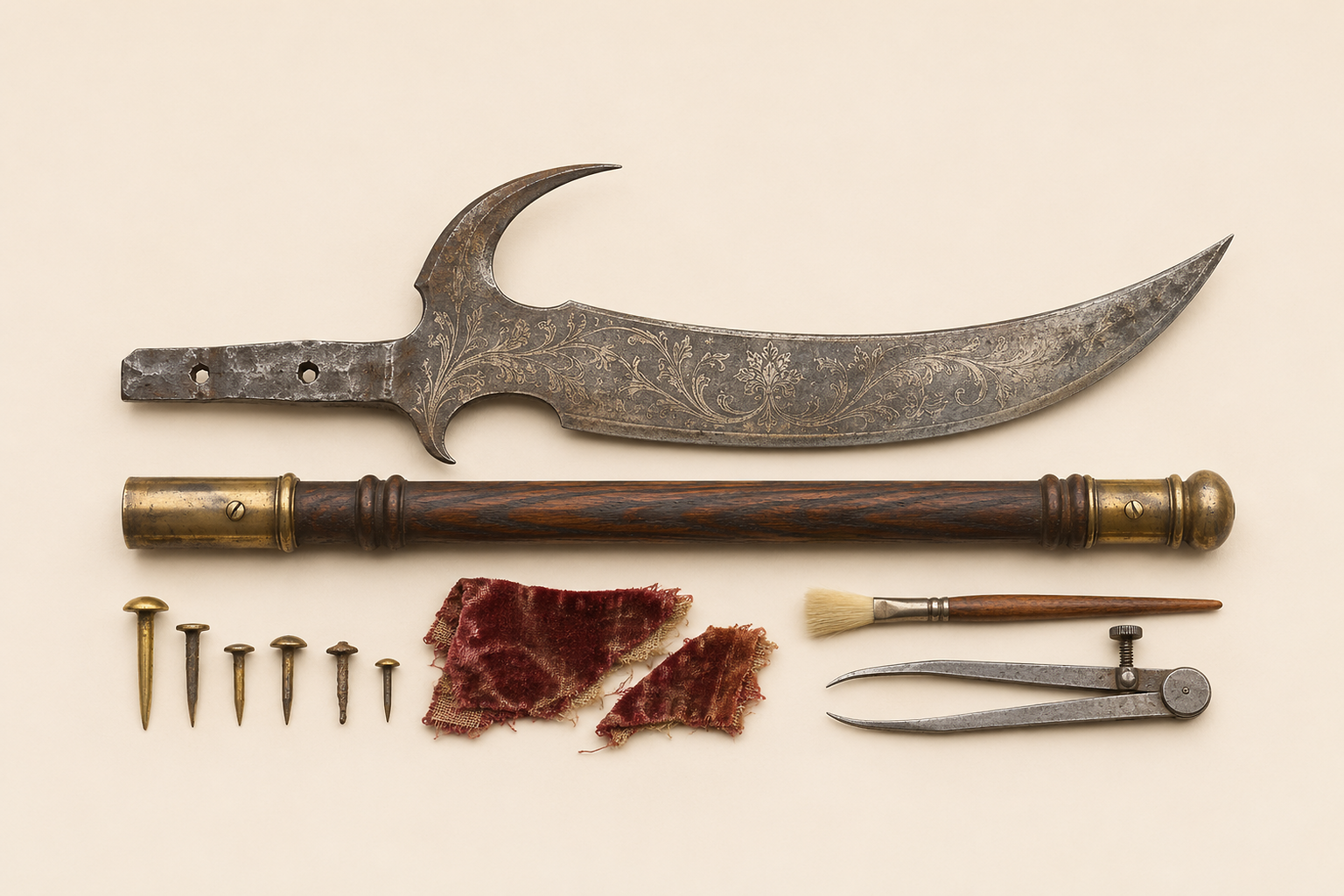
Caring for surviving Italian fauchards presents delicate conservation problems because each object combines reactive metals with fragile organic materials. Iron blades stored in humid armories suffered pitting and rust, while nineteenth-century collectors often over-cleaned surfaces with abrasives, blurring delicate acid-etched lines and wearing away thin layers of fire-gilding.
Wooden shafts, silk velvet, and metallic fringe deteriorate at different rates from steel. Exposure to light fades crimson velvet to pale brown, while dry air splits centuries-old ash wood beneath iron langets. Furthermore, nineteenth-century antiquarians and dealers frequently assembled composite weapons by pairing authentic Renaissance blades with newly turned shafts, replacement nails, or mismatched tassels to satisfy the market for Gothic and Renaissance interior decor.
Modern museum conservators rely on metallurgical examination, wood species analysis, and stylistic comparison of rivet heads to distinguish untouched court pieces from Victorian assemblies, stabilizing active corrosion without erasing historical wear.
Modern Replicas, HEMA Practice, and Digital Depictions
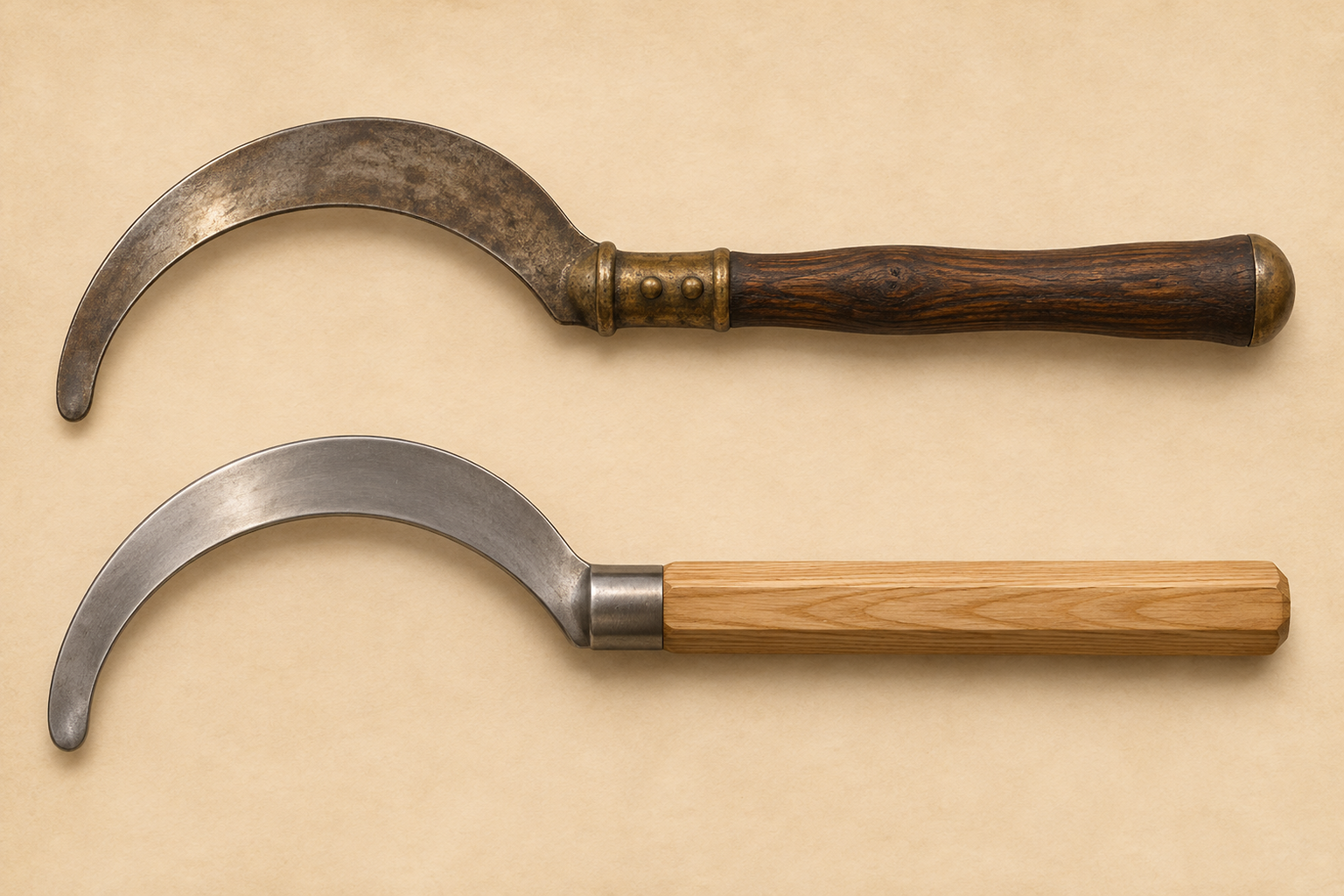
In the twenty-first century, the Italian fauchard reaches new audiences through historical European martial arts, living history reenactment, and historical video games. Because surviving sixteenth-century Italian fencing treatises by authors such as Achille Marozzo and Giacomo di Grassi focus primarily on the partisan, spetum, and halberd, modern practitioners reconstruct fauchard techniques by adapting general Italian polearm principles to the weapon's curved edge and rear hook.
For safe sparring, HEMA makers produce blunt steel or flexible polymer simulators that mimic the weight distribution and length of historical examples without sharp edges or rigid points. Meanwhile, historical games and tabletop miniatures often depict fauchards with oversized, exaggerated crescent blades or heavy fantasy spikes that prioritize dramatic silhouettes over historical balance.
Examining the surviving artifacts alongside guild records and Renaissance paintings restores the real weapon's proportions. Far from an unwieldy fantasy cleaver, the historical Italian fauchard was a carefully balanced tool of iron and hardwood, shaped first by the practical needs of Italian foot soldiers and preserved through the artistry of Renaissance court armorers.
Further reading
Follow the sources to examine the object and its historical context.
Bibliographic references are being reviewed by the editors.