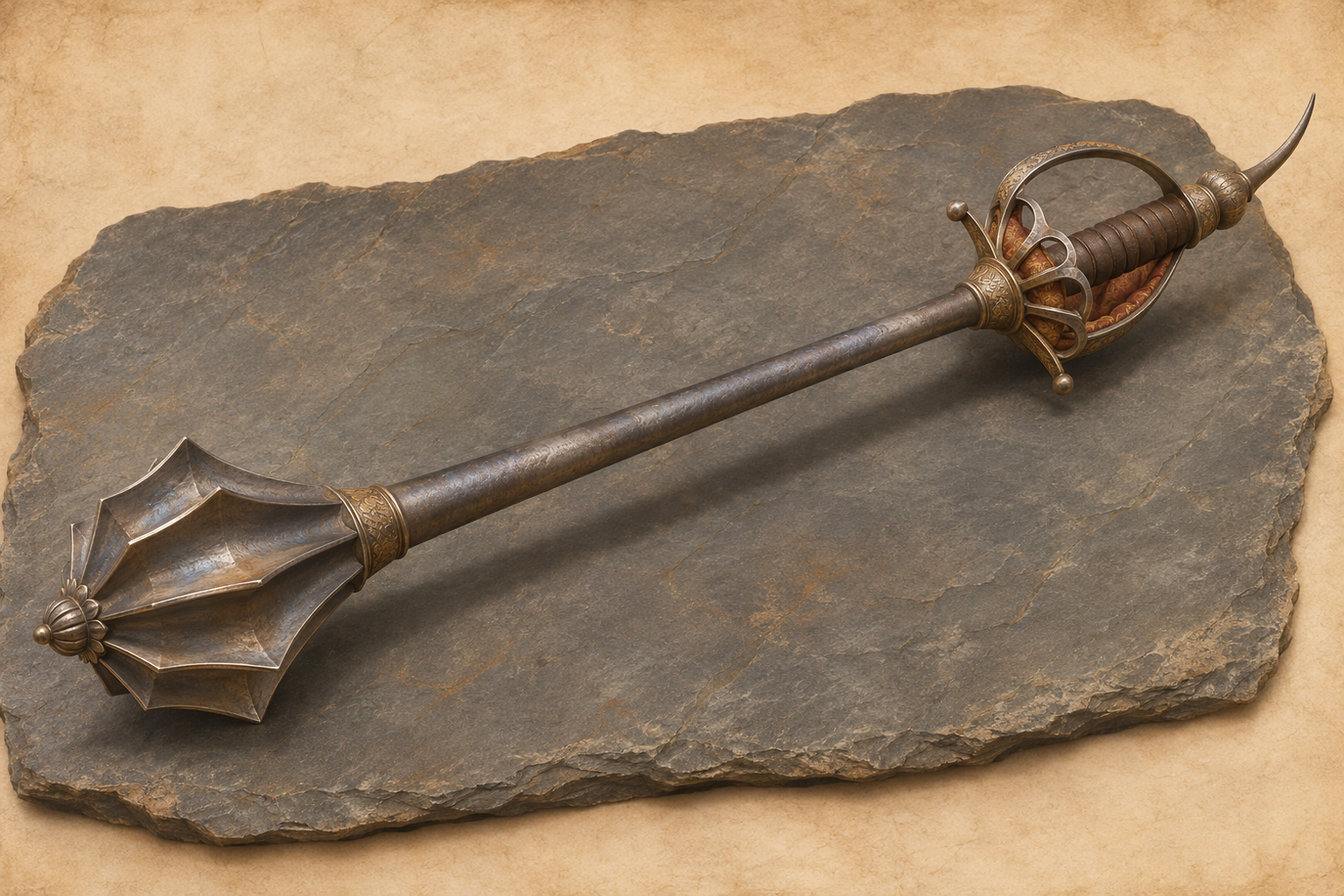
Mounted warfare across northern and central India during the sixteenth and seventeenth centuries demanded weapons capable of defeating layered defenses. As cavalrymen clad themselves in mail reinforced with steel plates, thick padded coats, and rigid domed helmets, cutting blades frequently glanced away without inflicting disabling trauma. The shishpar—etymologically a 'six-winged' mace, though executed with six, eight, or more radiating fins—offered a mechanical solution. Built with a solid or hollow iron shaft, an array of reinforced flanges, and frequently fitted with an enclosed basket hilt, this arm concentrated the momentum of a mounted swing into a narrow steel perimeter designed to crack plate and break bones beneath flexible armor.
The Geometry of the Flanged Head
The distinguishing feature of the shishpar is its clustered head of protruding fins. Rather than striking with a uniform spherical mass like an earlier ball mace, the flanged mace isolates the entire weight of its steel head onto the narrow leading edge of whichever fin makes contact. Because the wings project radially outward from the central shaft, the weapon requires no rotational orientation before a strike; an equestrian combatant can swing along any arc and reliably deliver an edge-first impact.
Surviving artifacts show flanges profiled in diverse silhouettes. Some taper downward in clean triangular wedges, while others expand outward into stepped, scalloped, or undulating profiles reminiscent of opening lotus petals. This floral contouring was not purely ornamental. By concentrating thickness along the perimeter of the flange and thinning slightly toward the interior, the smiths maintained structural rigidity along the impact axis while keeping the total weight manageable for sustained combat from the saddle.
The radial geometry also reduced the likelihood of the head glancing off angled iron surfaces. When striking the rounded bowl of a top helmet, a spherical mace could slide along the curve, deflecting energy into the air. The sharply defined shoulder of a shishpar flange engaged the curve directly, biting into the steel sheet or catching seams and rivets to transfer kinetic force directly into the wearer's skull.
Materials and Forge Construction
Constructing a durable flanged mace head required careful metallurgical choices. While the cutting edges of contemporary swords relied on high-carbon crucible steel to maintain razor sharpness, an impact weapon needed superior toughness to survive violent shocks against hardened defenses without shattering. Mughal armories consequently utilized forged wrought iron or medium-carbon steel for the core and flanges, occasionally carburizing the striking perimeters.
The joinery of the head determined whether the flanges could endure repeated impact without separating from the core. Armorers tailored their construction methods to available shop facilities, balancing manufacturing speed against structural resilience under violent shear stress.
Surviving arms reveal that hollow shafts were favored for high-status cavalry arms, balancing the heavy head assembly without making the weapon excessively tip-heavy. A solid shaft added punishing mass, but repeated shockwaves could travel into the rider's forearm, causing fatigue or tendon strain.
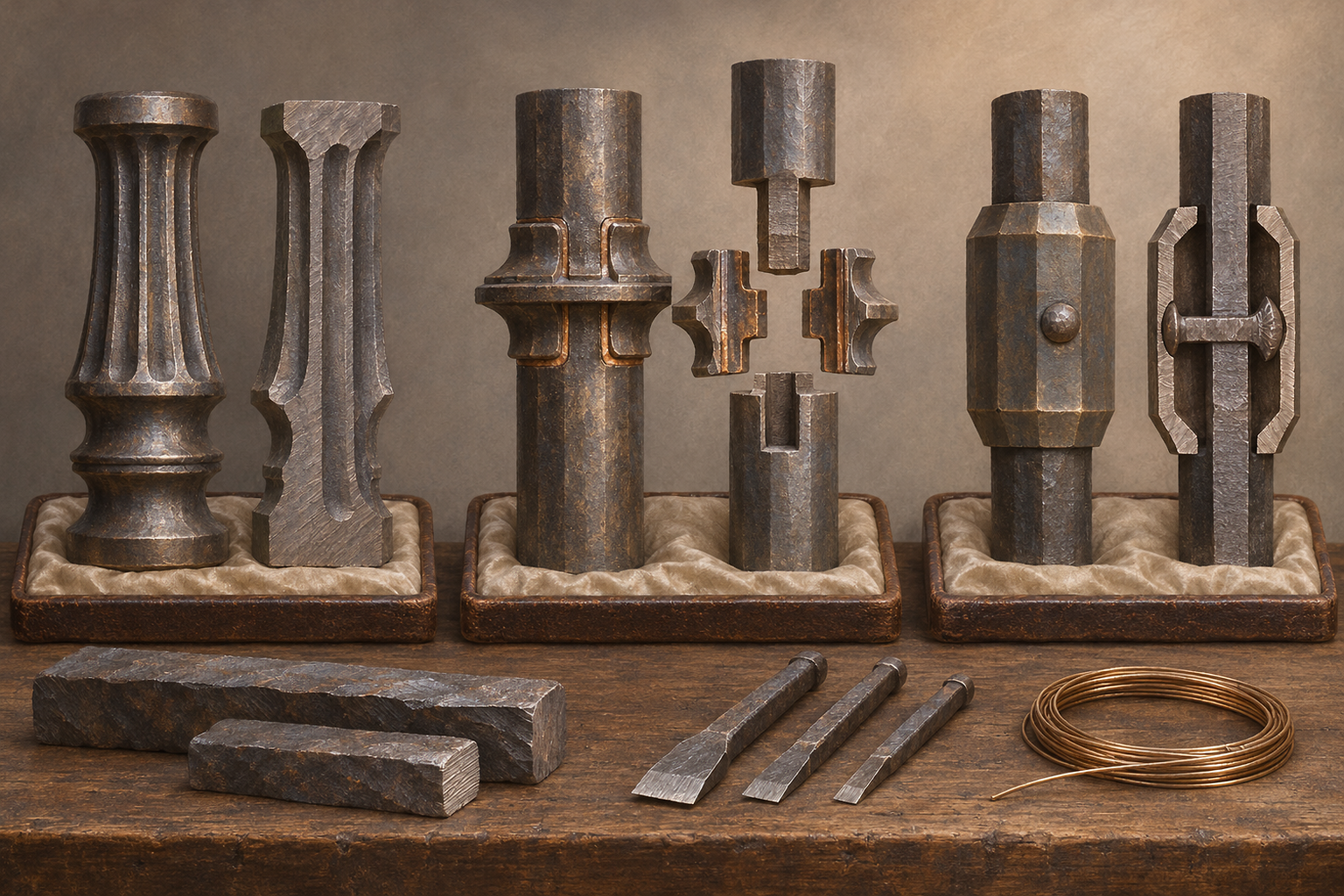
Historical workshop evidence documents three primary assembly methods for shishpar heads:
- Forging the head as an integral block by chiseling deep longitudinal channels into a thick billet and upsetting the remaining fins into outward flanges.
- Slotting individual forged flanges into mortised grooves cut down the length of a solid iron head sleeve, followed by high-temperature brazing with copper alloys.
- Welding shaped steel plates directly onto a faceted central socket that slipped over the upper shaft, anchored in place by a peened through-tang.
The Basket Hilt and Khanda Integration
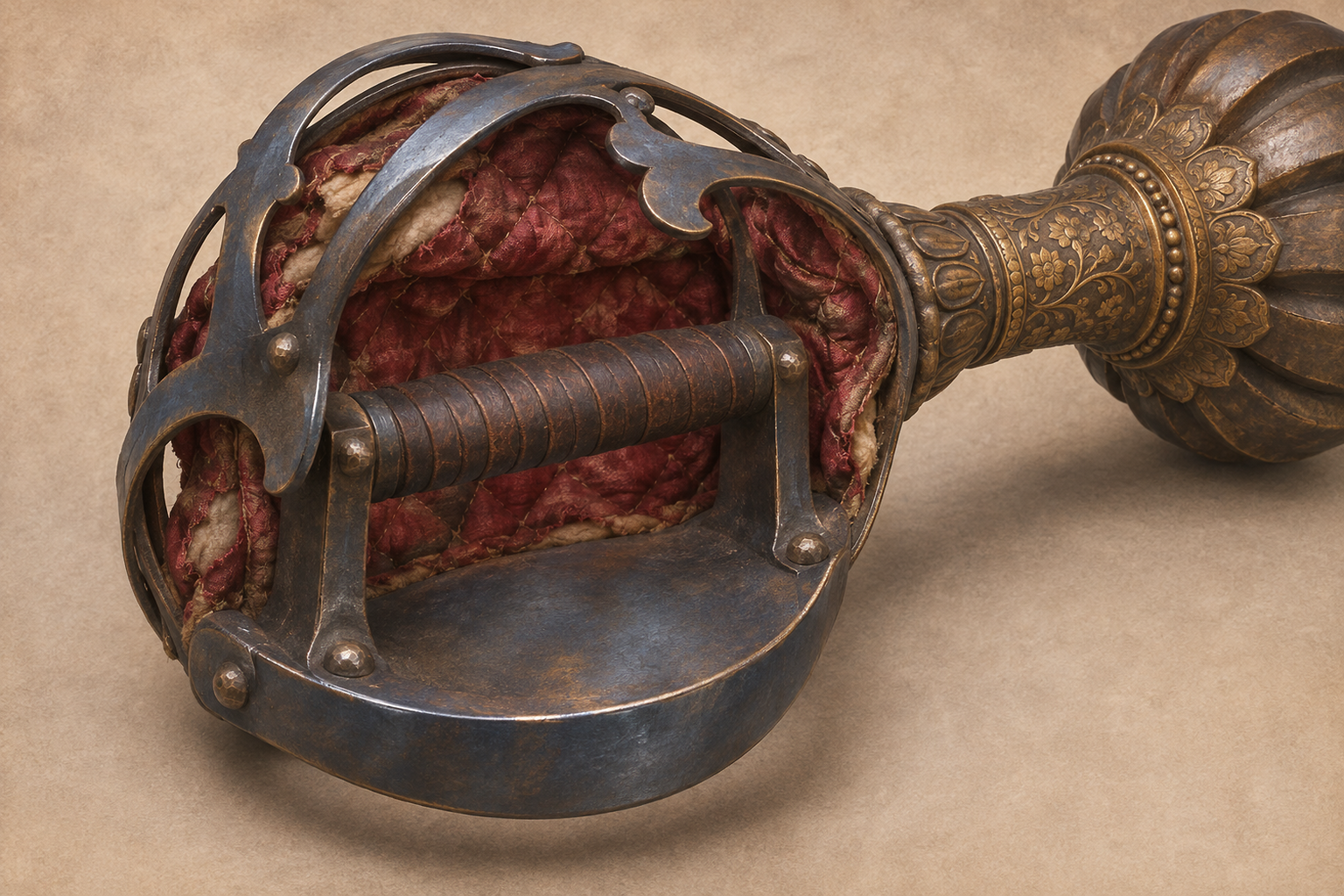
Early South Asian maces typically featured straightforward tubular handles with simple disc pommels, closely mirroring Persian and Central Asian imports. By the late sixteenth century, however, regional armorers began combining the flanged head with the distinct indigenous basket hilt associated with the khanda sword. This hybrid form created one of the most recognizable equestrian arms of the subcontinent.
The basket hilt featured a broad, curved knuckle-guard attached to an oval or dished guard plate, enclosing the hand entirely within steel plate lined with fabric. Inside the cage, a crossbar grip allowed the rider to lock their hand securely into position. A padded textile lining protected the knuckles from vibrating against the cold steel during impacts.
This development radically altered how the mace was held and swung. With the hand encased in rigid iron, a cavalryman could close into the dense melee without fear of an opposing tulwar blade sliding down the shaft to sever fingers. The protective enclosure enabled aggressive forward hand positions, shifting the pivot point of the swing closer to the mace's balance center.
The Extended Pommel Spike
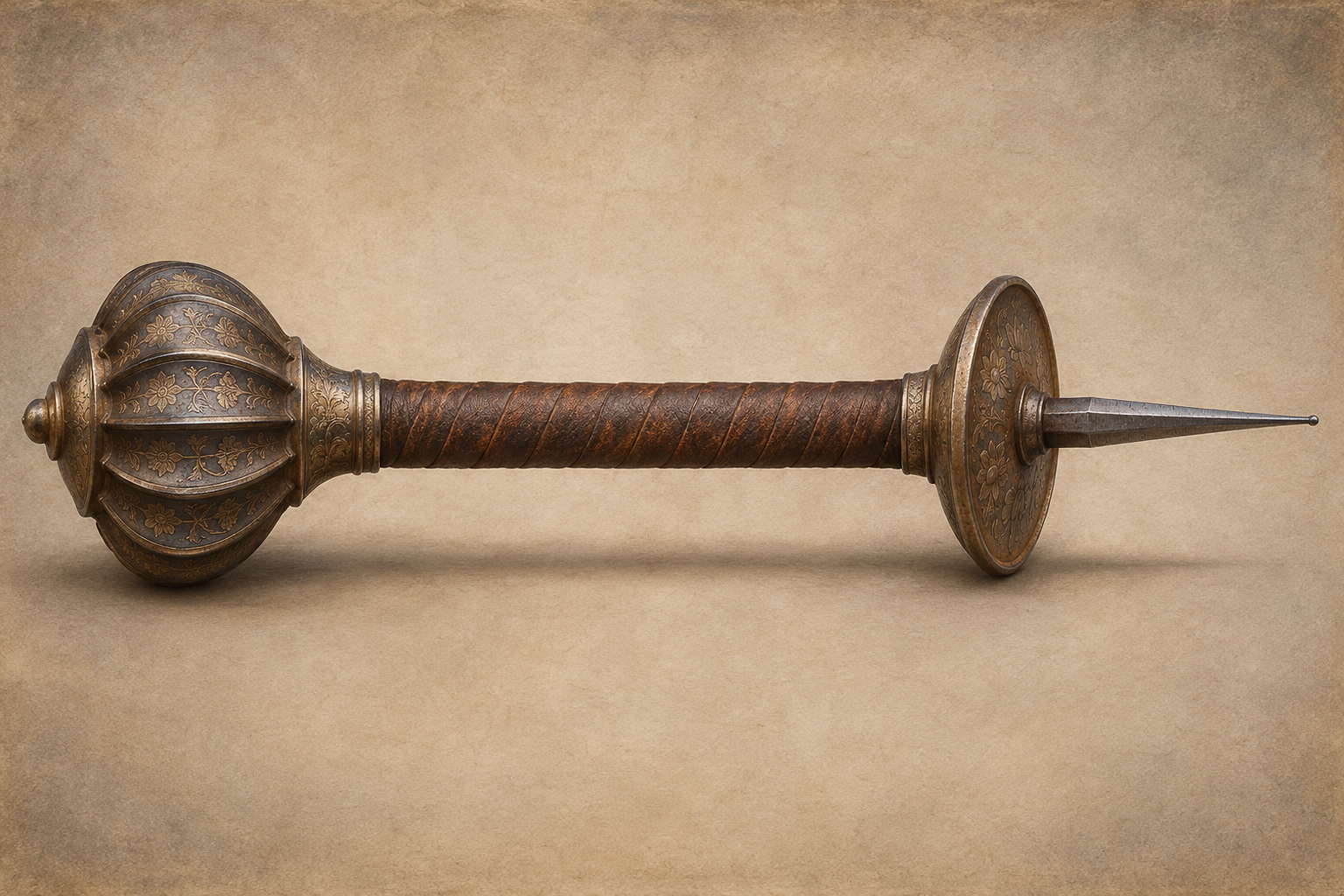
Extending backward from the disc pommel of the basket hilt, many shishpar featured an elongated, curving steel spike that tapered to a blunt or sharp point. Modern commentators often misidentify this feature as a decorative counterweight, but period fighting practices demonstrate a direct functional role.
During close-quarters equestrian entanglements, two horses frequently drew abreast, eliminating the clearance required to swing the heavy head of the mace. By reversing the wrist or punching directly downward, a mounted warrior could deploy the pommel spike as an effective stabbing awl. It could pierce through quilted cloth, punch between gaps in armor plates, or act as an offensive barrier to fend off an opponent attempting to grapple.
The long tail also allowed a two-handed grip when extra leverage was needed. A rider could grasp the primary grip with the dominant hand while pressing the secondary hand against the elongated spike, driving the head forward in a controlled shove or bracing against an incoming infantry spear.
The Mechanics of Armored Defeat
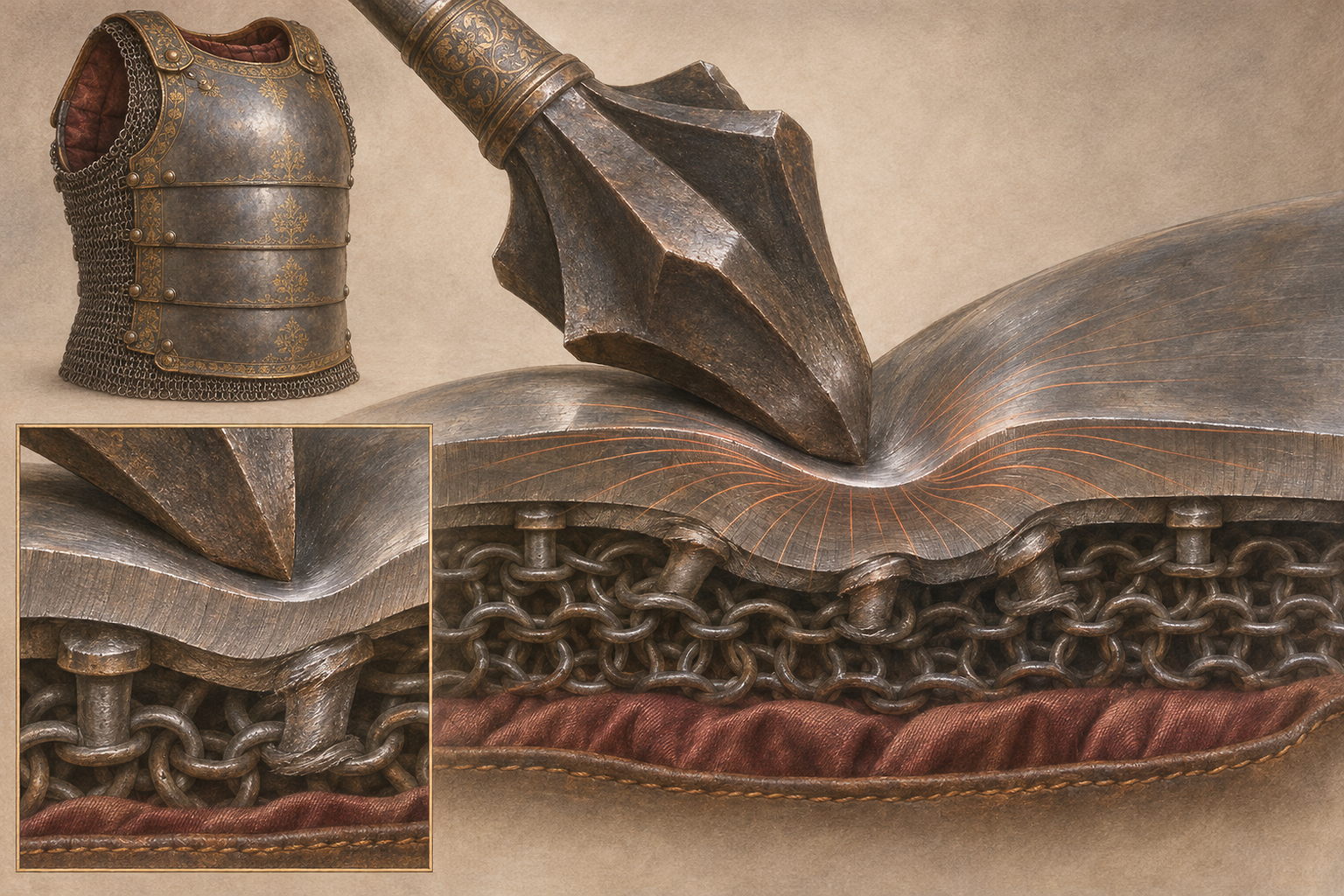
The rise of the shishpar corresponded directly to the widespread adoption of articulated mail-and-plate defenses, such as the zirah bakhtar and char-aina breastplate sets. These armor systems offered formidable protection against sword slashes. A razor-sharp tulwar would lose its cutting momentum against hardened plate, dulling or chipping along its edge, while mail absorbed drawing strokes effortlessly.
The flanged mace bypassed these protective mechanics by generating concentrated blunt trauma. When a heavy flange strikes a plate, it produces a high localized pressure. The steel plate deforms plastically, bending inward past its elastic limit. Even if the flange does not puncture the metal, the violent displacement drives the plate inward against the wearer's rib cage, collarbone, or limbs, causing fractures and internal bleeding.
Against pure mail, the effect was even more decisive. The narrow leading edge of the flange pinched the interlocking rings against the wearer's padding and bone. Under this sheer load, individual iron rivets sheared apart, splitting links and transferring the blow directly into muscle tissue. The mace converted the speed of a galloping horse into concentrated mechanical shock that no textile or link could dissipate entirely.
Battlefield Deployment from the Saddle
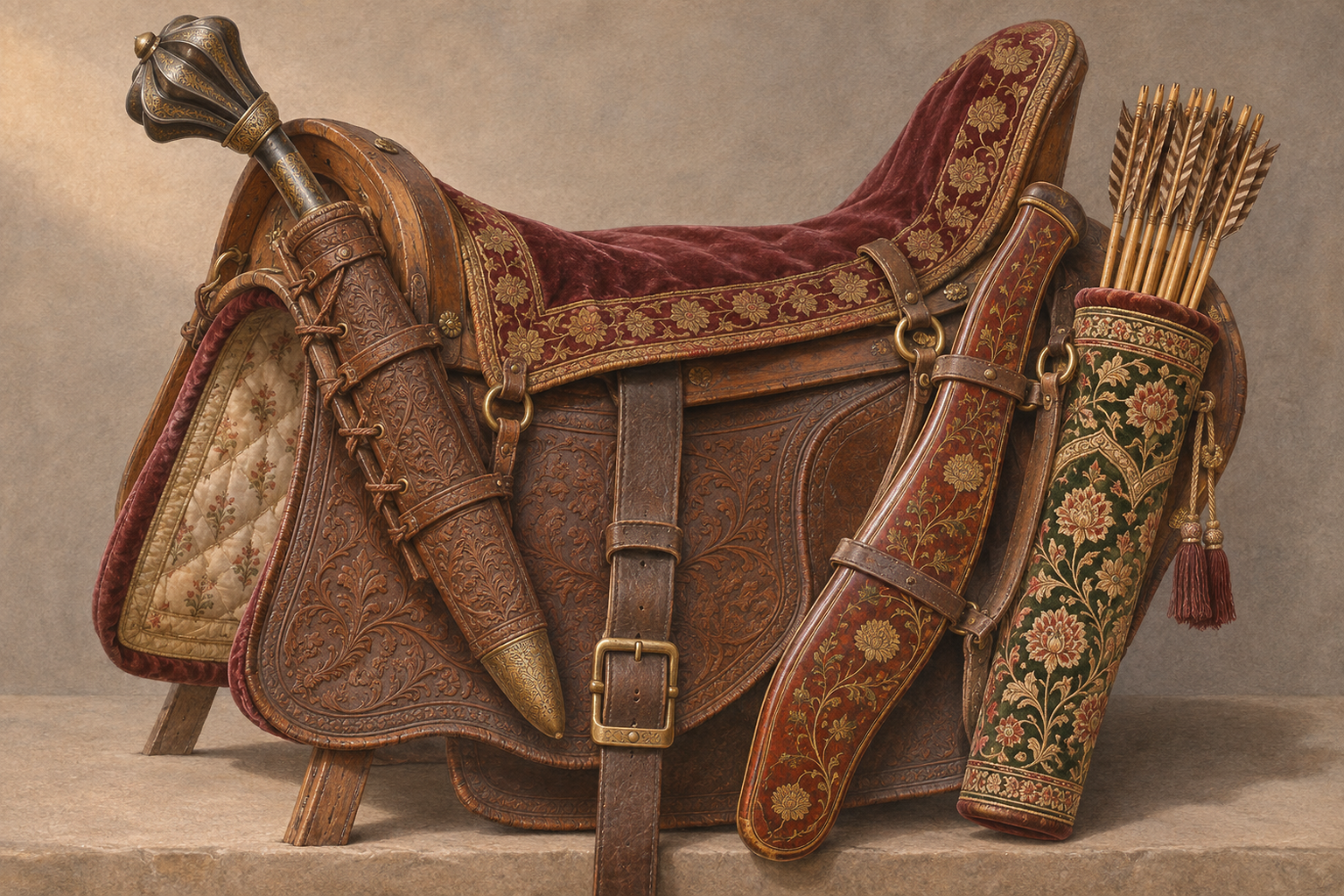
Carried by elite ahadi and noble officers within Mughal, Rajput, and Deccani armies, the shishpar was fundamentally an auxiliary shock weapon. Contemporary pictorial evidence from imperial manuscripts, such as the Akbarnama and Padshahnama, shows cavalry carrying the mace slung from the saddle bow or tucked behind a leather thigh strap, keeping the hands free for the composite bow or lance during initial charges.
Once the primary shock weapons broke or the melee collapsed into tight maneuvering, the rider drew the mace. Fighting from horseback favored percussive weapons because a rider possesses immense downward angular velocity. Striking downward at an infantry soldier or an opposing horseman maximized the mechanical advantage of gravity and horse movement.
Maneuvering a shishpar required disciplined arm mechanics. Unlike a flexible whip or light sword that recovers quickly through wrist rotation, a top-heavy flanged mace carries significant forward inertia. A missed swing could overbalance a rider or leave the flank exposed. Cavalrymen were trained to strike in short, crushing arcs that rebounded naturally from the target, enabling immediate defensive recovery or a follow-up thrust with the pommel spike.
Koftgari Ornamentation and Courtly Status
Beyond its functional role on the campaign trail, the shishpar served as a prominent badge of authority and imperial rank. In the hierarchically structured Mughal court, weapons formed an essential component of the khil'at, the ceremonial robes and gifts of honor bestowed by the emperor upon distinguished commanders, provincial governors, and allied princes.
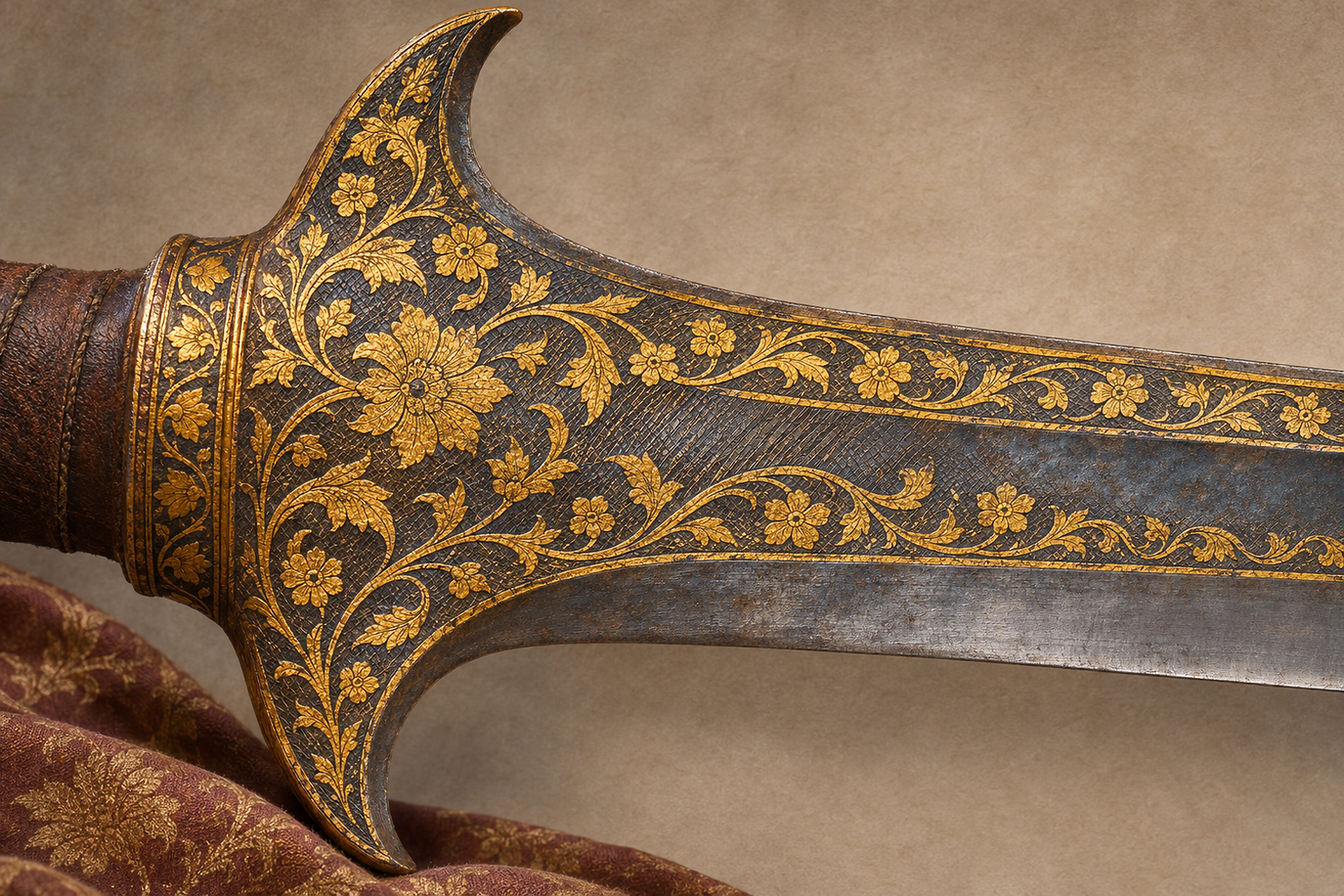
These presentation pieces received opulent surface treatments executed by master artisans. Foremost among these techniques was koftgari, or gold and silver damascening. Smiths hatched the base iron head with fine cross-hatched grooves, laid thin gold wire onto the roughened surface, and burnished it flat until it locked mechanically into the steel. The radiating flanges offered pristine canvases for intricate calligraphic inscriptions, including Quranic verses promising victory (Ayat al-Kursi), invocations to Ali, and Persian poetry praising the ruler's martial valor.
Despite their elaborate decoration, the majority of surviving gilded maces retain fully functional construction underneath the embellishment. The underlying steel remains solid, the flanges securely joined, and the balance strictly preserved, demonstrating that court regalia and functional arms emerged from the same technical lineage.
Deccani and Maratha Variations
As the Mughal Empire expanded southward into the Deccan plateau, imperial weapons traditions collided with local metallurgical and tactical habits. The independent Deccan Sultanates—Bijapur, Golconda, and Ahmadnagar—alongside the rising Maratha confederacy, developed distinct variants of the flanged mace that reflected regional needs.
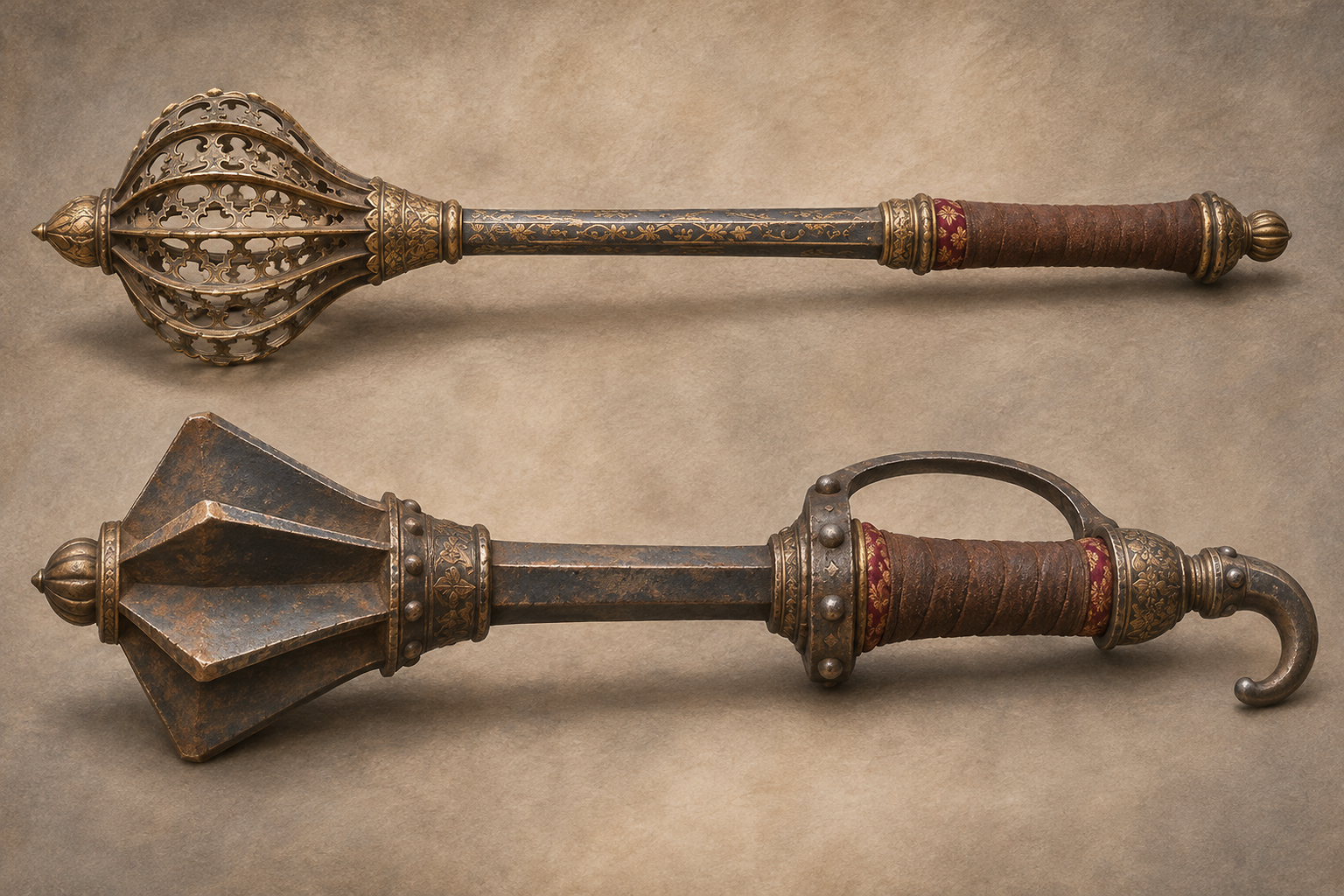
Deccani shishpars often display an exaggerated number of flanges, sometimes incorporating eight, ten, or twelve thin fins cut with deep crenellations or pierced with openwork patterns. These intricate cutouts lowered the head's weight without compromising the structural perimeter, allowing the weapon to retain an imposing diameter without becoming sluggish in the hand.
Maratha examples, frequently encountered in eighteenth-century arsenals, leaned toward utilitarian robustness. They paired massive, broad-faced flanges with reinforced iron basket hilts featuring thicker hand-guards. The pommel extensions on Maratha maces were often elongated further, occasionally terminating in a small finial designed to hook an opponent's reins or catch an incoming spear shaft.
Corrosion, Conservation, and Structural Survival
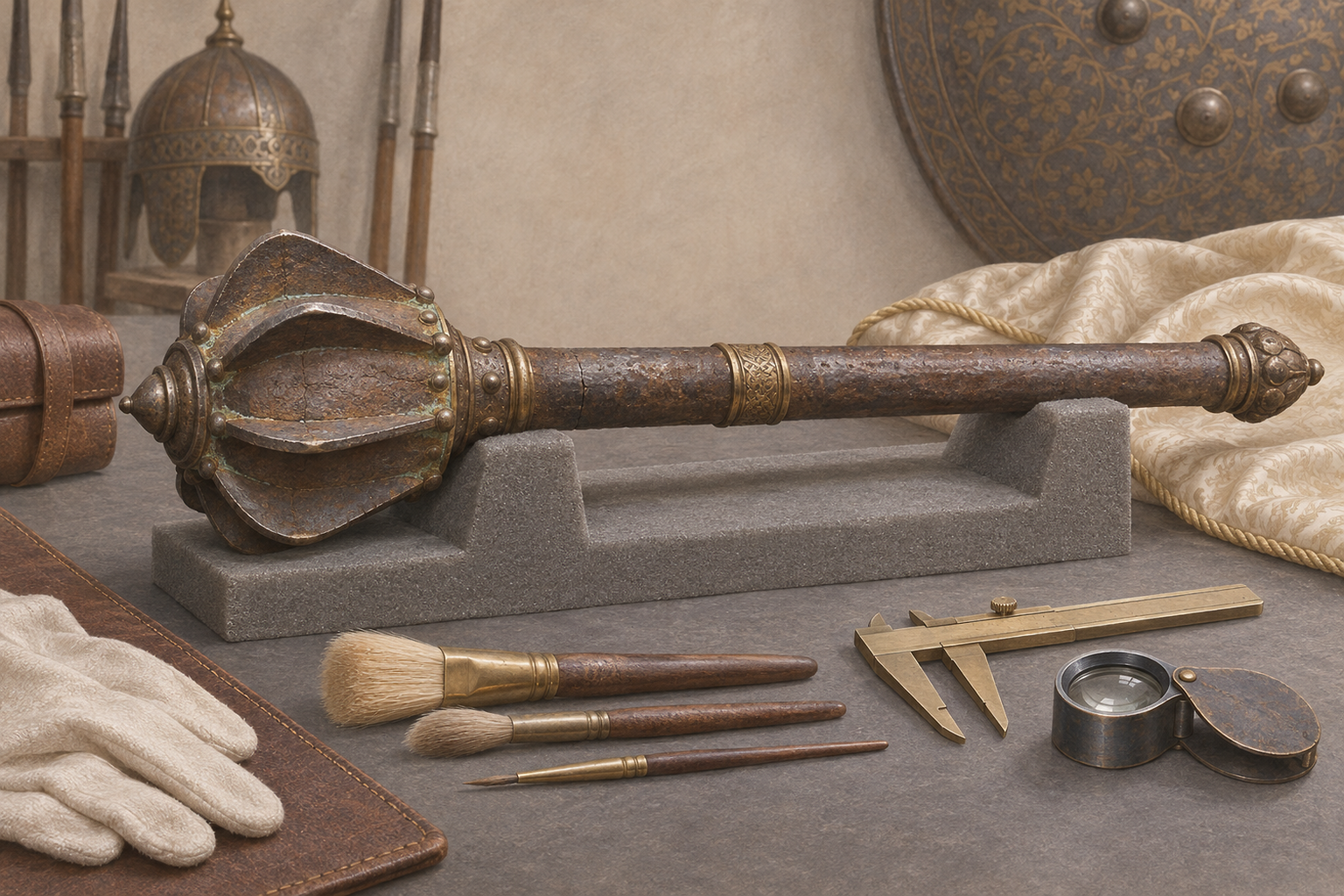
Surviving shishpars in museum collections present unique conservation challenges stemming directly from their composite construction. Because maces were built from separate components—shaft, flanges, collars, and hilts—corrosion frequently develops along hidden seams and braze lines where moisture and chemical residues accumulated over centuries.
In pieces assembled with copper-alloy brazing, galvanic corrosion can arise over long periods in humid climates. The boundary between the copper filler and the iron flange forms a microscopic galvanic cell, slowly oxidizing the iron interface until the structural bond weakens. Conservators frequently encounter nineteenth-century specimens where individual flanges have worked loose or detached entirely due to subterranean iron rot within the brazed sockets.
Surviving hilts also retain remnants of organic materials. The original horsehair, cotton padding, and velvet linings tucked inside the basket hilts are highly prone to insect infestation and moisture retention, which in turn accelerates rusting on the interior surfaces of the grip. Modern preservation focuses on stabilizing these composite layers through dry micro-abrasion, controlled relative humidity, and targeted consolidation of flaking gilding.
Distinguishing Combat Arms from Modern Reproductions
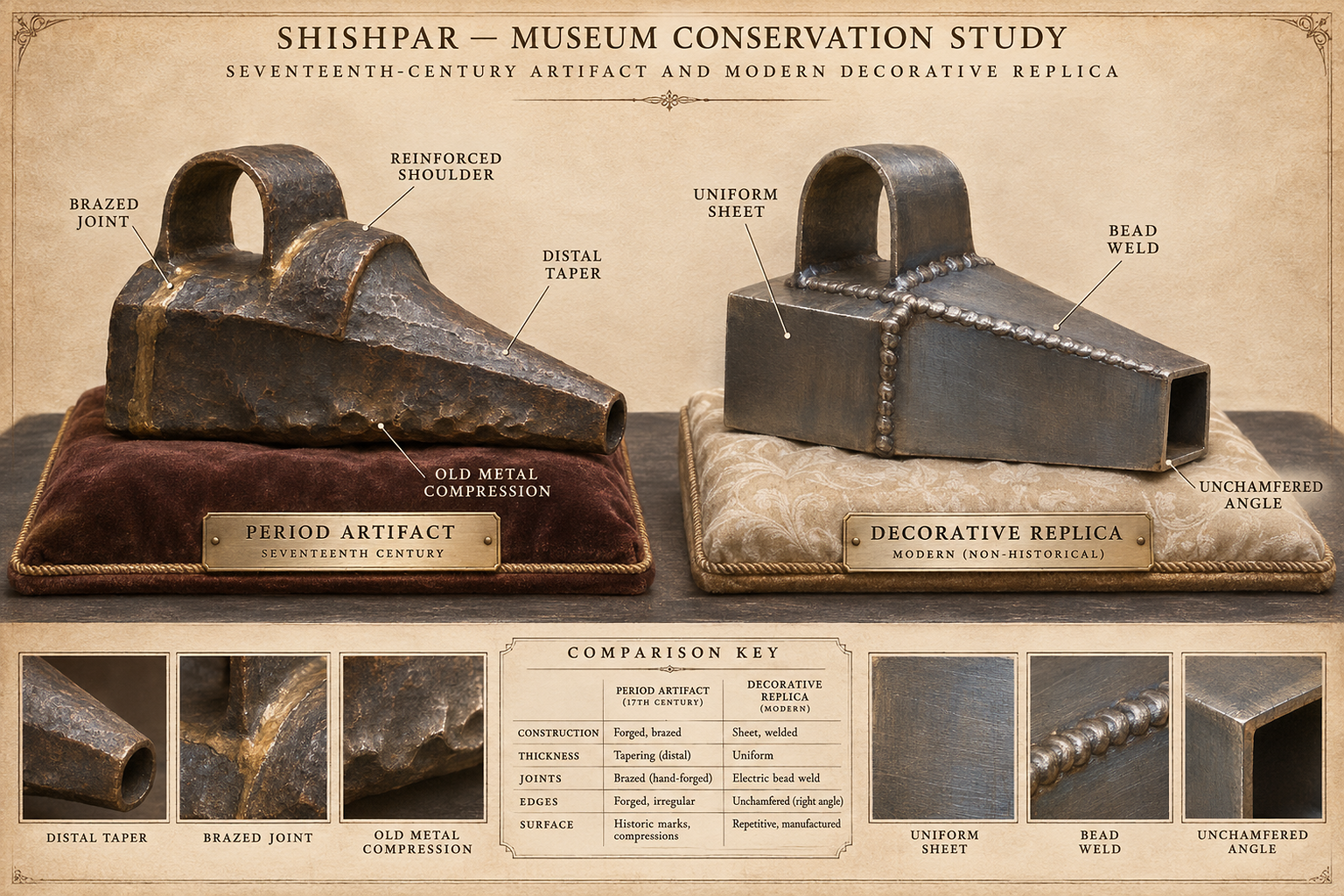
The dramatic visual appeal of the flanged mace has made the shishpar a frequent subject of modern reproduction, decorative fabrication, and misidentification in the art market. Discriminating between authentic period arms and nineteenth-century tourist wares or modern theatrical props requires careful structural examination.
Authentic historical pieces exhibit purposeful metallurgical logic. The flanges thin toward their centers and widen toward their welded bases to distribute striking shock without structural shear. In contrast, modern decorative copies commonly feature flat, stamped sheet-metal fins arc-welded or screwed onto modern mild-steel pipe. These decorative flanges lack distal tapering and will bend or snap under minor impacts.
Genuine koftgari decoration on historical arms shows micro-level mechanical keying beneath the gold, whereas nineteenth-century revival pieces or modern fakes often rely on superficial chemical gilding or paint. Authentic combat maces also carry distinct wear patterns: blunt compressions along the leading edges of the flanges, minor deformations on the pommel spike, and honest rubbing on the interior grip where the warrior's gauntlet abraded the steel over decades of service.
Further reading
Follow the sources to examine the object and its historical context.
Egerton, Lord of Tatton. Indian and Oriental Armour. Dover Publications, 2002 reprint of 1896 edition.External reference · Opens in a new tab Elgood, Robert. Hindu Arms and Ritual: Arms and Armour from India 1400–1865. Eburon Publishers, 2004.External reference · Opens in a new tab Pant, G. N. Indian Arms and Armour, Vol. II: Swords and Daggers. Army Educational Stores, 1980.External reference · Opens in a new tab The Wallace Collection, London. Online Collection Catalogue: Indian Percussion Arms.External reference · Opens in a new tab