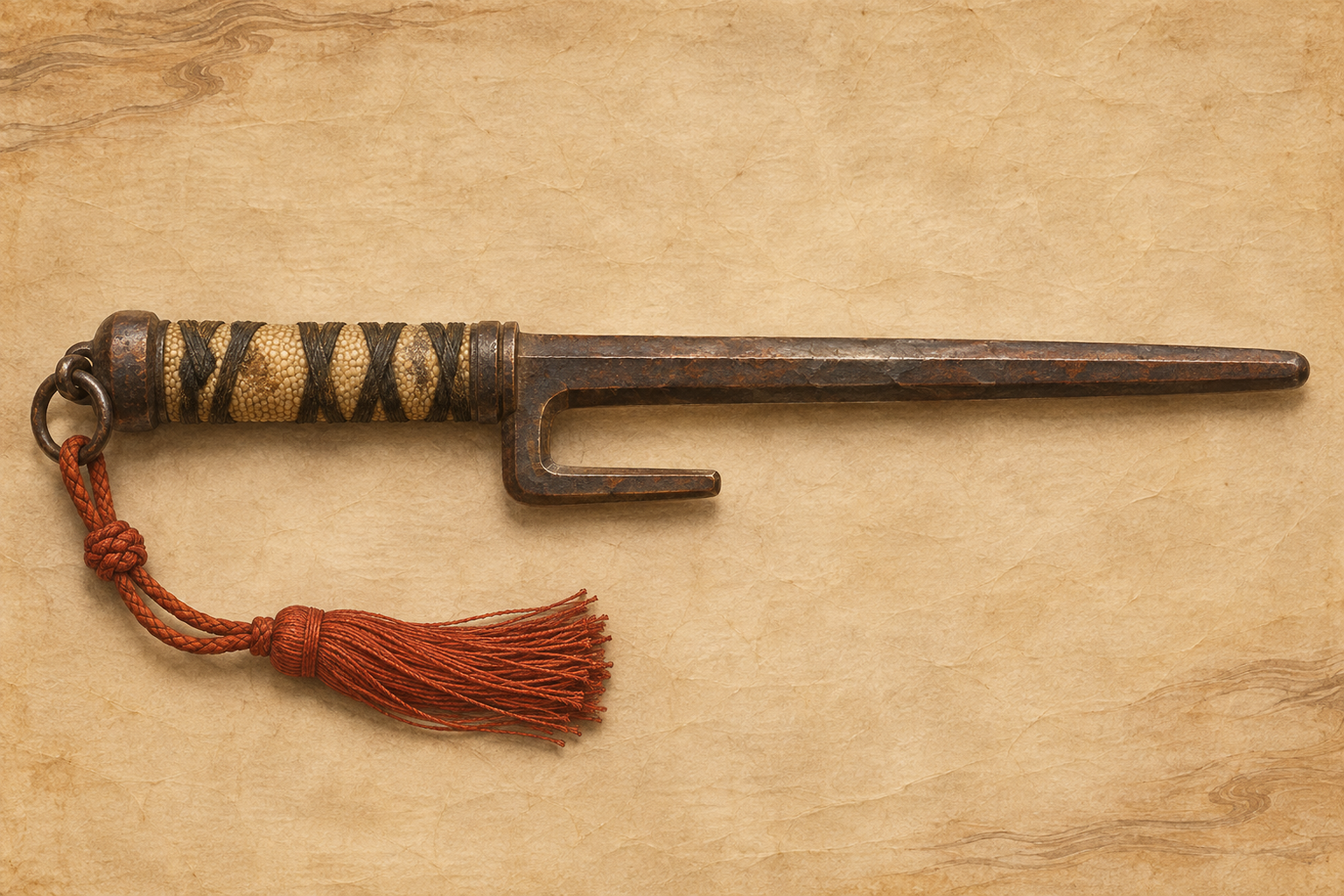
Surviving Edo-period police truncheons present an austere, functional silhouette: a solid bar of forged iron or steel, unsharpened, terminating in an integral hook near the grip and a cord loop at the pommel. Known primarily as the jutte—literally meaning 'ten hands' to denote the power of multiple men—this rigid bar served as both an arrest implement and a physical badge of office within the sprawling jurisdiction of the Edo town magistrates. Alongside it existed the hachiwari, or 'helmet breaker,' a related, often curved iron implement designed either to absorb the shock of an incoming blade or deliver a concussive blow against protective headgear. Far from the lightweight theatrical batons of later popular fiction, surviving examples are dense, front-heavy parrying tools. They were developed to solve a specific tactical and legal dilemma: how an arresting officer could disarm, restrain, and deliver a sword-bearing samurai to the magistrate alive, without violating strict prohibitions against public bloodshed.
The Iron Warrant of the Machi-Bugyō
In the densely packed wards of seventeenth- and eighteenth-century Edo, peace was maintained through a meticulous, stratified administrative machine. The Machi-bugyō-sho, or town magistrate's offices, operated with a remarkably lean contingent of official samurai personnel: two magistrates overseeing twenty-five yoriki commanders and approximately one hundred dōshin field officers. Because this small force governed an urban populace approaching one million people, symbols of executive authority had to be unmistakable, portable, and legally binding. The jutte functioned as that physical manifestation. Presenting the iron bar was equivalent to producing a direct warrant from the magistrate, compelling immediate obedience under Tokugawa law.
The truncheon addressed a fundamental legal restriction of the Pax Tokugawa. While samurai possessed the traditional right to cut down commoners who committed gross insolence, municipal constables faced severe bureaucratic scrutiny if an arrest resulted in a dead suspect. Judicial procedures placed a high premium on interrogation, confession, and formal sentencing. Slaying an armed suspect in the street was regarded as an operational failure except in cases of uncontrollable rampages. The jutte offered an officer a rigid defense that would not cut the quarry, granting the physical resilience needed to close the distance without drawing a lethal edge.
Because of this legal weight, the manufacture, ownership, and presentation of the jutte were closely regulated within the administrative ranks. A dōshin patrolling the merchant quarters of Nihonbashi carried his jutte thrust through his sash much like a dagger, but positioned so that the hilt and distinguishing cord were immediately visible to tavern keepers, watch-gate wardens, and street heads. Striking a constable bearing this iron bar was treated as an act of rebellion against the shogunal state, not a common street brawl.
Forge Craft and the Metallurgy of the Solid Bar
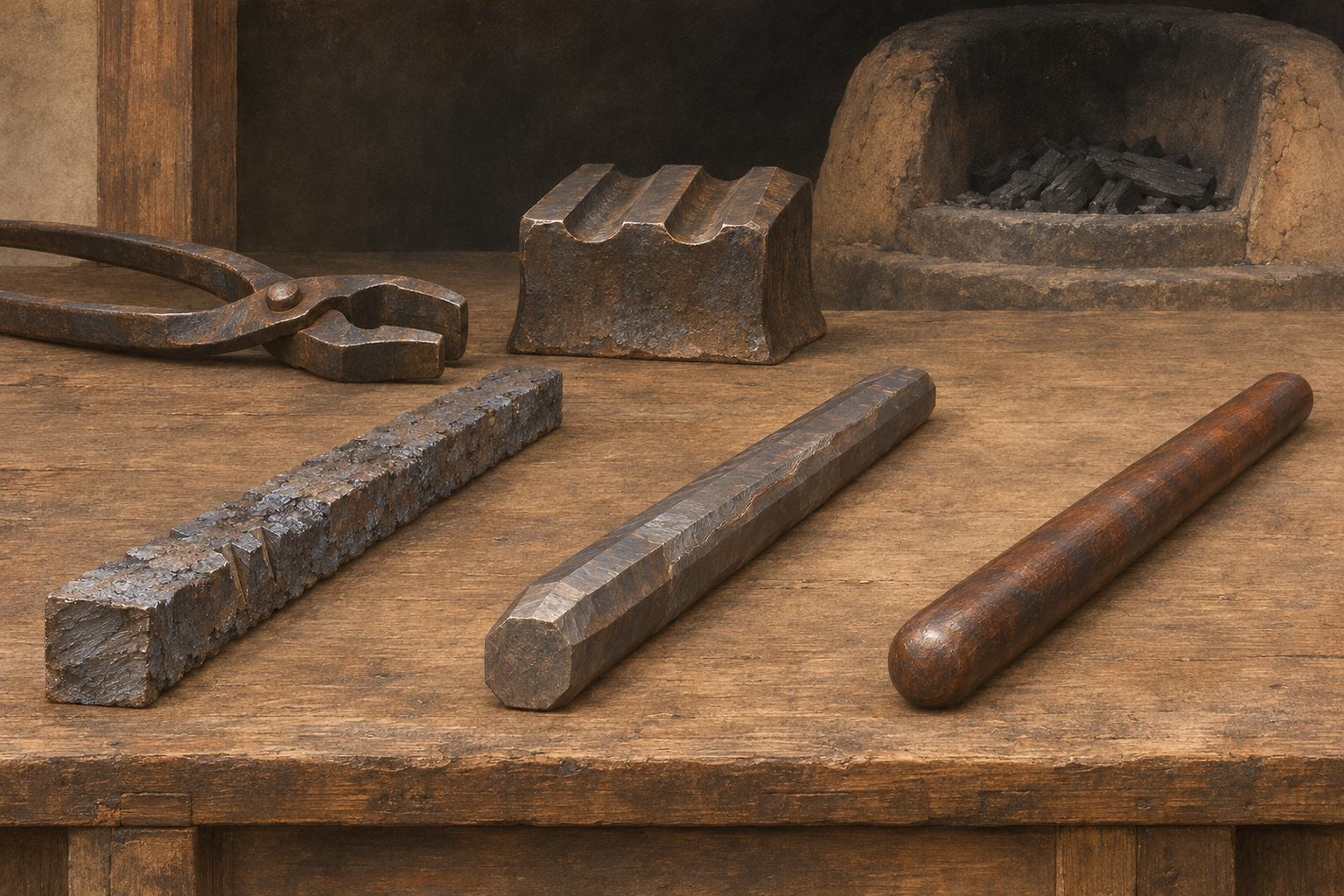
Unlike Japanese swords, which relied on complex differential hardening and folded high-carbon steels to maintain an acute cutting edge, the jutte was an exercise in pure structural toughness. Surviving examples examined in modern conservation labs reveal cores of homogenous wrought iron or medium-carbon forge-welded steel. The bar did not need the brittle hardness required to slice flesh; it required sufficient bulk and ductility to absorb the violent, kinetic impact of an incoming katana blade without snapping or taking a permanent, disabling set.
Blacksmiths produced the jutte by heating an iron billet and hammering it into a solid rod. Cross-sections varied depending on the maker and regional workshop traditions. While simple round cross-sections exist, many surviving examples display sharp hexagonal or octagonal flats. These longitudinal ridges concentrated the force of a percussive blow along a narrow line of contact, allowing a constable to deliver a disabling blow through thick winter clothing without necessarily crushing the underlying bone to pieces. The taper of the shaft was carefully calculated, keeping the mass biased toward the middle of the weapon so that the tip could recover quickly during rapid parrying sequences.
Corrosion resistance and finish reflected the status of the user. Field truncheons carried by low-ranking assistants often left the forge with a simple blackened scale finish, dipped in oil to stave off the humid summer climate of coastal Edo. Constables of official samurai status, however, often commissioned smiths to apply a russet-iron patina, fine lacquer, or even parcel-gilding and silver inlay to the flats. These finishes served a dual purpose: they protected the iron from moisture during rainy patrols and communicated the bearer's institutional standing through subtle decorative motifs.
The Mechanical Geometry of the Hook
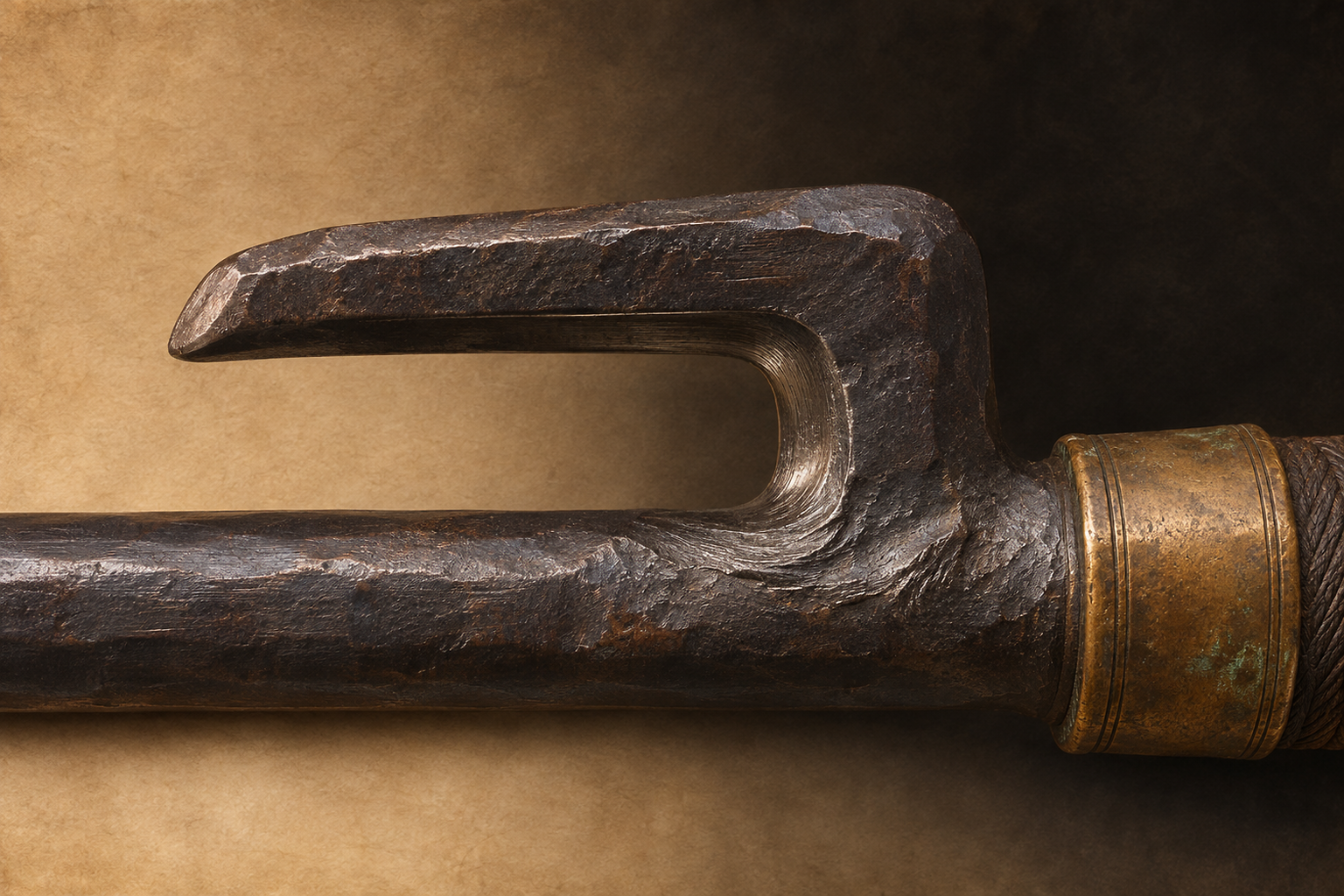
The single most recognizable feature of the classic jutte is the kagi, an L-shaped or curved hook projecting forward from the base of the shaft just above the grip. Forged as an integral extension of the main bar or hot-riveted through a reinforced collar, the kagi created an open notch measuring between one and two centimeters across. Modern martial arts fiction frequently depicts the hook as an offensive tool designed to snap a samurai's katana blade cleanly in two. Period metalcraft and basic mechanical principles tell a far more practical story.
A forged katana blade possessed significant lateral flexibility and a hardened edge; attempting to shear or shatter such a blade by twisting a hand-held hook required an extraordinary, near-impossible alignment of leverage and brute force. Instead, historical manuals and forensic wear marks on surviving jutte indicate that the kagi was a dynamic trapping and sliding guide. When an opponent delivered a downward cut, the constable raised the iron shaft diagonally to deflect the blow. The incoming edge struck the dense iron shaft, slid downward along its surface, and slammed harmlessly into the throat of the hook.
Once trapped within the kagi, the swordsman's blade was temporarily compromised. By applying a short rotational torque with the wrist and forearm, the constable could twist the opponent's sword off the centerline. This opened the swordsman's balance and exposed his unprotected forearms, neck, and face to follow-up strikes from the constable's free hand or the jutte's weighted pommel. The hook was not a blade-destroyer; it was a mechanical brake that seized initiative in the crucial second after an initial strike.
The Hachiwari Paradox: Breaking Steel or Breaching Armor
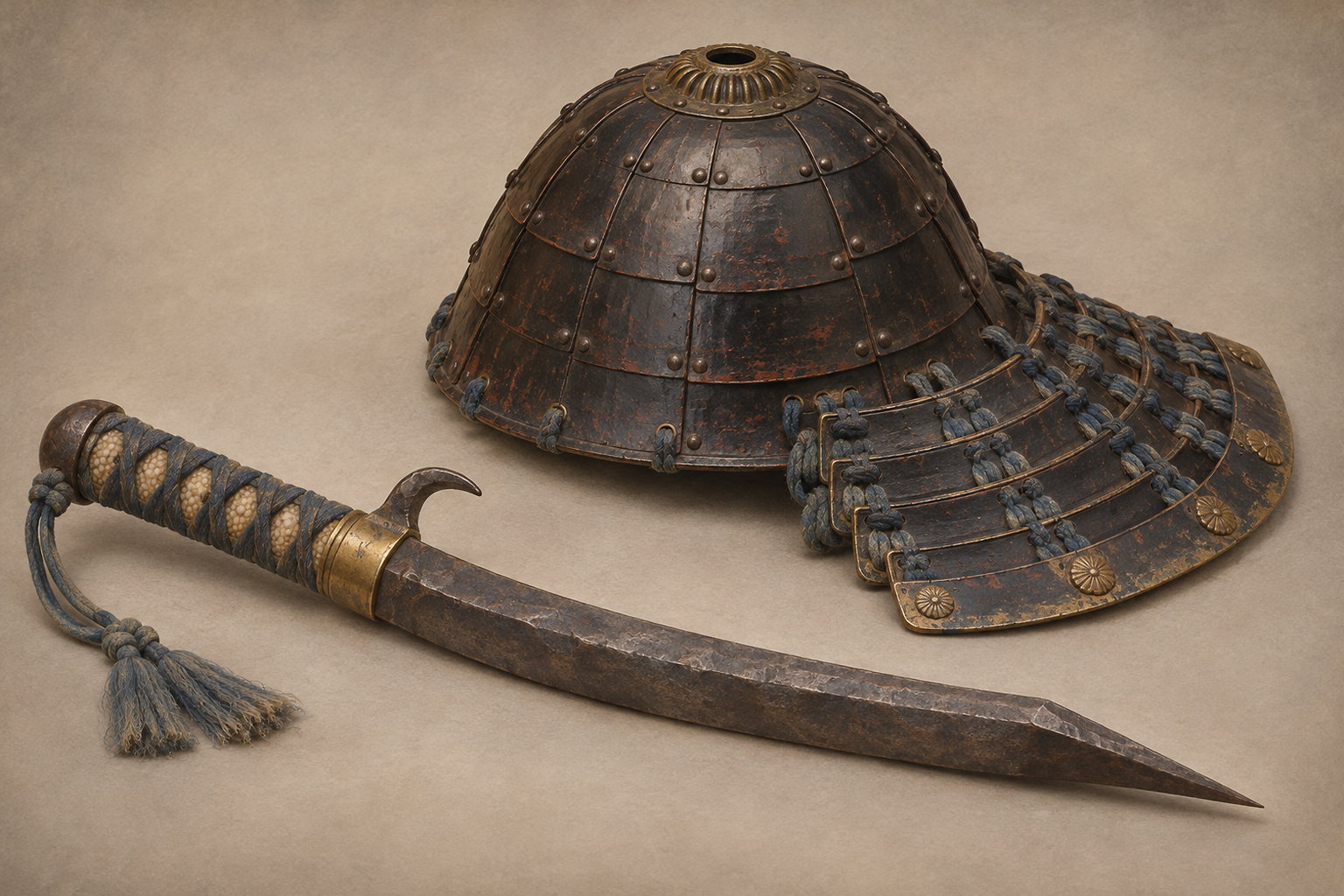
In the taxonomy of Japanese iron impact arms, the hachiwari occupies an ambiguous and controversial position. Often grouped with the jutte due to its unedged iron construction, the hachiwari—literally 'bowl breaker' or 'helmet breaker'—typically features a slightly curved bar resembling a tanto dagger, either blunt along its edges or tapering to an acute, reinforced thrusting point. Many specimens incorporate a small, backward-swept hook near the hilt, leading antiquarians to classify them variously as parrying daggers, armor punches, or truncheons.
The central controversy surrounding the hachiwari concerns its name and purported purpose. Romantic legends from the Meiji period forward claimed that renowned warriors could split an iron kabuto (helmet) through sheer percussive force using this tool. Modern practical testing and metallurgical reality contradict this assertion. A laminated, riveted iron helmet shell, curved to deflect blows and lined with leather and padding, will deform under massive kinetic force, but it does not simply crack open like a ceramic bowl under the strike of a hand-held iron bar. Such claims confuse figurative battlefield boasting with technical capability.
Instead, tactical records and surviving mounts suggest two distinct battlefield and civil functions. Mounted in dagger-like wooden scabbards (koshirae), some hachiwari were carried as secondary weapons to be thrust into the small gaps of an enemy's armor—such as under the neck guard (shikoro) or between the armpit plates—where the rigid, unbending iron could lever plates apart or pierce underlying mail without dulling or snapping like a razor-sharp steel edge. In urban civil defense, unsharpened hachiwari operated essentially as curved jutte, providing a natural parrying curve that redirected incoming strikes while allowing the blunt tip to strike vulnerable nerve clusters.
Hierarchies, Cords, and Magistrate Regalia
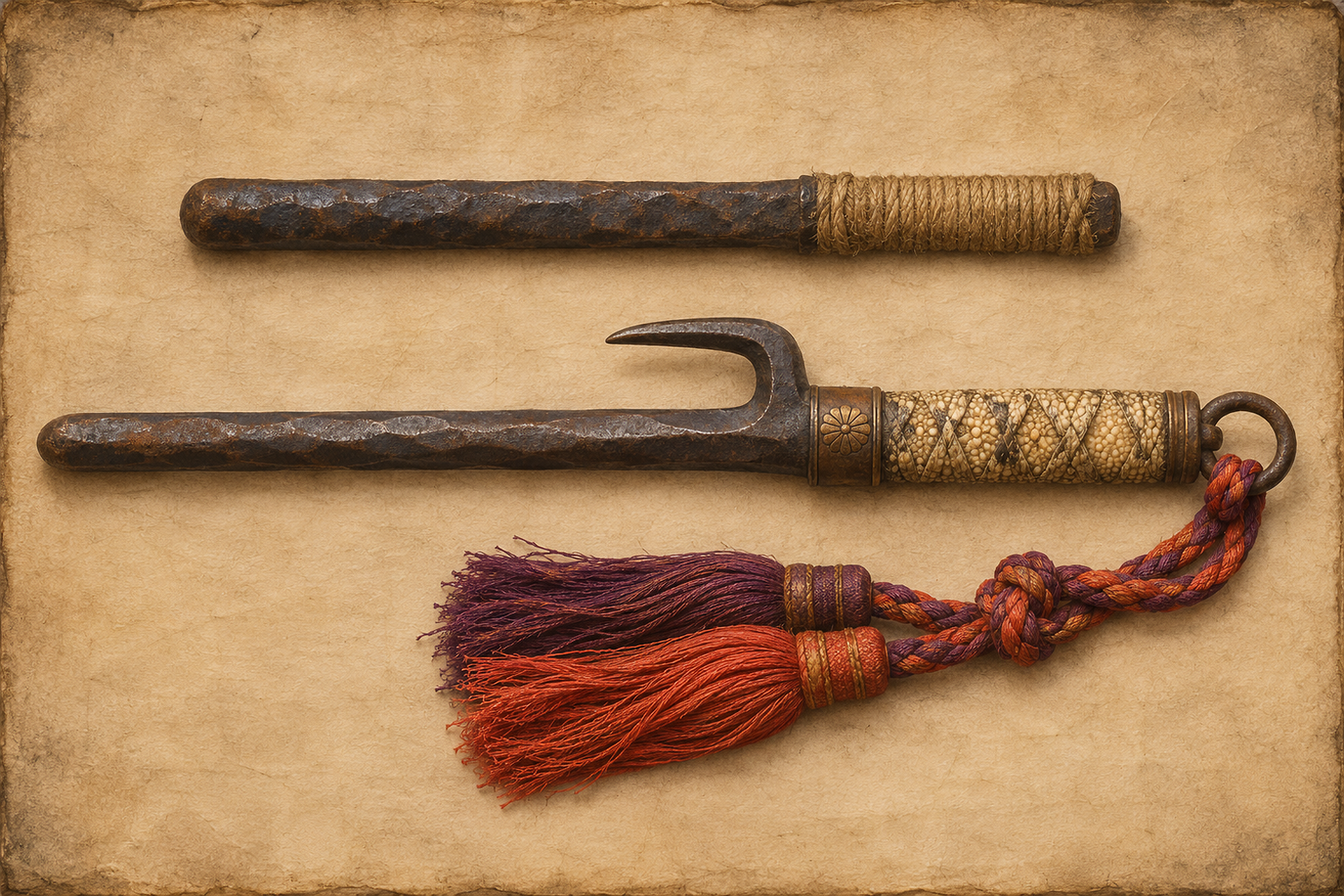
The social hierarchy of Tokugawa policing was encoded directly into the ornamental fittings of the jutte. Edo's police network relied heavily on an informal underclass of private hirelings known as okappiki or meakashi. These men were often reformed gamblers, market laborers, or former criminals who possessed intimate knowledge of the city's underworld. Despite their practical necessity on the streets, they were strictly commoners and were formally prohibited by shogunal decree from carrying swords or wearing the official badges of the samurai magistrate class.
Official samurai constables—the dōshin—carried jutte furnished with elaborate silk cords and tassels passed through the iron ring (kan) at the pommel. The color of these cords served as an overt system of institutional identification. In the capital, cords of vermilion, purple, or alternating dyed silk indicated specific duties, patrols, or direct warrants from the North or South Magistrate's offices. The length of the cord was functional as well as symbolic: it was wrapped snugly around the constable's wrist during violent scuffles to prevent the heavy iron tool from being torn from his grip or lost in a surging crowd.
In contrast, the lower-tier okappiki carried either plain, unadorned iron rods without cords or shortened truncheons easily concealed within the wide sleeves of a merchant's kimono. If an okappiki attempted to display a formal tasseled jutte, he risked severe corporal punishment for impersonating a magistrate officer. The artifact thus stood at the exact intersection of feudal caste law and street-level necessity: a weapon whose right to display was as fiercely defended as the right of a samurai to bear his paired swords.
Tactical Doctrines of Juttejutsu
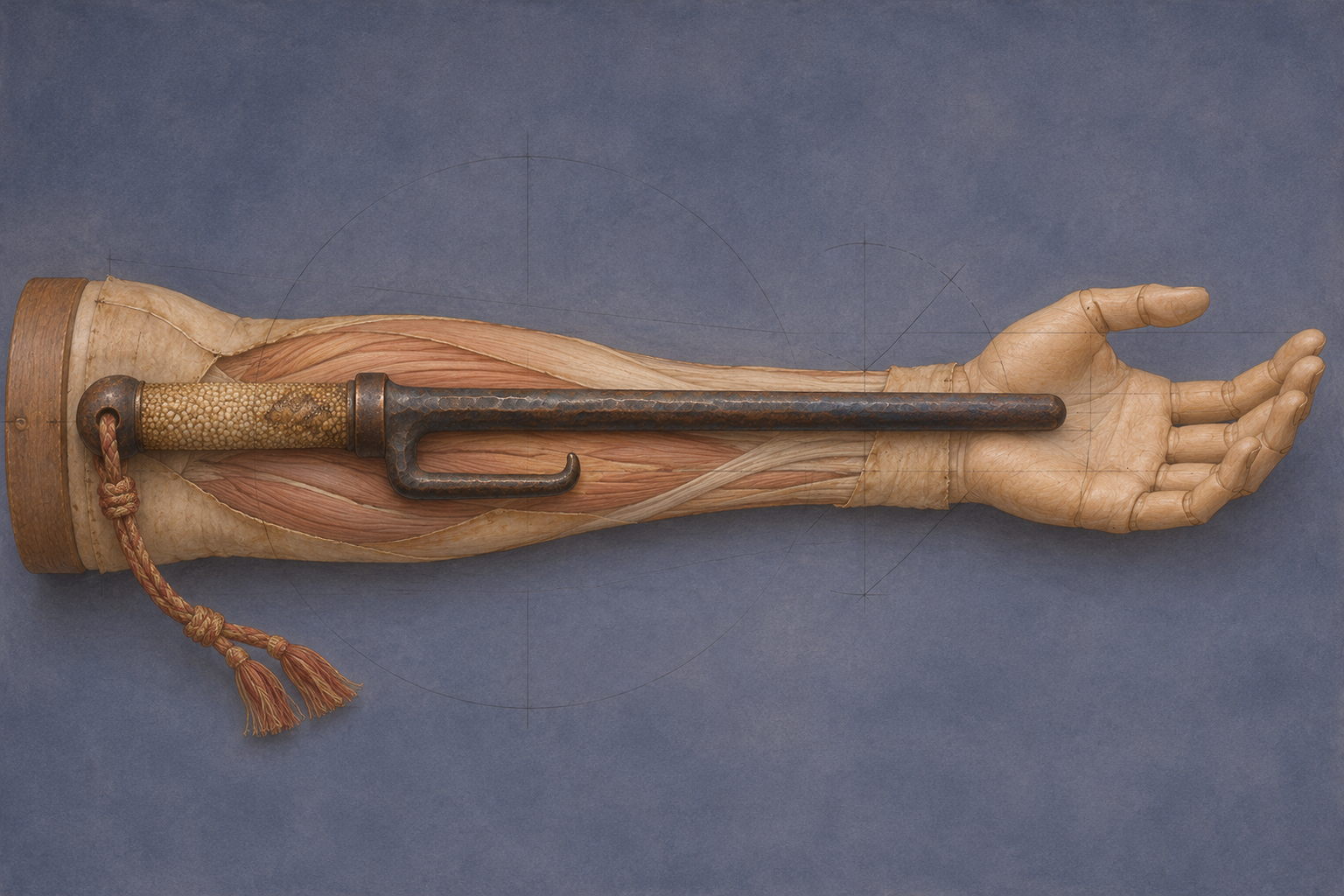
The deployment of the jutte was not left to undisciplined brawling; it was codified into sophisticated martial systems known collectively as juttejutsu. Often taught alongside unarmed arresting arts (taijutsu or jūjutsu) and short-sword systems, these arts treated the iron bar as an extension of the officer's skeletal structure. Renowned schools, such as the Ikkaku-ryū juttejutsu incorporated into the Shindō Musō-ryū tradition, developed precise technical catalogs for neutralizing sword-bearing adversaries.
The foundational posture in juttejutsu differed sharply from standard sword stances. The constable typically held the jutte with the hook facing upward or inward toward his forearm, keeping the iron bar aligned with his radius bone. This alignment turned the forearm into a rigid iron-reinforced shield, capable of absorbing glancing cuts from a katana without exposing soft tissue. The off-hand remained free, ready to grasp the opponent's sleeve, trap a wrist, or deploy a concealed restraint cord.
Offensive movements focused on rapid, percussive compliance rather than lethal destruction. A trained dōshin did not attempt wide, sweeping swings that would leave him off-balance. Instead, he drove the blunt tip of the bar into the adversary's solar plexus, thrust it upward under the chin to snap the head back, or struck sharply downward across the radial nerve of the sword arm to force the opponent's fingers to unclamp from their hilt. Once the sword was dropped, the jutte's shaft was pressed against the back of the suspect's neck or throat to pin him securely to the pavement until backup arrived.
Combined Arms of the Urban Night Patrol
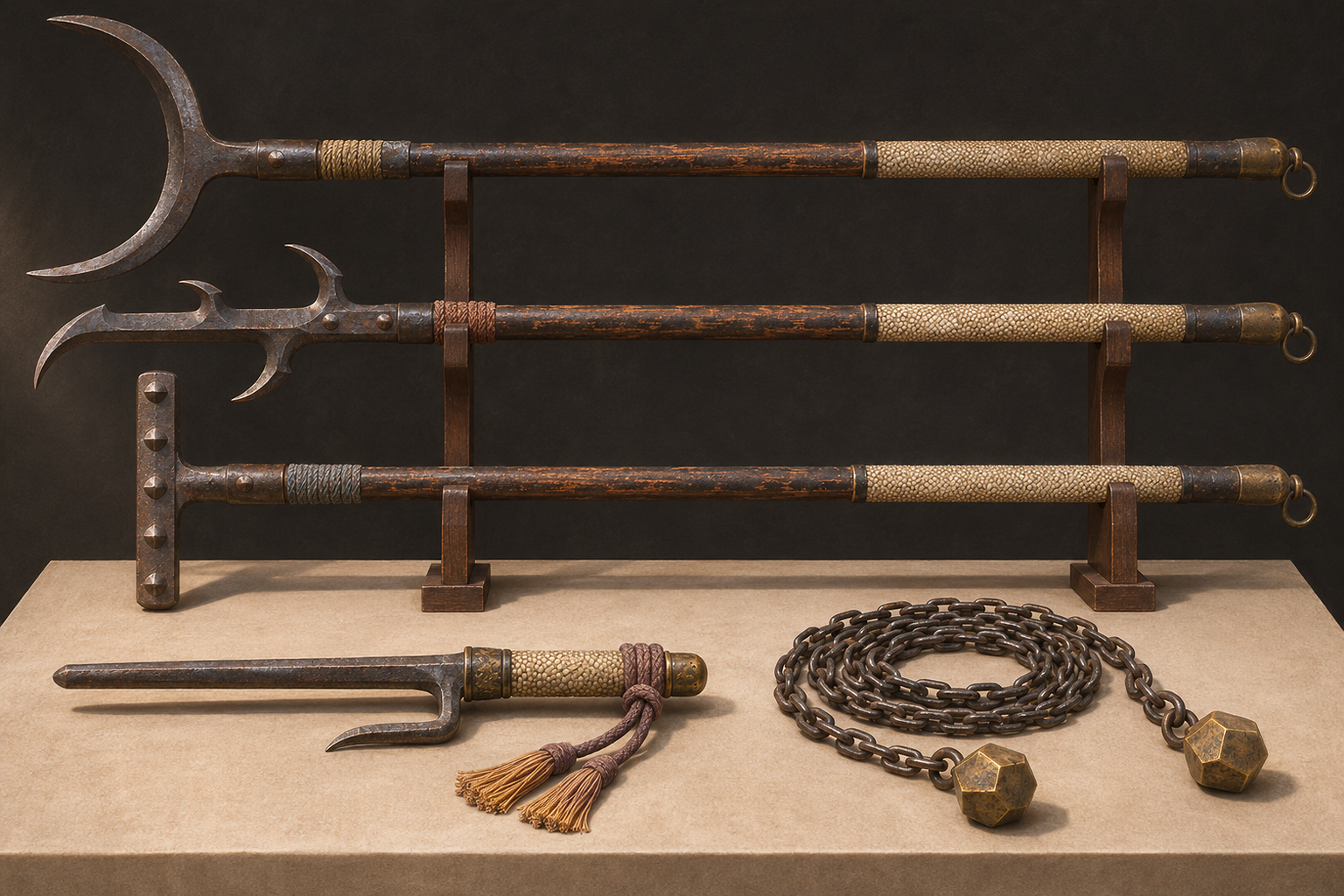
Popular imagination often pictures a lone detective wandering Edo's darkened alleys armed only with a jutte, but historical reality was a matter of coordinated, combined-arms team tactics. When the machi-bugyō officers set out to raid a gambling den, capture an outlaw, or corner a barricaded rōnin, the jutte operated as the command weapon and close-quarters anchor within a multi-layered tactical squad.
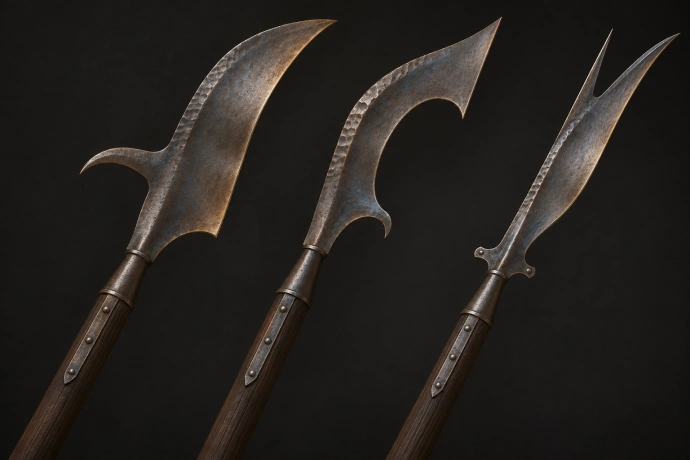
Arrest squads relied on an array of specialized polearms designed specifically to entangle and immobilize without inflicting fatal wounds. These three standard tools, known collectively as the torimono sandōgu ('three arresting tools'), formed the perimeter around the suspect.
Behind these three polearms stood the constable with his jutte, directing the containment. If a suspect managed to break through the forest of barbed poles, or if the confrontation occurred inside a cramped room where two-meter poles could not maneuver, the jutte came into play as the interior containment weapon. Alongside it, constables deployed the manriki-gusari—a short, weighted chain that could be whipped around a sword blade or wrapped around a suspect's ankles—creating a suffocating net of non-lethal control that gave the swordsman no clean target to cut.
The standard triad of specialized polearms included:
- Sasumata: A two-pronged, fork-like iron head mounted on a long wooden pole, used to pin a suspect against walls, screens, or the ground by the neck, torso, or limbs.
- Sodegarami: A pole wrapped in alternating rows of sharp forward- and backward-pointing iron barbs, thrust directly into the voluminous sleeves and garments of a suspect to entangle the cloth thoroughly and immobilize his arms.
- Tsukubō: A T-shaped heavy wooden pole capped with an iron crossbar set with blunt or semi-sharp spikes, used to push back charging adversaries, break down interior screens, or create physical distance.
Morphology and Structural Variations
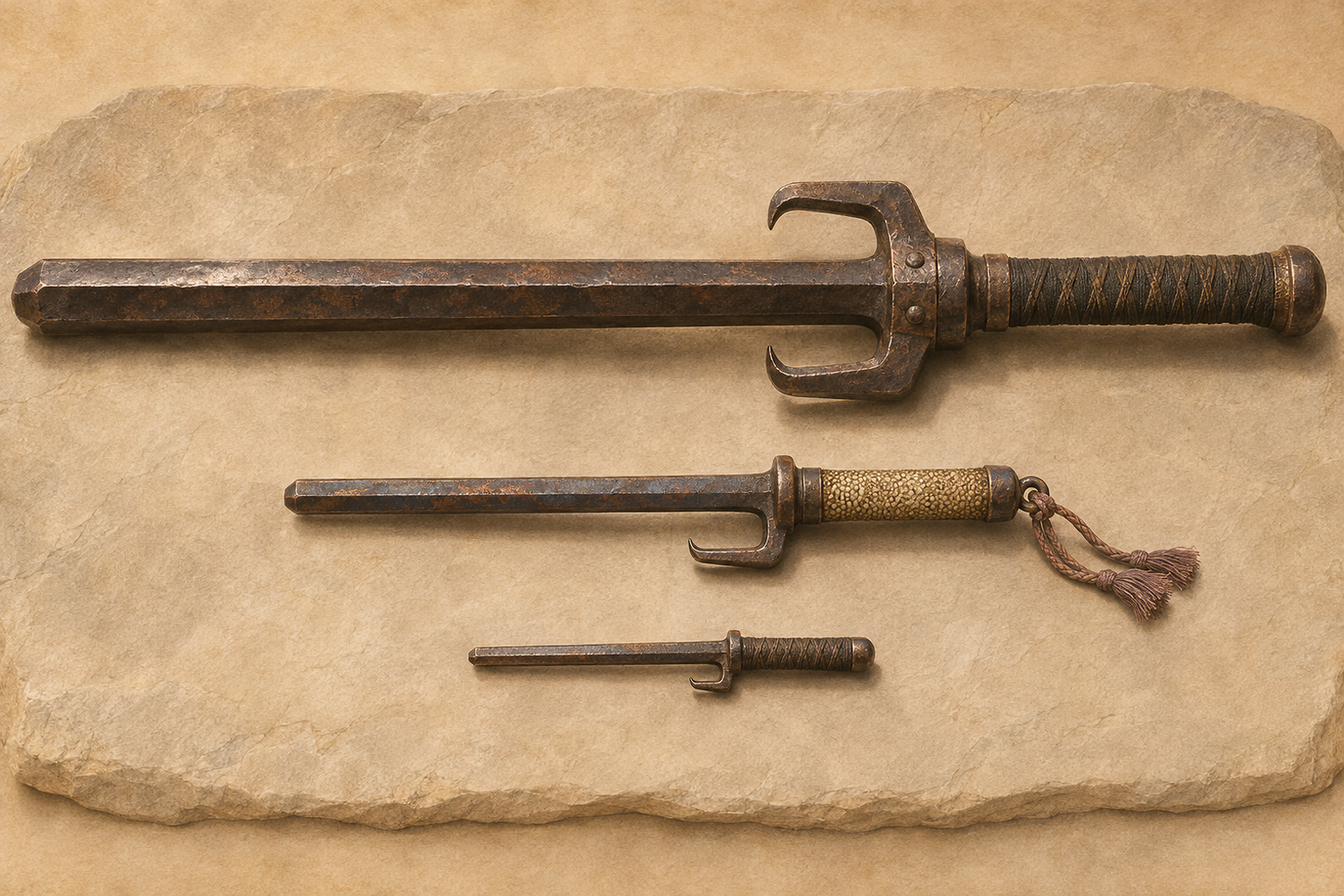
While the standard municipal jutte maintained a recognizable baseline form, surviving museum collections illustrate a remarkable diversity of shapes tailored to specific operational environments. Field-patrol jutte, designed for rural roads or riverbank searches on the outskirts of Edo, were frequently scaled up to lengths of seventy centimeters or more. These longer weapons, sometimes called ō-jutte, sacrificed easy concealment for extended reach, functioning almost like short iron clubs capable of parrying polearms or horse-mounted attackers.
At the opposite end of the spectrum were pocket-sized jutte, barely twenty centimeters in length, designed for discreet undercover work. Known informally as te-jutte, these compact iron bars lacked the long hook of their municipal counterparts, featuring instead a diminutive stub that served merely to catch a blade edge or reinforce the thumb during pressure-point manipulation. Such weapons were easily slipped into the folds of an obi sash or hidden inside a tobacco pouch, allowing plainclothes informers to navigate volatile pleasure quarters without alerting criminal networks to their identity.
Blacksmiths also experimented with hybrid features. Some rare surviving examples incorporate a small, concealed single-shot firearm mechanism within the grip or hollowed shaft, triggered by a hidden lever near the pommel. Others featured sharp, chisel-like tips designed to pry open locked sliding doors or chest lids during midnight searches. Despite these experimental outliers, the overwhelmingly dominant type remained the simple, monolithic solid-iron bar: an indestructible, low-maintenance tool that could withstand decades of violent rain-swept patrol work without mechanical failure.
Disguised Mountings and Civil Dress
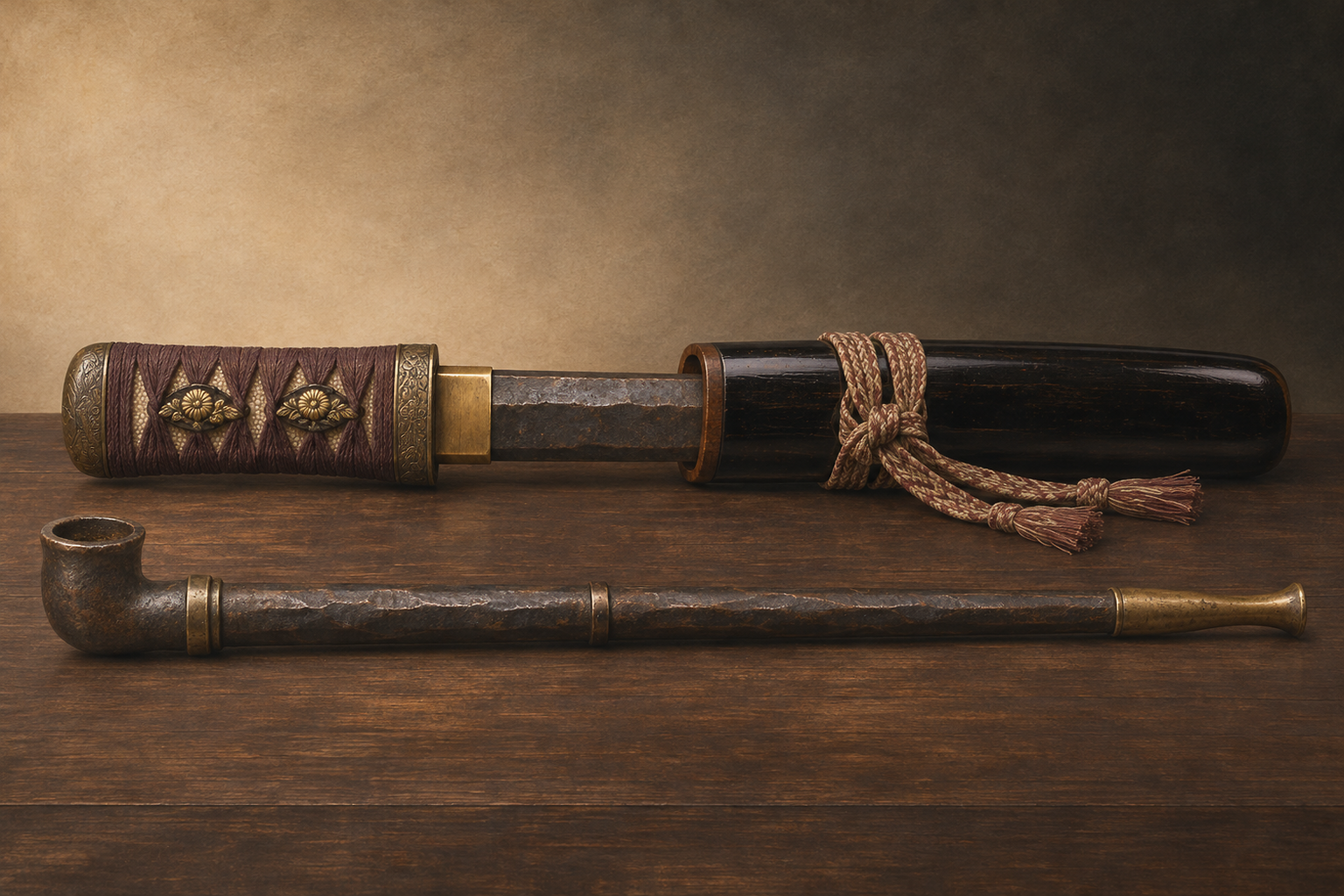
In the strictly regulated social landscape of the Tokugawa shogunate, where carrying arms was closely tied to legal status, weapons that mimicked ordinary household or personal objects offered tactical utility. Both the jutte and the hachiwari lent themselves naturally to deceptive disguises. Because neither weapon possessed a cutting edge, they could be carried in configurations that raised no suspicion among townspeople or administrative gatekeepers.
Many hachiwari were mounted inside traditional wooden daggers, complete with ray-skin hilts, braided silk wraps, ornamental menuki ornaments, and polished lacquer scabbards (saya). To any observer on the street, the wearer appeared to be carrying a standard civil dagger (tanto). Only when drawn from the scabbard did the solid, blunt iron core become visible. This allowed travelers, merchants, or off-duty retainers to carry a durable, shock-absorbing defensive tool into private estates or tea houses where sharp blades might be restricted or considered socially provocative.
Similarly, urban jutte were occasionally forged to resemble iron smoking pipes (kiseru) or portable writing cases (yatate). The kiseru in particular was carried openly by men of all social classes; an iron-bodied pipe with an elongated stem functioned effectively as an impromptu truncheon without violating city ordinances regarding weapon displays. These disguised impact tools highlight a society that was intensely litigious and heavily monitored, where the physical presence of violence had to be carefully masked beneath layers of civil decorum.
Forensic Wear and Museum Artifacts
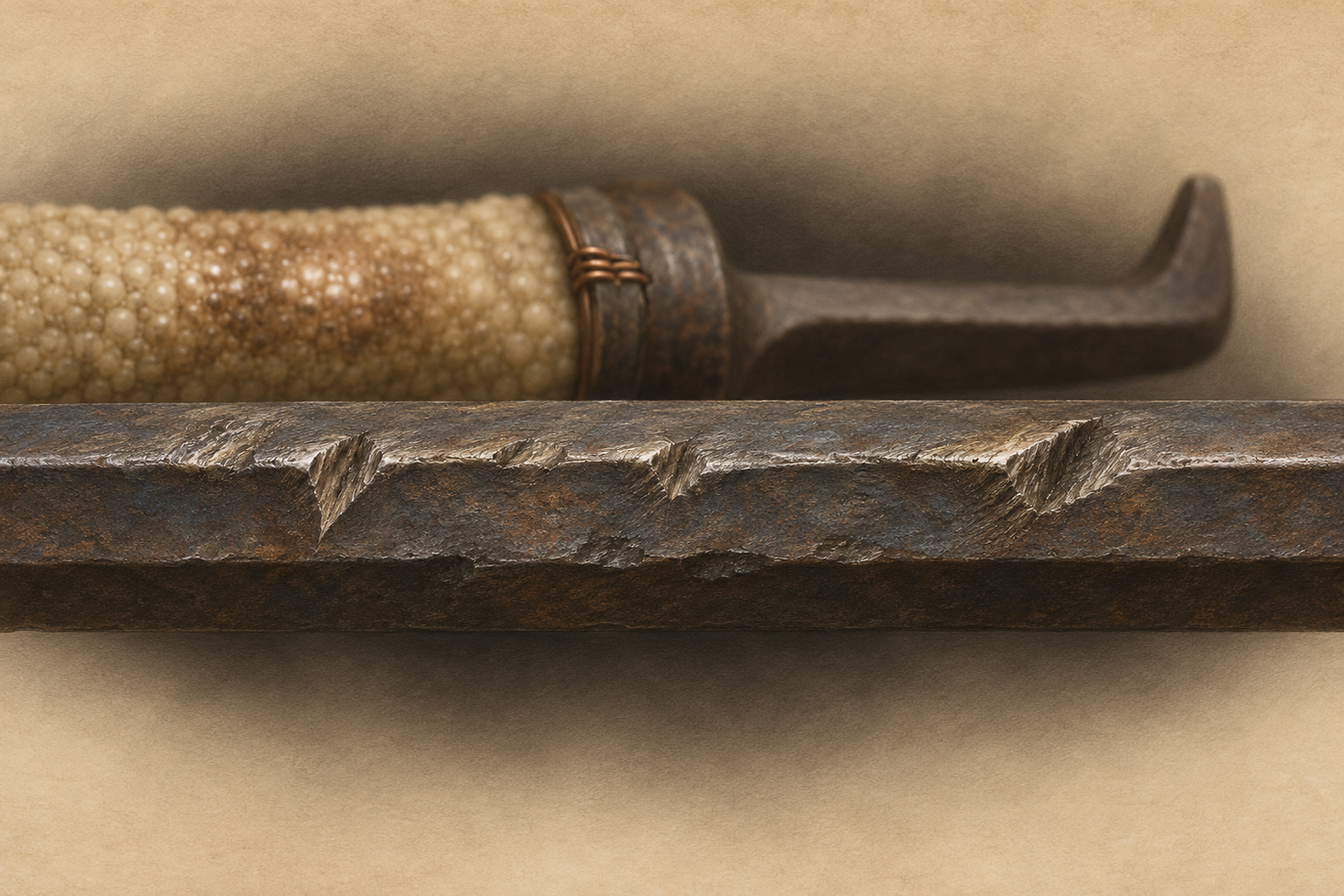
Surviving Edo-period jutte and hachiwari preserved in Japanese municipal collections, police archives, and university museums provide concrete material evidence of their operational history. Unlike presentation swords, which were meticulously polished, oiled, and stored in pristine silk bags, authentic working jutte bear the unmistakable physical scars of violent physical encounters. Microscopic examination of surviving iron shafts frequently reveals distinct clusters of shallow, notched abrasions.
These notches are clustered predominantly along the middle third of the iron bar and inside the inner crook of the kagi hook. The profile of these indentations matches the strike of a convex, hardened sword edge striking a softer, tougher iron bar at high velocity. Because the iron of the jutte was comparatively soft, the edge of an attacking katana would bite slightly into the surface rather than glancing off wildly. This slight indentation helped the constable control the opponent's blade, offering enough surface friction to drag the edge into the trapping hook rather than allowing it to skip off into the defender's shoulder.
Museum specimens also reveal extensive wear on the grip components. Original ray-skin (samegawa) wraps are often worn completely smooth along the high ridges from decades of sweat-soaked handling, while the brass and copper wire bindings frequently show contemporary field repairs. In contrast, many hachiwari preserved in Western and Japanese art collections display pristine lacquer scabbards and elaborate gold fittings. This marked contrast underscores a fundamental divide: while the hachiwari frequently crossed into the realm of eccentric luxury curio and status accessory for wealthy connoisseurs, the working jutte remained a gritty, sweat-stained tool of urban law enforcement.
The Screen and the Page: Transforming the Truncheon into Myth
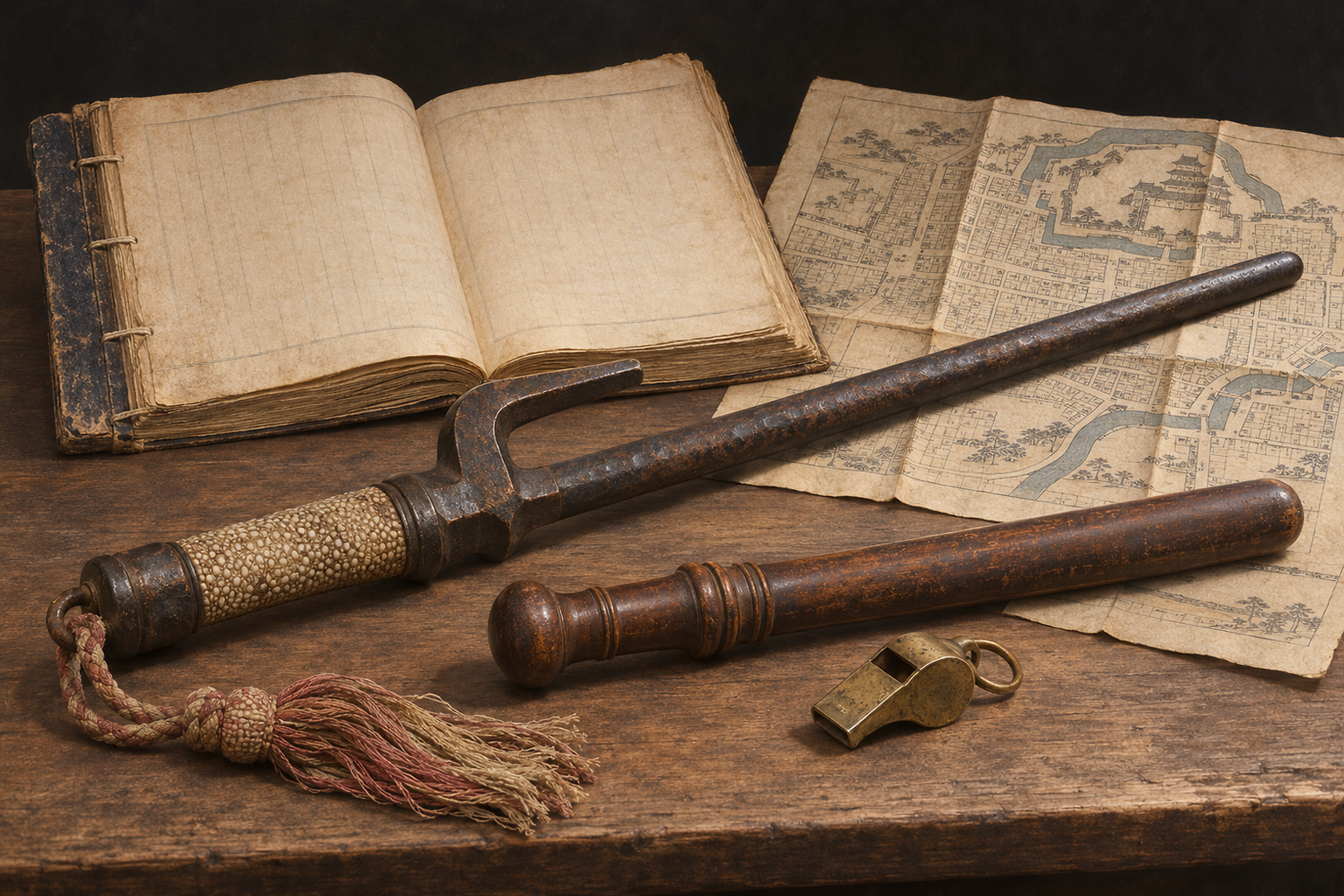
Following the Meiji Restoration of 1868, the feudal policing apparatus of the machi-bugyō-sho was formally dismantled. The newly established Tokyo Metropolitan Police Department adopted Western-style uniforms, sabers, and later wooden batons, pushing the iron jutte into retirement. Yet as the real tool vanished from city streets, it immediately entered the realm of romantic historical memory, finding a vibrant second life in early twentieth-century print literature, theater, and cinema.
The post-war explosion of jidaigeki—historical period dramas on television and film—solidified the jutte in the global imagination. Classic series like Zenigata Heiji transformed the truncheon into an infallible emblem of moral rectitude. In these fictional narratives, the detective spins the heavy iron bar around his index finger with fluid agility, snaps the blades of villainous master swordsmen with a single flick of the wrist, and holds off entire gangs single-handedly. These cinematic conventions vastly exaggerated the weapon's lightness and speed while ignoring the brutal concussive mechanics of its actual historical use.
Contemporary martial arts video games and fantasy fiction have inherited these romanticized tropes, often categorizing the jutte as a fast-striking 'parrying dagger' comparable to the Okinawan sai. Yet when one lifts an authentic, four-hundred-gram solid-iron bar from the late eighteenth century, the theatrical illusion immediately evaporates. The authentic artifact is heavy, rigid, and unapologetically blunt. It was not built for acrobatic flourishes, but for the unforgiving, claustrophobic reality of disarming desperate men under the absolute authority of the Tokugawa state.
Further reading
Follow the sources to examine the object and its historical context.
Meiji University Museum, Criminal Materials Section CatalogueExternal reference · Opens in a new tab Tokyo Metropolitan Police Department Museum Historical ArchivesExternal reference · Opens in a new tab