Between the seventh and thirteenth centuries, the primary single-edged sidearm of the Chinese soldier transformed from a rigid, straight-backed iron blade into a gently swept saber with a broad tip and a disc guard. This evolution answered the changing demands of cavalry combat, advances in infantry armor, and continuous military encounters along China's northern and western frontiers. The straight hengdao of the Tang dynasty marked the culmination of ancient straight-blade traditions, while the peidao of the Song dynasty laid the structural foundations for the sabers used across East Asia through the late imperial era.
The Ancient Lineage of the Iron Dao
The single-edged Chinese sword, or dao, served as a battlefield staple long before the founding of the Tang empire. During the Western Han dynasty, mass-produced iron and steel dao rapidly displaced the double-edged jian as the standard weapon for shock infantry and the cavalry regiments raised to counter the Xiongnu. These early weapons shared a uniform architecture: a straight, stiff blade with a flat spine, a bevel ground on one side or symmetrically to the edge, and an integral ring pommel forged directly onto the tang.
The ring pommel balanced the forward weight of the long iron blade and provided a solid anchor for a fabric wrist lanyard. Over four centuries of continuous use under the Han, Three Kingdoms, and Jin periods, this basic geometry altered very little. The blade was primarily an assertive chopping implement, capable of cleaving textile, leather, and unhardened iron armor plates.
By the close of the Northern and Southern Dynasties, changes in manufacturing and international trade began to alter the sword's exterior dress. Foreign merchants and nomadic federations introduced new fittings, distinct pommel collars, and altered suspension mechanisms. When the Sui dynasty reunified the Chinese heartland in 581 CE, imperial workshops inherited a hybrid bladed tradition that combined ancient Han metallurgy with North and Central Asian ergonomics.
The Four Dao of the Tang Liudian
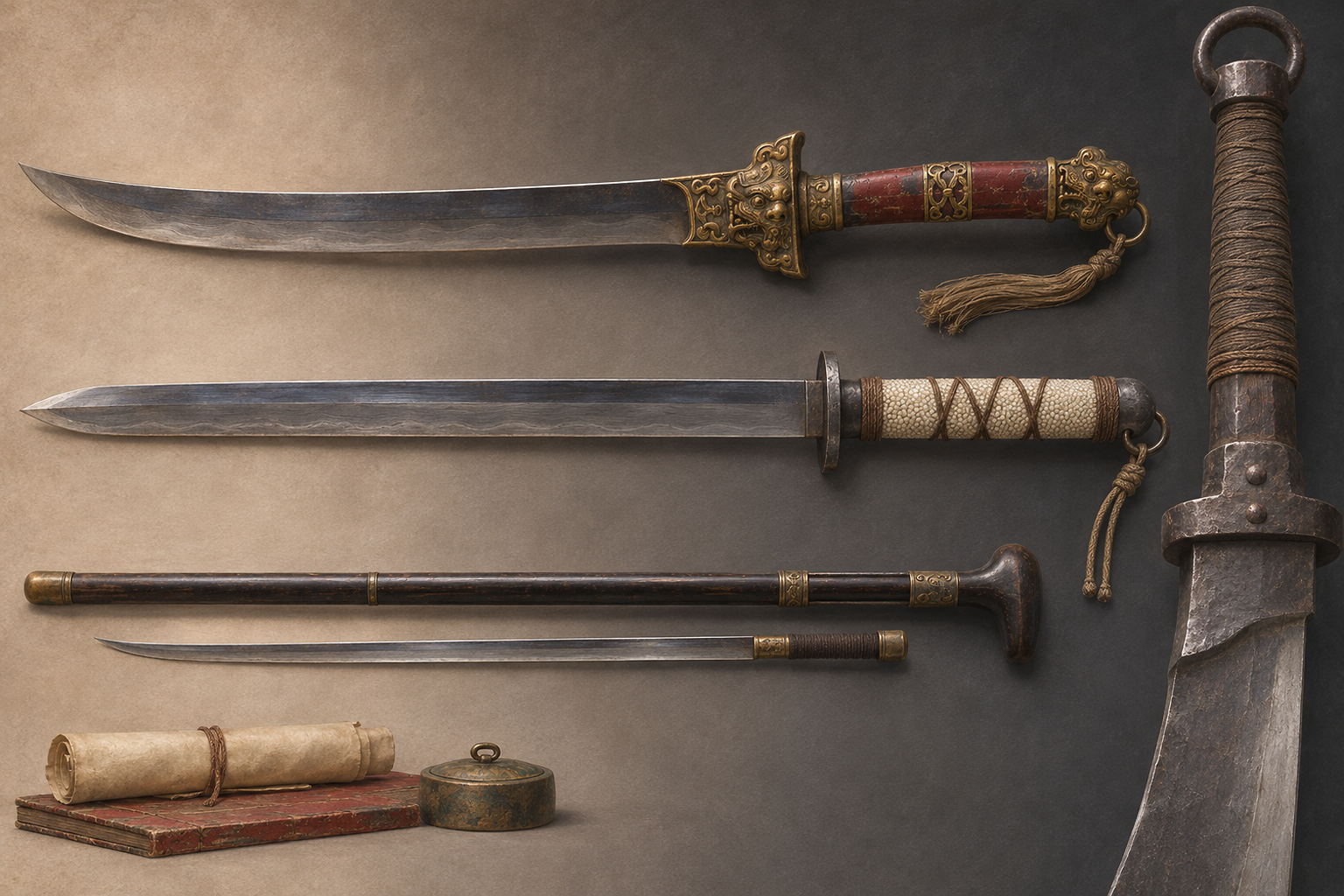
The Tang dynasty regularized this diverse inheritance through bureaucratic standardization. The Tang Liudian, or Six Statutes of the Tang, compiled in 739 CE under the supervision of Li Linfu, records the official administrative divisions of military equipment under the Directorate of Armaments. In scroll sixteen, the text categorizes the edged sidearms of the empire into four distinct designations.
The first was the yidao, or ceremonial sword, worn by courtiers, palace guards, and civil officials as an emblem of rank; these carried gold, silver, and jade fittings. The second was the zhangdao, a staff or cane-mounted sword intended for imperial messengers, imperial bodyguards, and senior retinue members. The third was the modao, a formidable two-handed great weapon assigned to elite heavy shock troops to break enemy cavalry charges. The fourth and most widespread was the hengdao, literally the 'horizontal blade' or cross-sword, carried as the universal sidearm of line infantry, cavalry, and regional garrison troops.
The designation hengdao referred to the manner in which the weapon hung across the wearer's hip, suspended horizontally or at an angle by cords rather than held vertically inside a scabbard slide. While the Tang Liudian establishes the names and bureaucratic allocations of these four types, it provides neither measurements nor metallurgical recipes. Reconstructing the physical reality of the Tang sidearm requires turning from administrative ink to physical relics.
Artifacts of the Shōsōin and the Tang Archaeological Gap
Physical iron weapons from the Tang dynasty are virtually absent from the modern archaeological record within China. The acidic soils of the central plains, paired with strict sumptuary laws that discouraged burying functional weapons in civilian tombs, have corroded most steel blades into fractured, unreadable oxides. What domestic excavations have yielded—such as the stone reliefs from the tomb of General Gao Li in Shaanxi or burial murals at Dunhuang—provides profiles of hilts and scabbards, but leaves cross-sections and steel grain invisible.
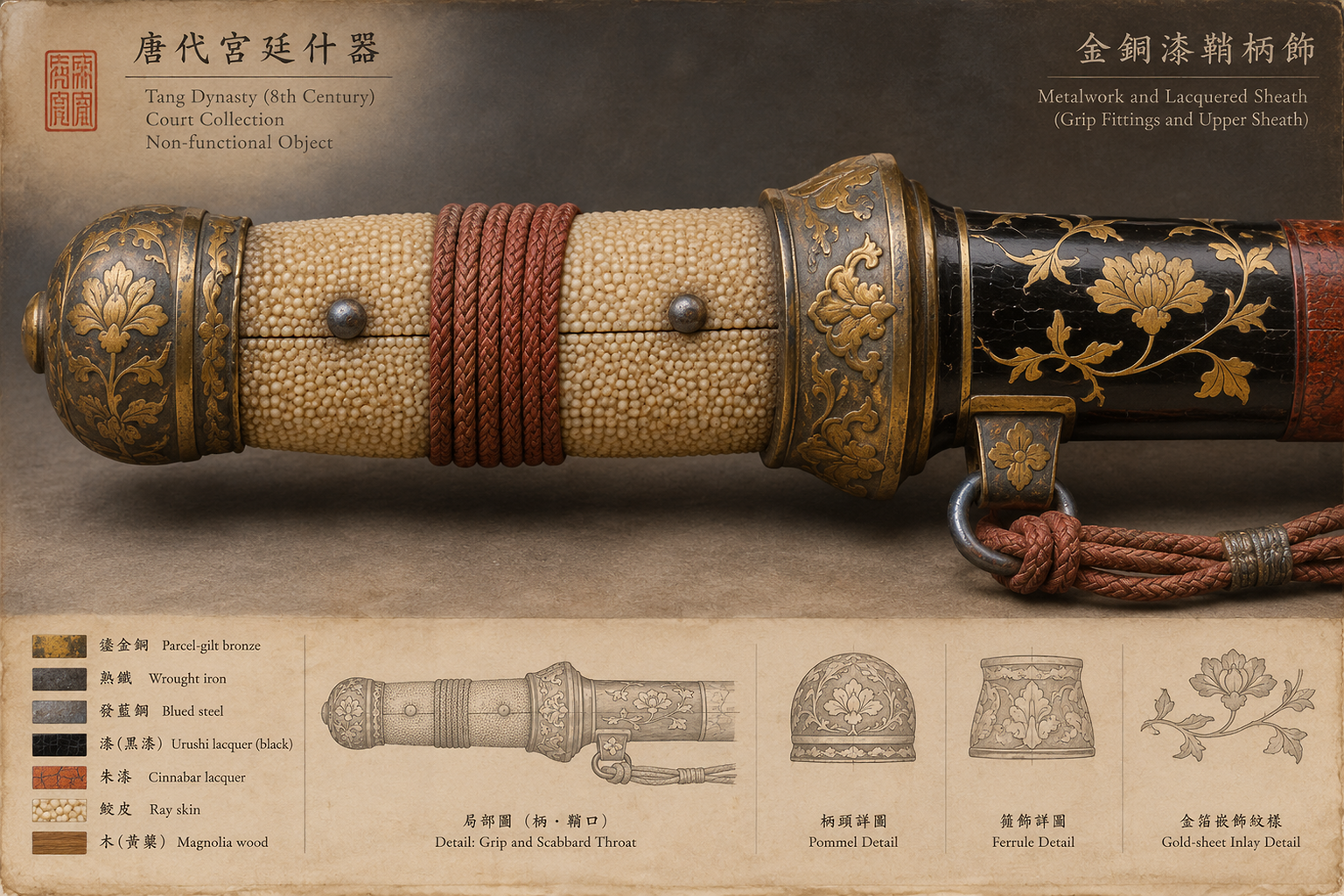
The primary reference point for intact eighth-century Tang swords survives across the Yellow Sea in Nara, Japan. The Shōsōin repository, founded at Tōdai-ji by Empress Kōmyō in 756 CE, preserves ritual objects, household goods, and high-status weaponry from the Nara court, including imported continental swords designated as kara-tachi (Tang-style blades). These artifacts were either brought back directly by Kentōshi (Japanese embassies to the Tang court) or manufactured in Japan by immigrant guilds working in direct imitation of contemporary continental methods.
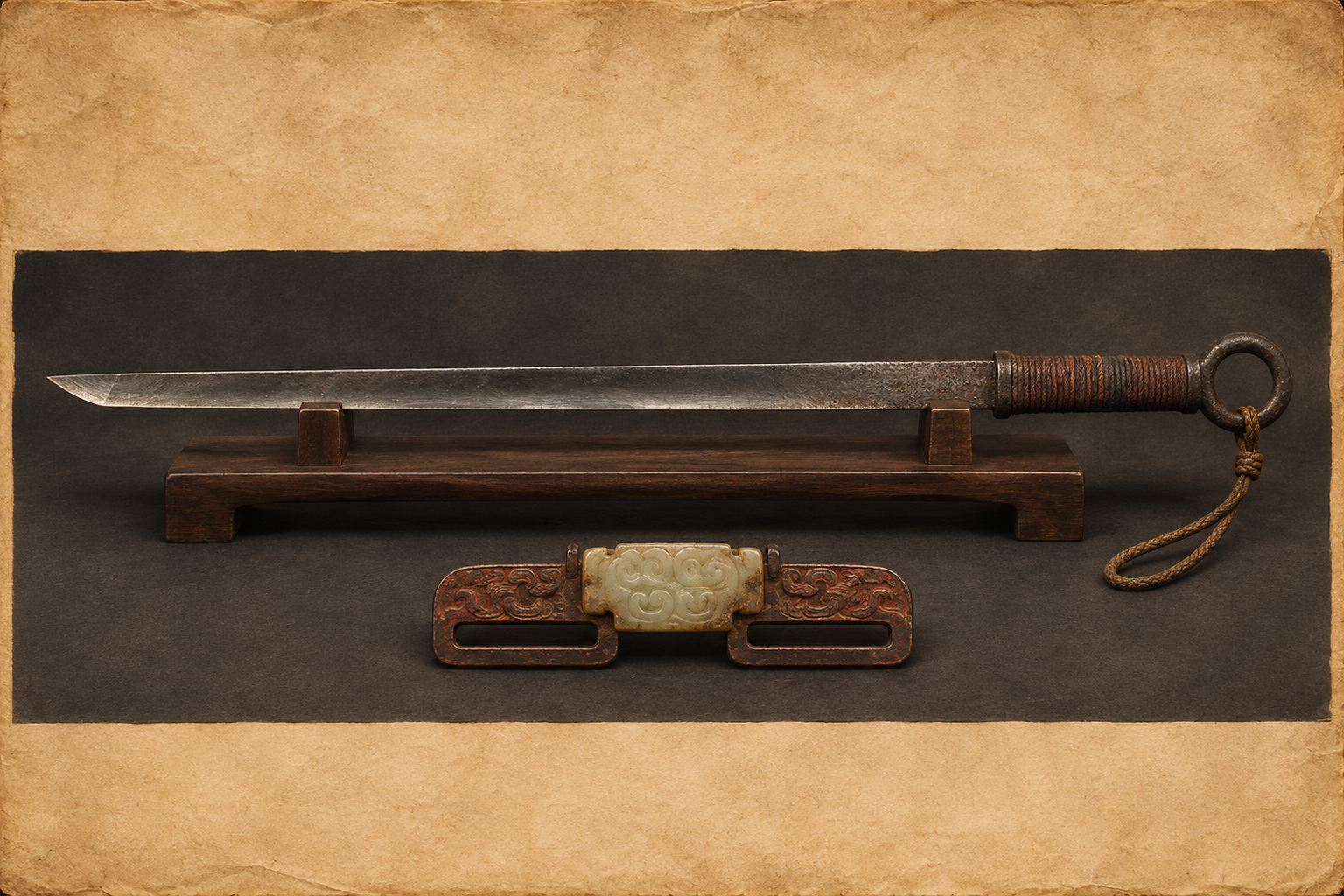
The Shōsōin blades display a remarkable consistency. They feature straight, narrow, single-edged iron plates without curvature. Their tangs are long, fitted with wooden hilt slabs secured by metal collars and soft-soldered pins, terminating not in ancient ring pommels, but in hollow caps or cast bronze fittings. These weapons show that high-status Tang swords had discarded the integral ring pommel in favor of an enclosed, sleeved hilt construction.
Two-Point Scabbard Suspension
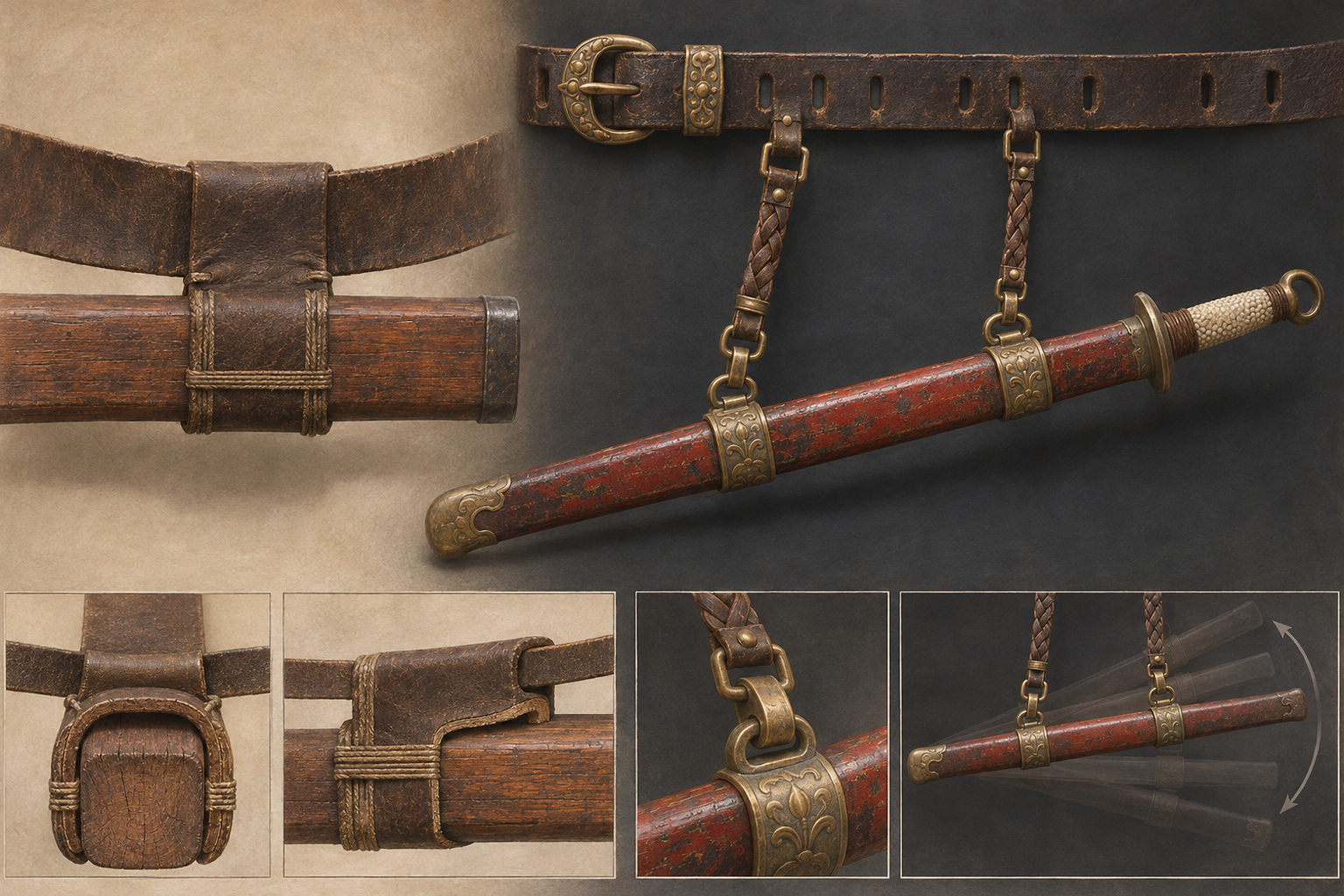
One of the decisive mechanical transformations separating ancient Chinese blades from the Tang sidearm was the scabbard suspension system. Han-era swords relied on a scabbard slide, an oblong bracket bound to the upper third of the sheath through which a leather belt was threaded. This fixed the scabbard snugly against the wearer's hip at a forward tilt, an effective setup for an unarmored footman, but clumsy for a rider navigating a saddle.
During the sixth and seventh centuries, Tang armorers adopted the two-point suspension system, a mechanism that had developed among Sasanian Persians, Sogdian traders, and the nomadic confederations of the Eurasian steppe. This design employed two discrete scabbard bands, each fitted with a small loop, suspended from a waist belt by split straps of varying lengths.
This mounting configuration addressed the tactical demands of combined-arms armies operating both on foot and in the saddle.
This mechanical independence allowed the hengdao to remain comfortable during long marches, stable during a cavalry gallop, and instantly reachable whether the wearer stood, ran, or mounted a horse.
The two-point suspension offered distinct tactical improvements:
- Dynamic self-alignment: The suspended scabbard rotated freely when the wearer sat in a high wooden saddle, preventing the tip from digging into the earth or tangling the reins.
- Load redistribution: The weight of the weapon was split across two points along the utility belt, reducing local wear and pulling forces on lamellar waist armor.
- Adjustable draw angle: By altering the length of the rear suspension cord, the soldier could adjust the blade's resting angle from horizontal to nearly vertical.
Cross-Section and Edge Geometry of the Straight Hengdao
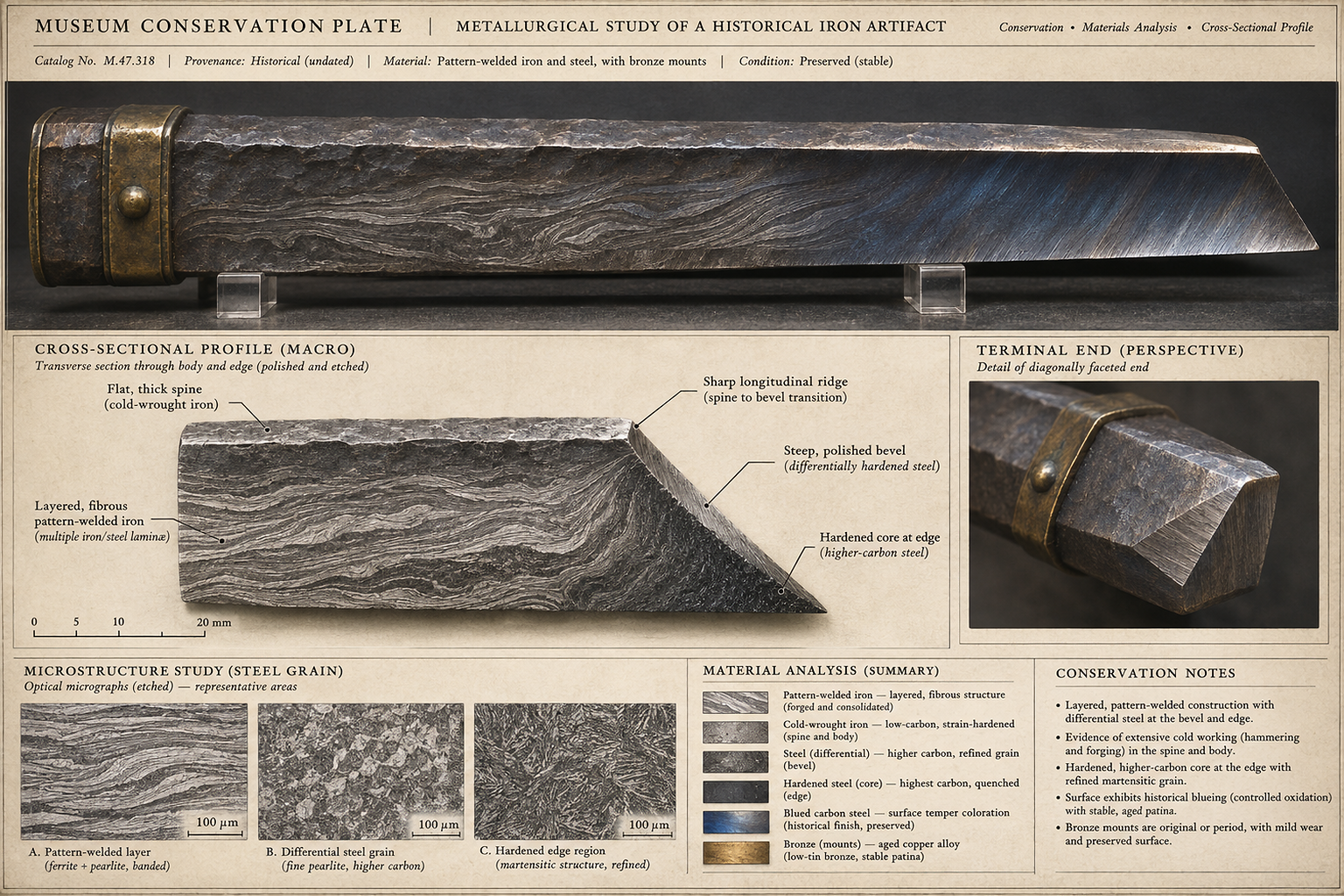
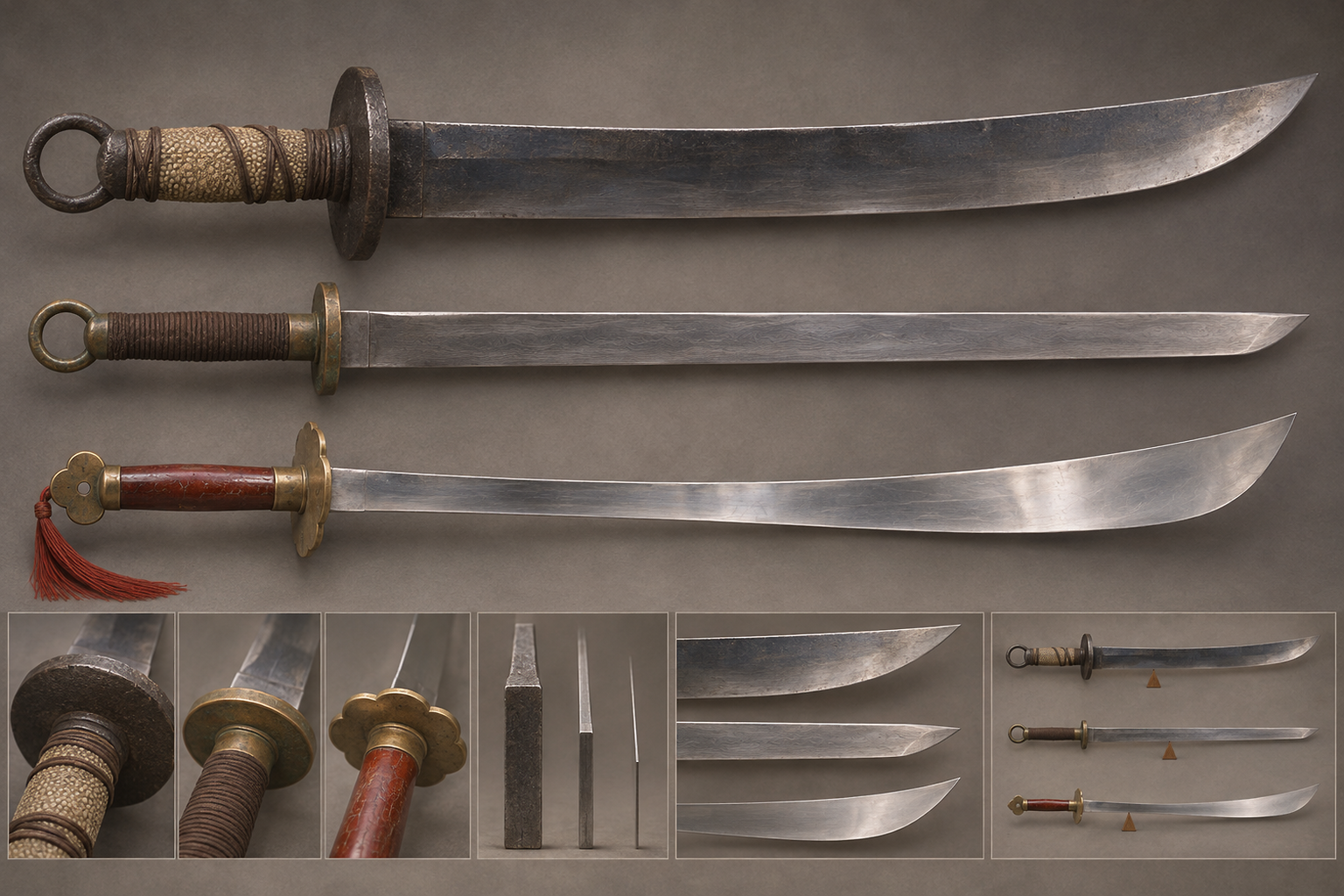
The typical cross-section of a high-status straight hengdao was crisp and angular. Surviving continental blades and their close insular counterparts generally show a profile known in modern blade terminology as kiriha-zukuri, a ridged, chisel-like cross-section. The blade features a thick, flat back that maintains uniform thickness until tapering toward the tip. Near the cutting edge, the steel breaks abruptly into a steep, flat primary bevel, creating a robust wedge behind the cutting edge.
This edge geometry was not optimized for soft tissue slicing; it was engineered to resist severe impact against iron mail, lamellar plates, and lacquered rawhide. By placing a heavy volume of steel directly behind the apex of the edge, the blade gained structural resilience against chipping or curling when meeting hard obstacles. The cross-section also retained substantial lateral stiffness, allowing the soldier to use the straight tip in direct thrusting attacks against armor gaps.
The tip itself typically terminated in an angled, chiseled point, formed by cutting the spine downward in a straight, diagonal line toward the edge, or by sweeping the edge upward into a sharp triangle. This made the tip stiff and wedge-like. While efficient at piercing layered textile and hide armors, this straight, tip-neutral balance demanded substantial wrist effort during rapid swings.
Steppe Encounters and the Physics of the Curved Edge
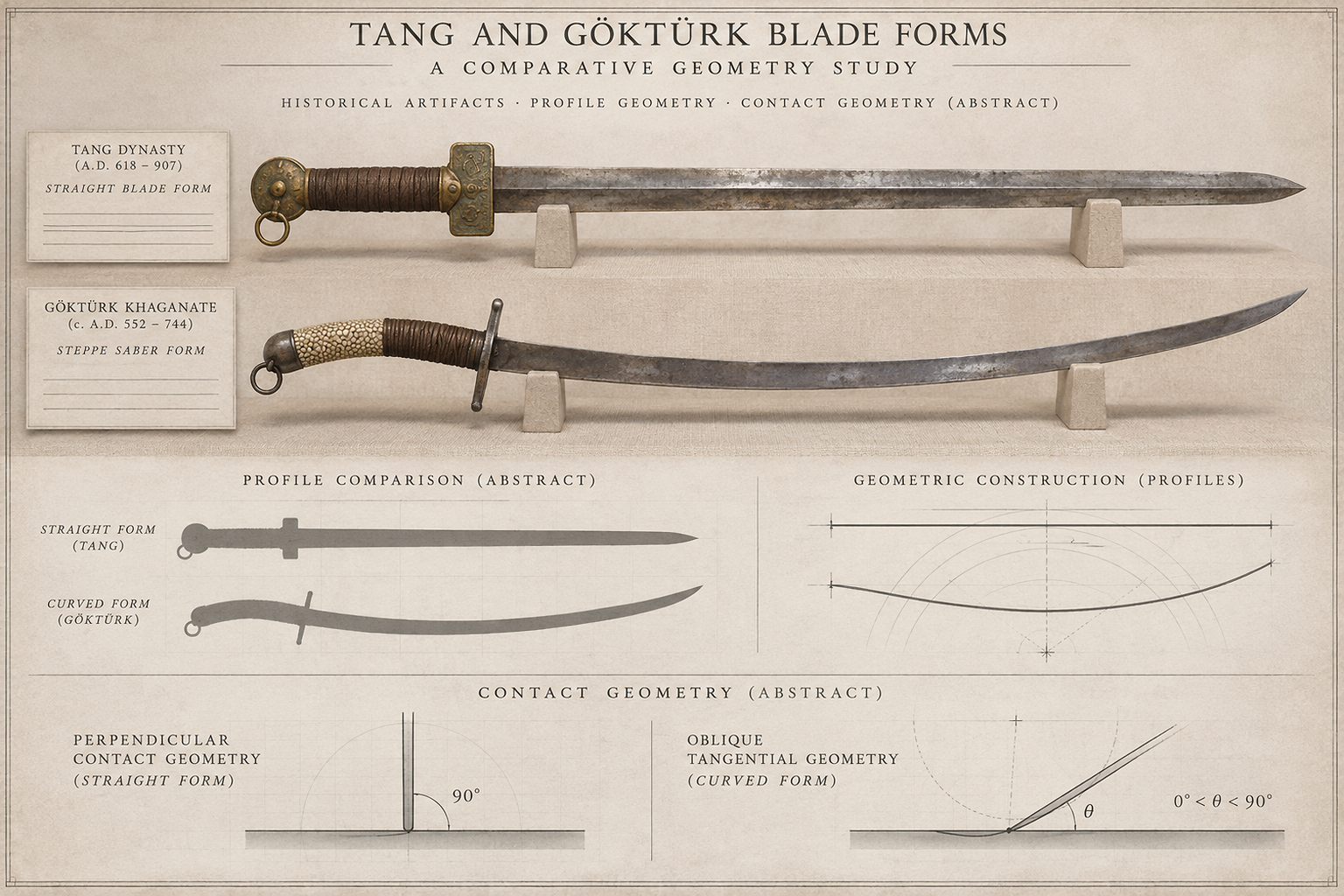
Throughout the eighth and ninth centuries, Tang military expeditions engaged continuously with mobile nomadic powers, including the Eastern and Western Göktürks, the Uyghur Khaganate, and later the Khitans. These steppe peoples fought almost exclusively on horseback, relying on powerful composite bows supported by light, agile sabers. These early Eurasian sabers carried a slight, continuous curvature along the length of the blade.
Curvature fundamentally alters the physics of an edged strike, particularly from horseback. When a straight blade strikes an opponent, the entire force of the blow delivers an impact perpendicular to the target. If the weapon strikes armor or bone, it transfers a severe shock back through the hilt into the rider's wrist and forearm, frequently knocking the blade off course or wrenching it from the hand.
A curved blade, by contrast, automatically initiates a draw cut upon impact. Because the cutting edge meets the target at an oblique angle, the forward momentum of the horse or the arm pulls the edge across the surface as it makes contact. This converts raw percussion into a slicing action, effectively increasing the length of the wound while reducing shock to the wielder's arm. As Tang frontier armies integrated more nomadic auxiliaries and cavalry tactics, imperial armorers began recognizing the operational advantages of curved steel.
The Five Dynasties and Khitan Proto-Sabers
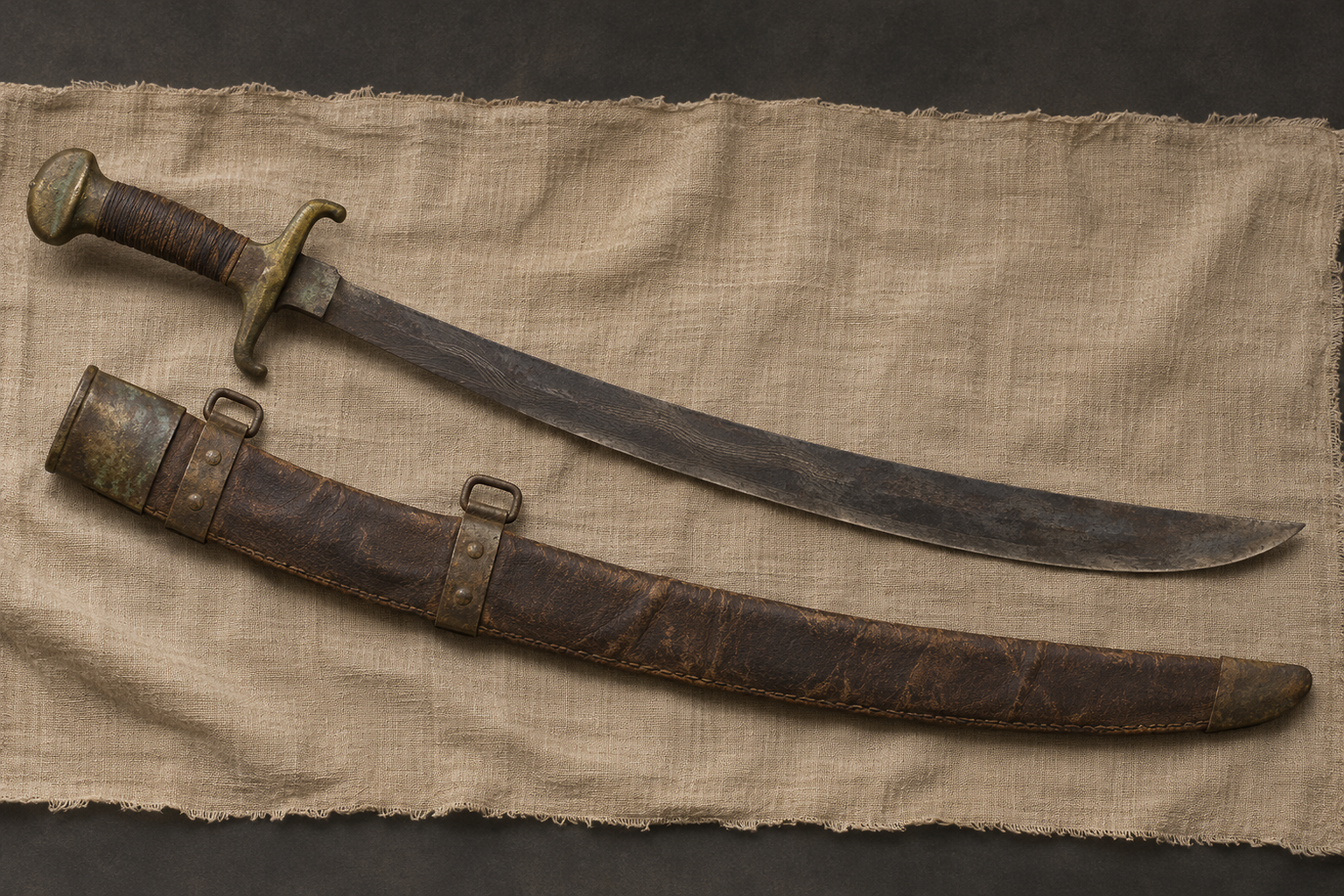
The collapse of the Tang dynasty in 907 CE plunged China into the chaotic Five Dynasties and Ten Kingdoms period. Over fifty years of regional warfare shattered the centralized armories of Chang'an and Luoyang, forcing provincial warlords to equip their armies rapidly through private foundries and frontier trade. During this turbulent half-century, the Khitan people established the Liao dynasty in the north, creating an empire that fused nomadic cavalry traditions with Chinese administrative structures.
Excavations of Liao-era aristocratic tombs in Inner Mongolia and Hebei show a hybrid class of sidearms. These blades display a distinct, gentle sweep, often measuring between two and four centimeters of total curvature over an eighty-centimeter blade. The tangs of these Khitan weapons are frequently stepped or angled slightly downward relative to the spine, a subtle ergonomic modification that helps align the wrist for powerful draw cuts from the saddle.
These tenth-century proto-sabers also shed the narrow, delicate fittings of the Tang period. Their scabbards feature heavier cast bronze or iron chapes, reinforced suspension collars, and wide, flared crossguards designed to stop an opposing blade during mounted clashes. When the northern warlord Zhao Kuangyin unified central China as the Song dynasty in 960 CE, his soldiers were already carrying sidearms that combined straight Tang roots with Khitan curvature.
Song Arsenal Production and the Junqijian
The Song dynasty faced a strategic situation radically different from that of the Tang. Lacking control of the northern horse-breeding pastures of the Ordos and the Yan-Yun regions, the Song could not maintain the massive cavalry forces that had guarded earlier dynasties. Song defense rested primarily on infantry, defended positions, crossbow arrays, and disciplined combined-arms formations designed to shatter enemy cavalry attacks.
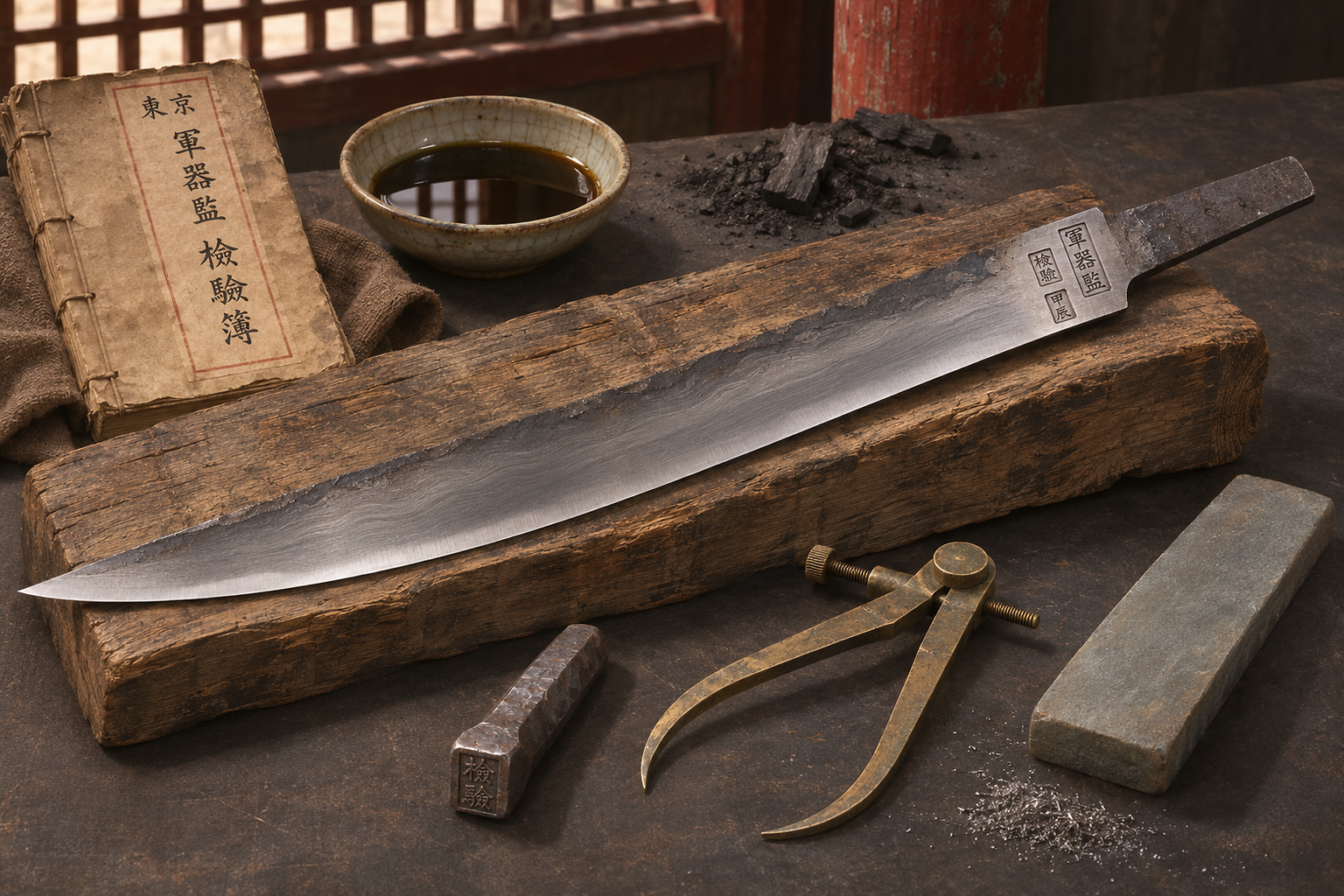
To equip these vast infantries, the Song established an unprecedented state-run manufacturing bureaucracy centered on the Junqijian, or Directorate of Armaments. Operating out of the capital at Kaifeng and major provincial capitals, the Junqijian oversaw state workshops employing tens of thousands of specialized artisans, organized into separate departments for iron smelting, blade forging, woodwork, scabbard lacquering, and quality assurance.
State regulations required every finished weapon to bear stamped or engraved inscriptions naming the workshop, the master armorer, the inspecting official, and the production year. If a blade snapped or chipped during official testing, the supervisory chain faced direct administrative penalties. This rigorous factory system produced hundreds of thousands of uniform, field-ready sidearms, but it also prioritized robust durability over the exquisite, individualized fit and finish seen on aristocratic Tang swords.
The Typology of the Wujing Zongyao
The definitive textual record of Song military equipment is the Wujing Zongyao (Compendium of Military Classics), compiled by imperial scholars Zeng Gongliang and Ding Du between 1040 and 1044 CE. Written to address the growing military threat of the Western Xia and the Khitan Liao, the text includes illustrations and descriptions of contemporary weaponry across every branch of the imperial military.
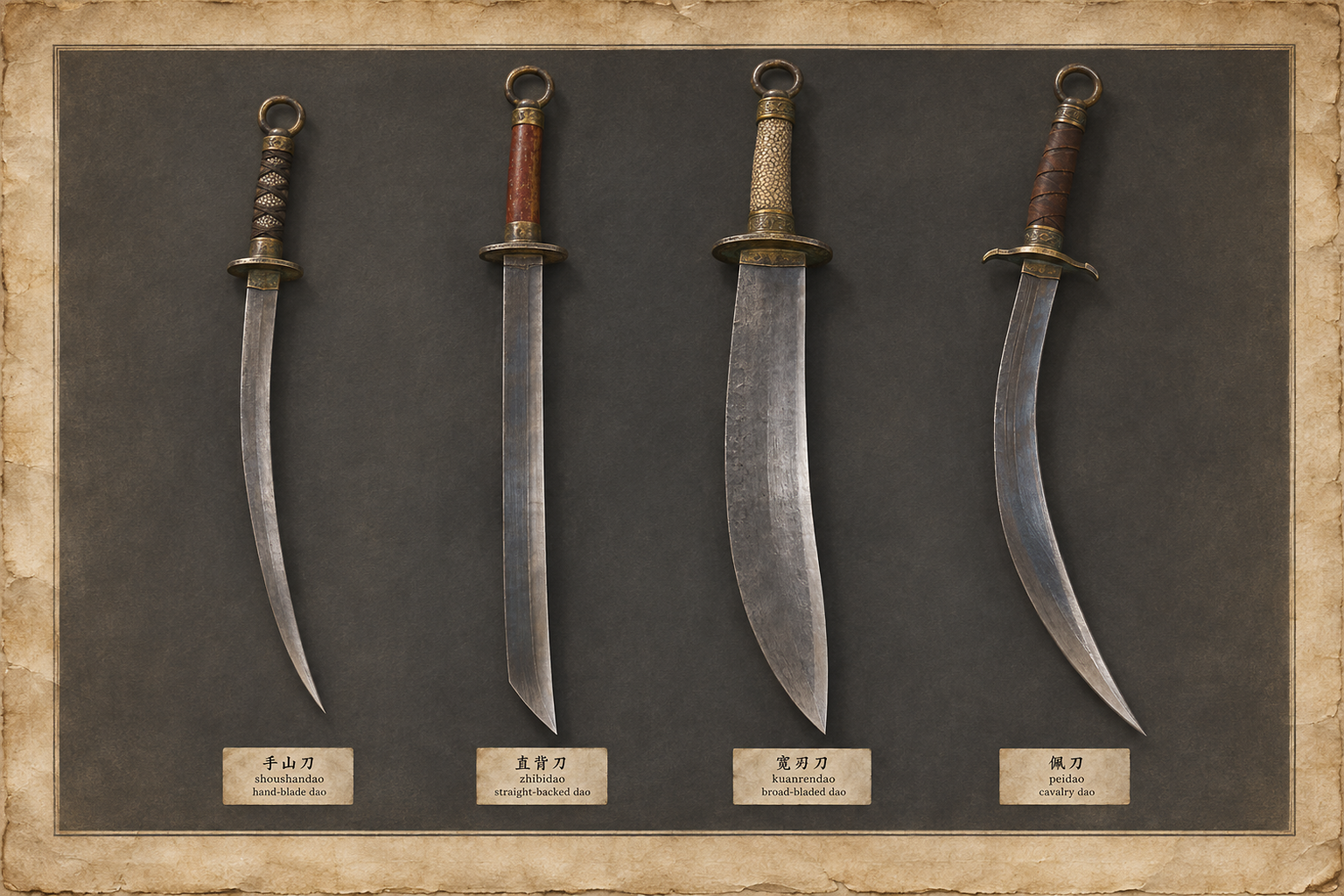
The Wujing Zongyao catalogs eight distinct military dao, demonstrating that the sidearm had splintered into specialized forms based on unit roles. While several entries illustrate long polearm dao used to dismantle cavalry, the sidearms carried at the belt are grouped under names that highlight functional variations: the shoushandao (hand-held dao), the zhibidao (straight-backed dao), the kuanrendao (broad-bladed dao), and the general category of the peidao (girdle or belt dao).
The woodblock illustrations in surviving editions of the Wujing Zongyao depict blades that are markedly broader than the narrow Tang hengdao. The weapons display a pronounced widening of the blade toward the tip, curved spines, and broad, triangular points. The uniform, needle-straight profile of the Tang era was officially replaced by an array of heavy, tip-weighted choppers designed to smash through iron armor.
The Widening Tip and Shift in Dynamic Balance
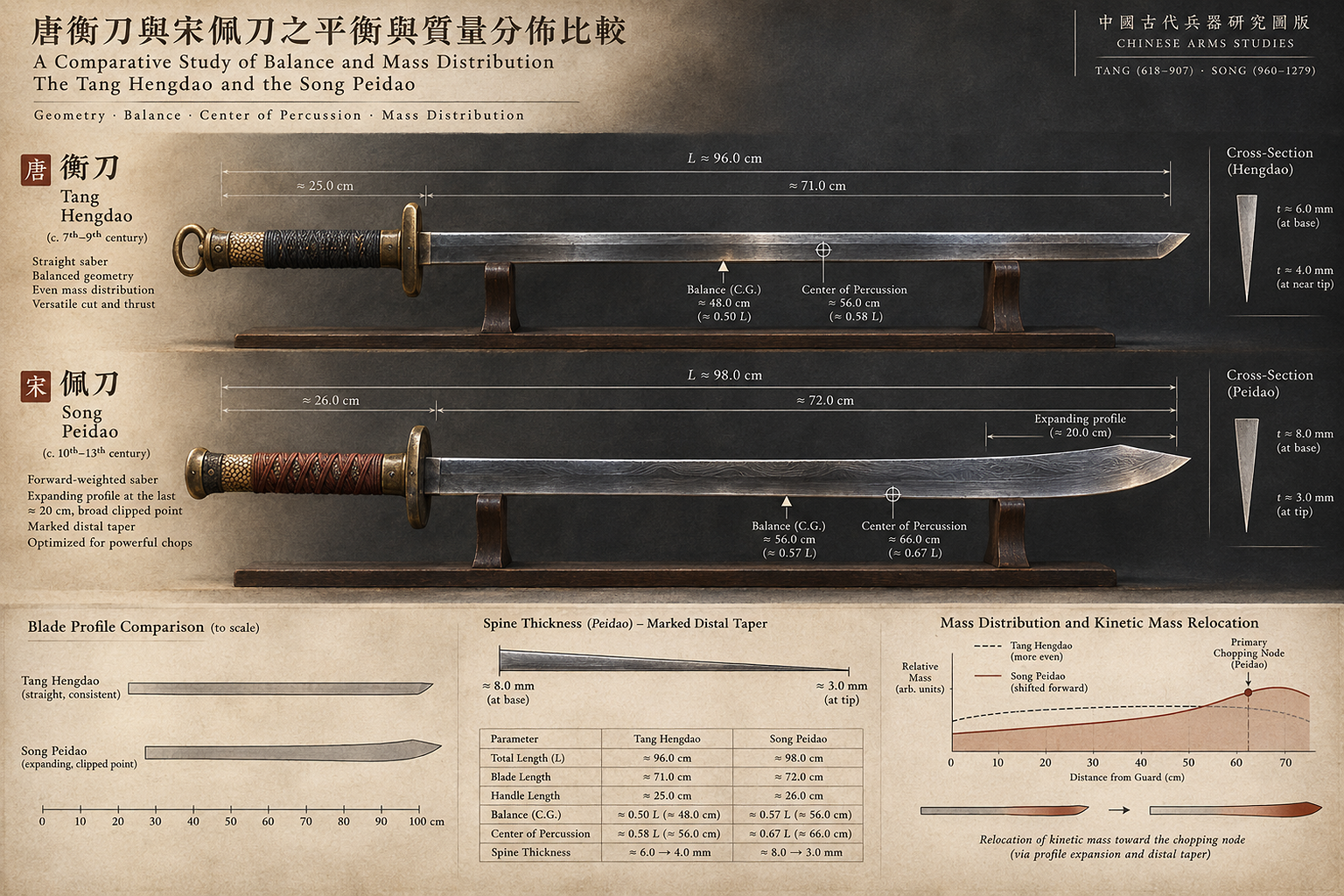
The most critical functional difference between the Tang hengdao and the Song peidao was the relocation of the blade's center of percussion. The Tang hengdao maintained a narrow profile with minimal profile taper, and its mass was distributed evenly along its length. This gave the straight blade a quick, agile feel suitable for rapid fencing, thrusting, and unarmored targets, but limited the sheer kinetic force of a single cut.
The Song peidao shifted its weight forward. Armorers widened the distal third of the blade, expanding the width of the steel near the point. In many excavated examples from the Southern Song, the blade widens by ten to twenty percent over its final twenty centimeters, terminating in a swept or clipped point. At the same time, the spine of the blade was given a noticeable distal taper, thinning progressively from a thick eight-millimeter base near the guard to three millimeters behind the expanded tip.
This combination reshaped cutting dynamics, allowing a relatively short blade to deliver striking power comparable to a much heavier weapon.
By concentrating steel at the point of impact while thinning the spine, the Song peidao delivered massive cutting energy without requiring excessive total weight. It functioned less like a light rapier and more like a weighted cleaver, capable of bursting open iron lamellae, crushing mail links, and shearing through thick padded defensive coats.
The forward-weighted blade changed how the weapon functioned in combat:
- Increased kinetic delivery: The forward-shifted center of mass magnified the chopping force delivered at the primary striking node.
- Torsional stability: The wider profile prevented the blade from twisting when cleaving through curved metal helmets and shoulder guards.
- Controlled recovery: Distal thinning of the spine prevented the expanded tip from becoming clumsy, allowing the soldier to recover the weapon after a missed stroke.
Guard and Grip Ergonomics: Rise of the Disc Guard
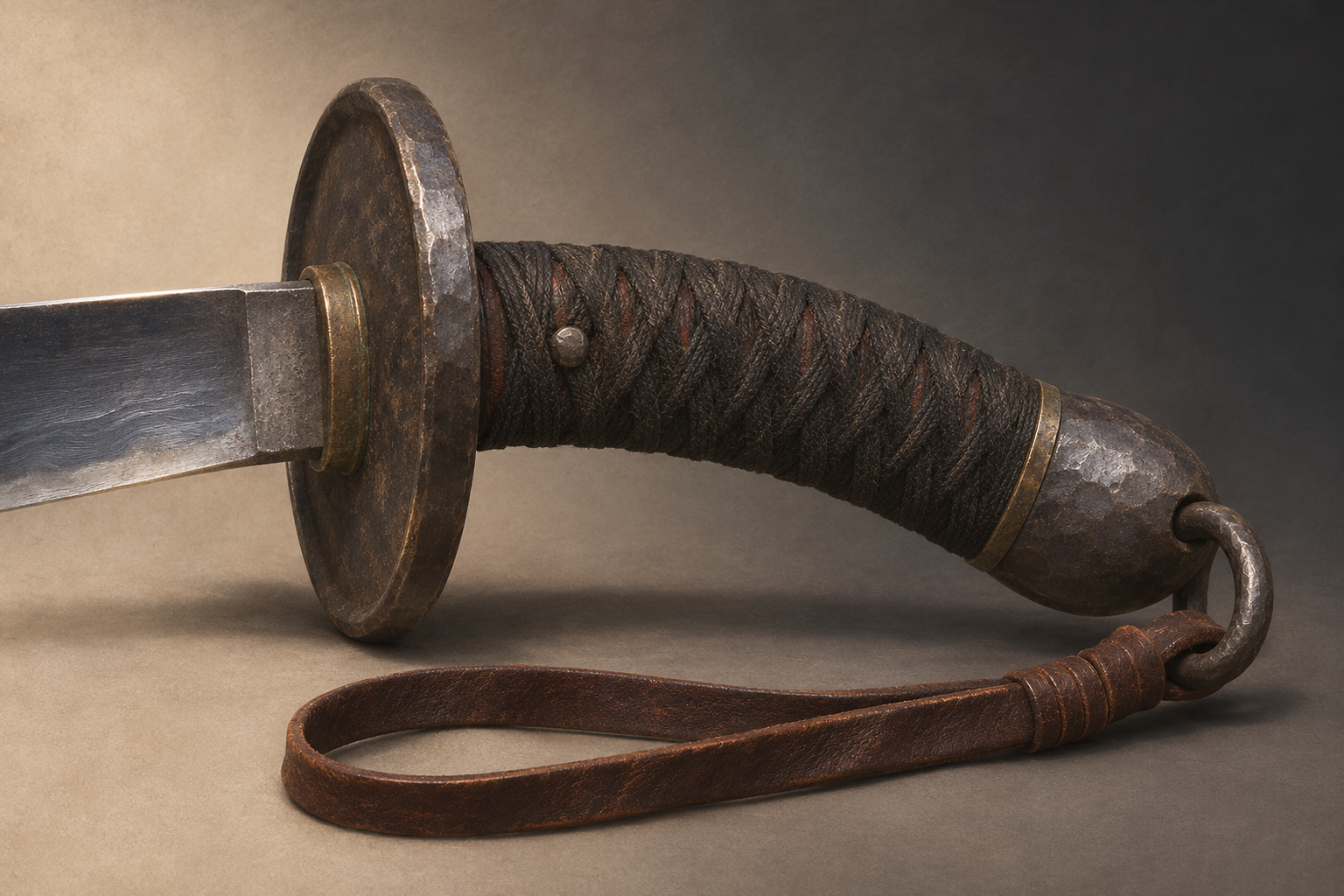
The evolution from hengdao to peidao brought a complete redesign of the sword's hilt furniture. Tang swords typically featured minimal, low-profile fittings: a slim oval guard or simple ferrule collar (yuanpan) that sat flush against the mouth of the scabbard, complemented by an understated wooden grip wrapped in braided cord or ray skin. These small fittings kept the weapon streamlined against the body, but offered almost no protection for the user's hand.
In Song line infantry formations, close-quarters combat was chaotic and crowded. Soldiers found themselves parrying heavy polearms, maces, and opposing sabers. In response, Song armorers introduced the iron disc guard, an oblong, circular, or four-lobed plate positioned between the grip and the blade base. This guard blocked opposing blades from sliding down the spine onto the fingers and shielded the knuckles from glancing blows.
Grip ergonomics evolved simultaneously. Surviving Song-era sabers reveal grips that curve gently downward toward the pommel, aligning the wrist with the sweep of the edge. The pommel itself abandoned the flush decorative caps of the Tang. Instead, it was reinforced with a heavy iron cap or flattened loop ring through which a substantial leather lanyard could be tied, securing the weapon to the soldier's wrist during violent close-quarters brawls.
Steelmaking and Lamination: Bailian Iron and Inserted Edges
The mechanical shifts in blade profile were supported by advances in Chinese iron and steel metallurgy. The Song dynasty witnessed an unprecedented expansion in coal-fired iron smelting, producing vast quantities of pig iron and refined wrought iron. However, raw hardness alone does not make a reliable sword; a blade made entirely of high-carbon steel is brittle and snaps under impact, while one made entirely of low-carbon iron bends and loses its edge.
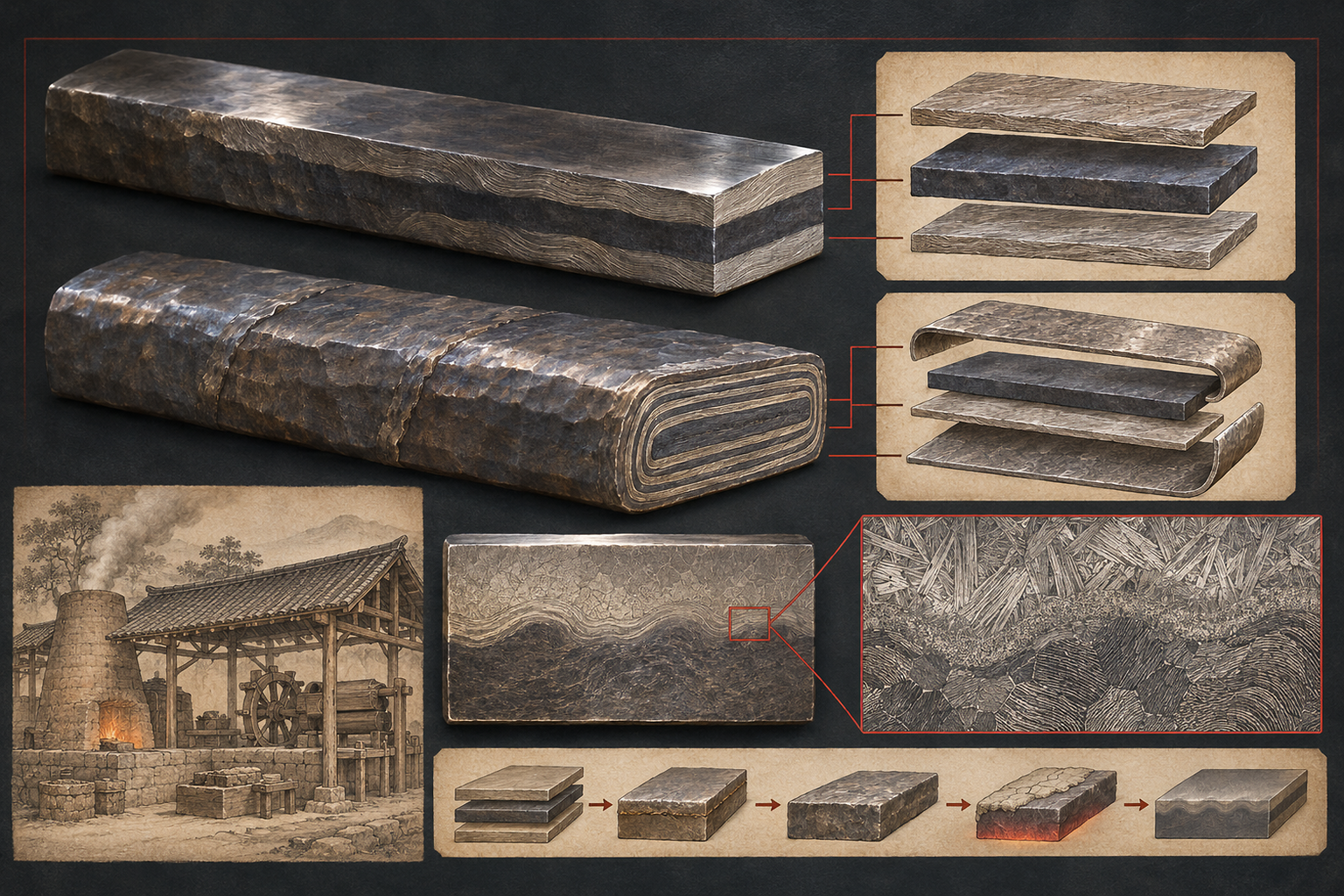
Song arsenals relied on refined pattern-folding techniques known historically as bailian gang, or 'hundred-refined steel'. Artisans repeatedly folded, hammered, and welded billets of iron and steel to homogenize carbon content, disperse slag inclusions into microscopic filaments, and introduce fibrous toughness. To combine shock resistance with a lasting edge, armorers employed sophisticated multi-part lamination structures.
State arsenals relied on two standardized composite constructions to combine edge hardness with structural toughness.
These laminated structures were treated with differential heat treatment. Armorers applied an insulating mixture of clay and ash to the spine of the blade before quenching it in water or oil. The exposed edge cooled rapidly, forming hard martensite capable of holding a sharp bevel, while the insulated spine cooled slowly into tough pearlite and ferrite, ensuring the blade could flex without shattering.
Song arsenals organized composite blade forging into two reliable systems:
- Sanmei (Three-plate sandwich): A high-carbon steel core plate forge-welded between two outer cheeks of softer, shock-absorbing wrought iron.
- Baogang (Wrapped steel): A soft iron spine wrapped around a high-carbon cutting core, creating a flexible backbone supporting an exceptionally hard edge.
Tactical Integration in Song Combined-Arms Formations
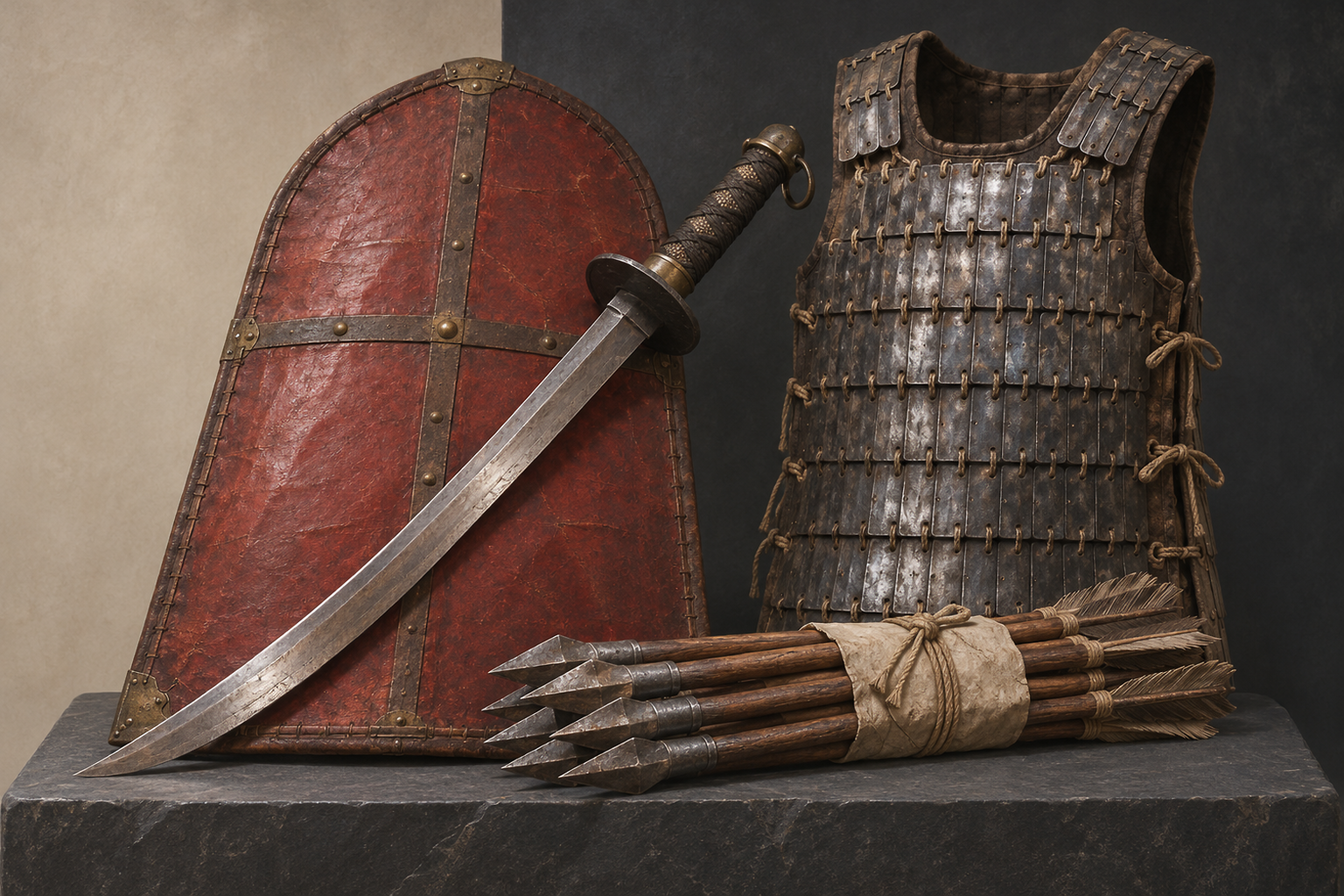
The Song peidao functioned as a secondary component within a deep defensive system rather than a standalone dueling weapon. The core of a Song field army was its missile troops, who operated devastating volley-fire systems using heavy composite bows and mechanized crossbows like the Shen Bi Gong. These formations could engage incoming cavalry at distances exceeding two hundred paces.
If enemy shock units survived the missile barrage and penetrated the perimeter, the line relied on heavy polearms: long spears, hooked glaives, and axes. The peidao was the sidearm of last resort. Crossbowmen slung their bows, spearmen dropped broken shafts, and frontline foot soldiers drew their curved sabers to fight in dense, hand-to-hand melee.
In these close quarters, where thrusting was often obstructed by the bodies of men and horses, the broad, curved peidao excelled. A soldier could deliver short, decisive chopping strikes against unprotected joints, horse legs, and helmets. Its curved belly and wide tip allowed for vicious horizontal cuts while remaining short enough to maneuver within tightly packed shields, proving far more practical than the long, unyielding straight blades of the ancient world.
The Mongol Conquest and the Standardization of the Saber
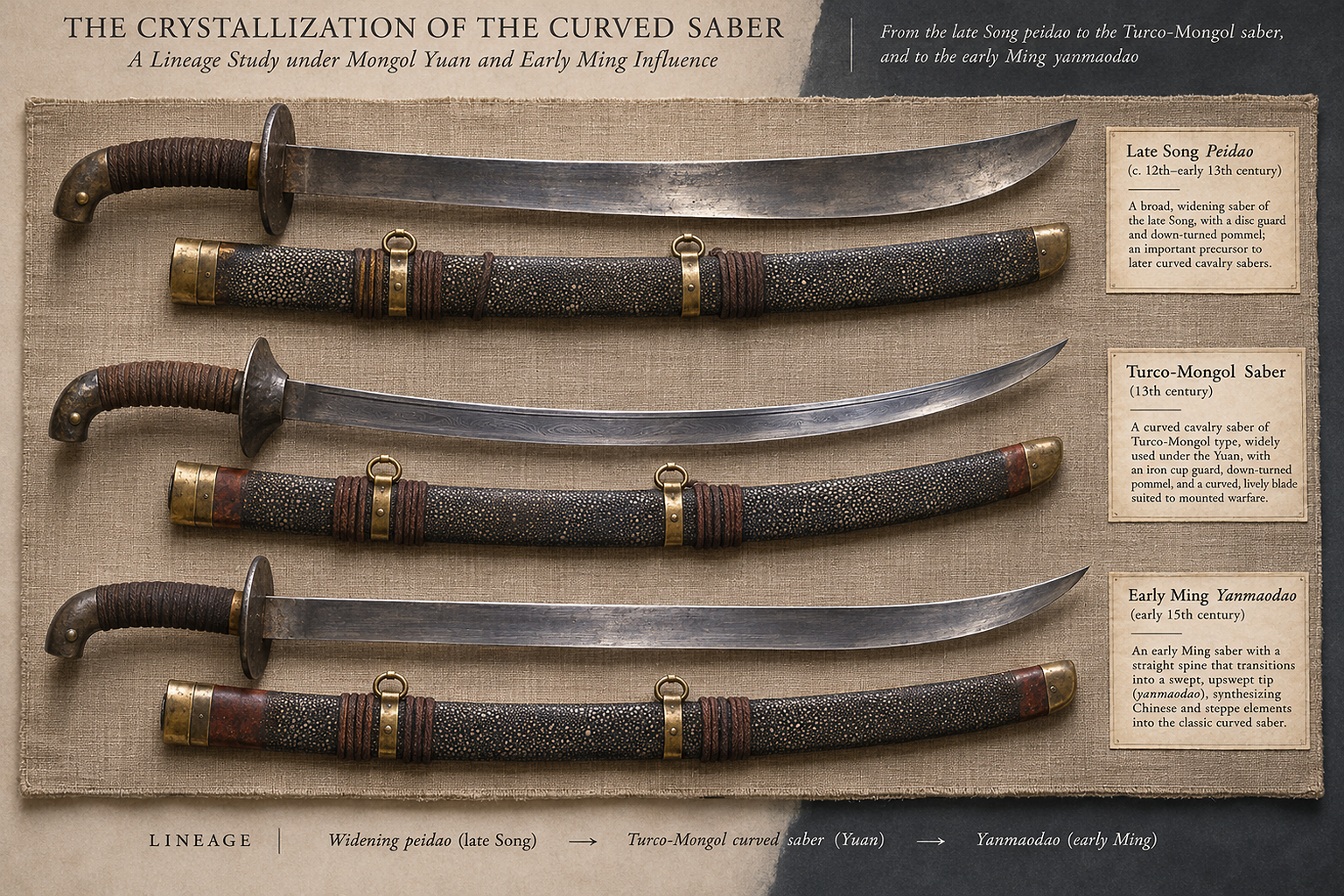
In the thirteenth century, the Mongol conquests swept across Eurasia, bringing the Jurchen Jin, Western Xia, and Southern Song under the rule of the Yuan dynasty. The Mongol armies operated almost entirely on horseback, using light and heavy cavalry tactics honed on the central steppes. Their primary bladed sidearm was a curved saber, a direct descendant of the earlier Turco-Mongol weapons that had influenced the Khitans centuries before.
When the Mongols established the Yuan dynasty, they consolidated Chinese, Persian, and Central Asian armorers under central imperial bureaus. The straight-edged military sidearm, already marginalized during the Song dynasty, disappeared entirely from operational military doctrine. Straight single-edged blades survived primarily in localized martial arts traditions and ceremonial armories.
The sweeping, curved geometry of the Song peidao merged with the Turco-Mongol saber to create the standard forms of the Ming and Qing dynasties. Weapons such as the liuyedao (willow-leaf saber) and the yanmaodao (goose-quill saber) trace their direct lineage to the tip-weighted, disc-guarded innovations developed in Song workshops between the eleventh and thirteenth centuries.
Historiographical Myths and Modern Misconceptions
The historical transition from the straight hengdao to the curved peidao is frequently obscured by modern popular culture, cinematic representations, and commercial replica markets. One of the most persistent misconceptions is that the straight Tang hengdao was an imitation of the Japanese katana. In historical reality, the influence ran entirely in the opposite direction. Tang China exported manufacturing techniques, blade profiles, and fitting styles to the Japanese archipelago during the Asuka and Nara periods, providing the direct architectural ancestor for early Japanese straight swords (chokutō) before Japanese smiths developed their own indigenous curved traditions (tachi).
A second common myth asserts that the straight blade was entirely abandoned because it was metallurgically inferior to the curved saber. Historical evidence demonstrates that the straight hengdao was an advanced product of differential heat treatment and pattern welding, fully capable of high-level performance. The transition to the peidao was driven not by metallurgical inadequacy, but by tactical evolution: the rise of heavy personal lamellar armor, the dominance of cavalry shock tactics, and the need for a sidearm that delivered immediate, powerful kinetic chops in close-quarters infantry melees.
Finally, modern martial arts and theatrical media frequently depict Song-era soldiers carrying the broad, flaring, paper-thin 'sheet metal' broadswords (oxtail dao) common in twentieth-century wushu. These late civilian weapons, which emerged during the late Qing dynasty for unarmored street defense, bear almost no structural resemblance to the thick-spined, carefully balanced, steel-laminated peidao of the medieval imperial arsenals. Recovering the true history of the Chinese saber requires looking past modern performance props to study the iron, text, and stone left behind by the imperial dynasties.
Further reading
Follow the sources to examine the object and its historical context.
Wujing Zongyao (Compendium of Military Classics), compiled by Zeng Gongliang and Ding Du, 1044 CEExternal reference · Opens in a new tab Tang Liudian (Six Statutes of the Tang Dynasty), compiled by Li Linfu, 739 CEExternal reference · Opens in a new tab Shōsōin Imperial Repository Artifact Database, Nara National MuseumExternal reference · Opens in a new tab Needham, Joseph. Science and Civilisation in China, Volume 5: Chemistry and Chemical Technology, Part 7: Military Technology; The Gunpowder Epic. Cambridge University Press, 1986External reference · Opens in a new tab