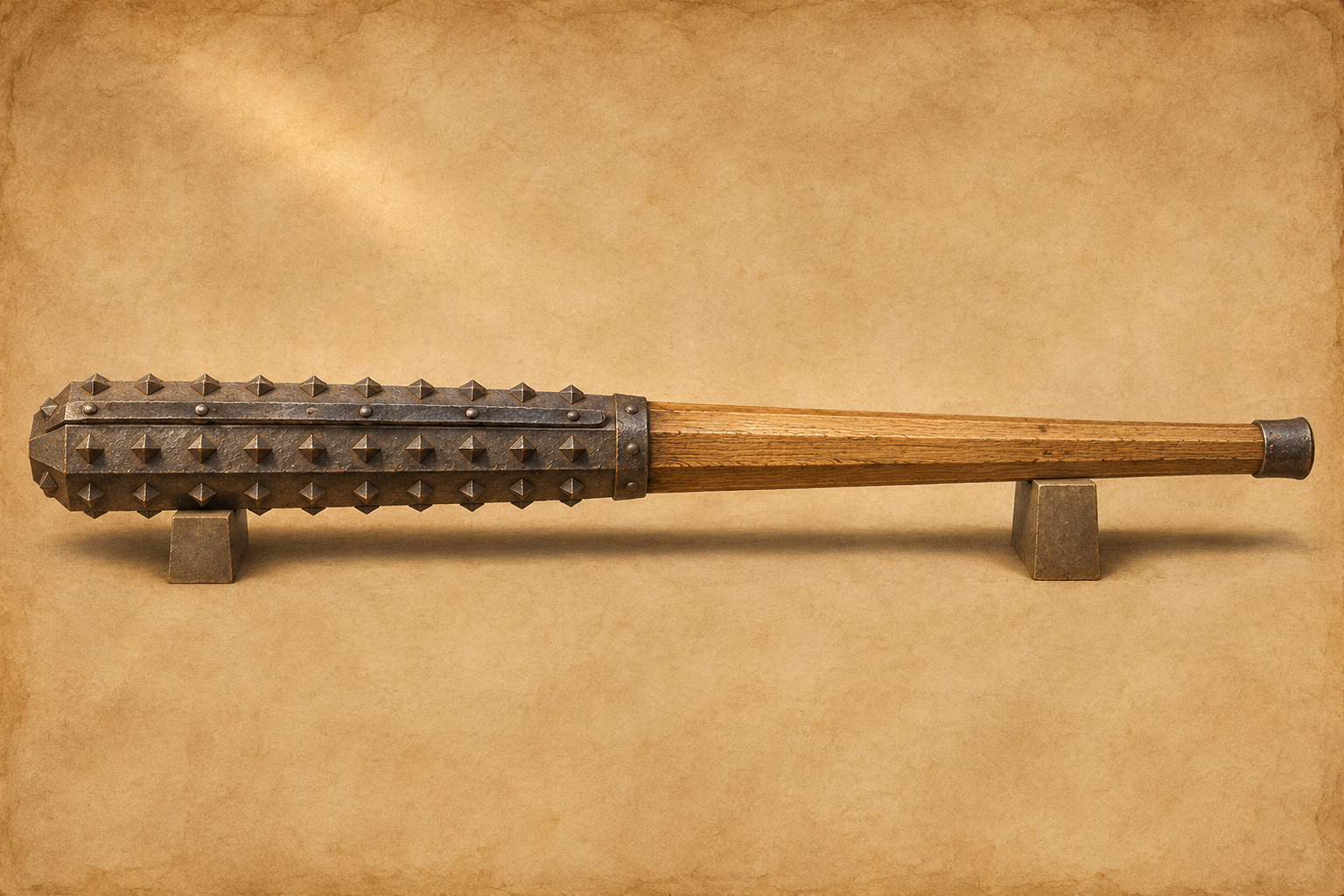
In popular imagination and folklore, the kanabō belongs to the horned oni, an impossibly heavy bar of studded iron swung with supernatural fury. The archaeological and documentary record of fourteenth-century Japan reveals a far more calculated weapon. During the Nanboku-chō wars (1336–1392), when competing imperial courts fractured samurai loyalties and foot skirmishes reshaped battlefield tactics, smiths and carpenters produced composite impact arms: seasoned Japanese oak reinforced with iron bands, fitted sockets, and forged studs. Rather than a crude lump of metal, the genuine battlefield club was a balanced kinetic tool designed to crush limbs, burst wooden shields, and transfer blunt shock through laced lamellar armor.
Folklore and Battlefield Realities in Fourteenth-Century Warfare
The proverb oni-ni-kanabō—giving an iron club to an ogre—has long associated the studded bludgeon with insurmountable, monstrous strength. In the popular mindset, this creature wields an eight-foot pillar of solid cast iron capable of pulverizing stone. Yet medieval Japanese warfare was strictly governed by human biomechanics and metallurgical expense. The chaotic warfare of the Nanboku-chō period placed infantrymen and dismounted cavalry in rugged mountain passes, defensive stockades, and tight riverbanks where massive, sluggish weapons invited immediate counter-thrusts from spears and glaives.
Writers of the period celebrated warriors of extraordinary stature, but battlefield survival demanded weapons that could recover quickly between swings. When historical fighters selected a heavy impact weapon, they required sufficient velocity to concuss an armored opponent without exhausting the bearer in the first minute of an encounter. The medieval kanabō developed as an adaptation of hardwood staves reinforced with iron to meet the rising prevalence of iron-laced armor.
The Literary Record of the Taiheiki and Fourteenth-Century Chronicles
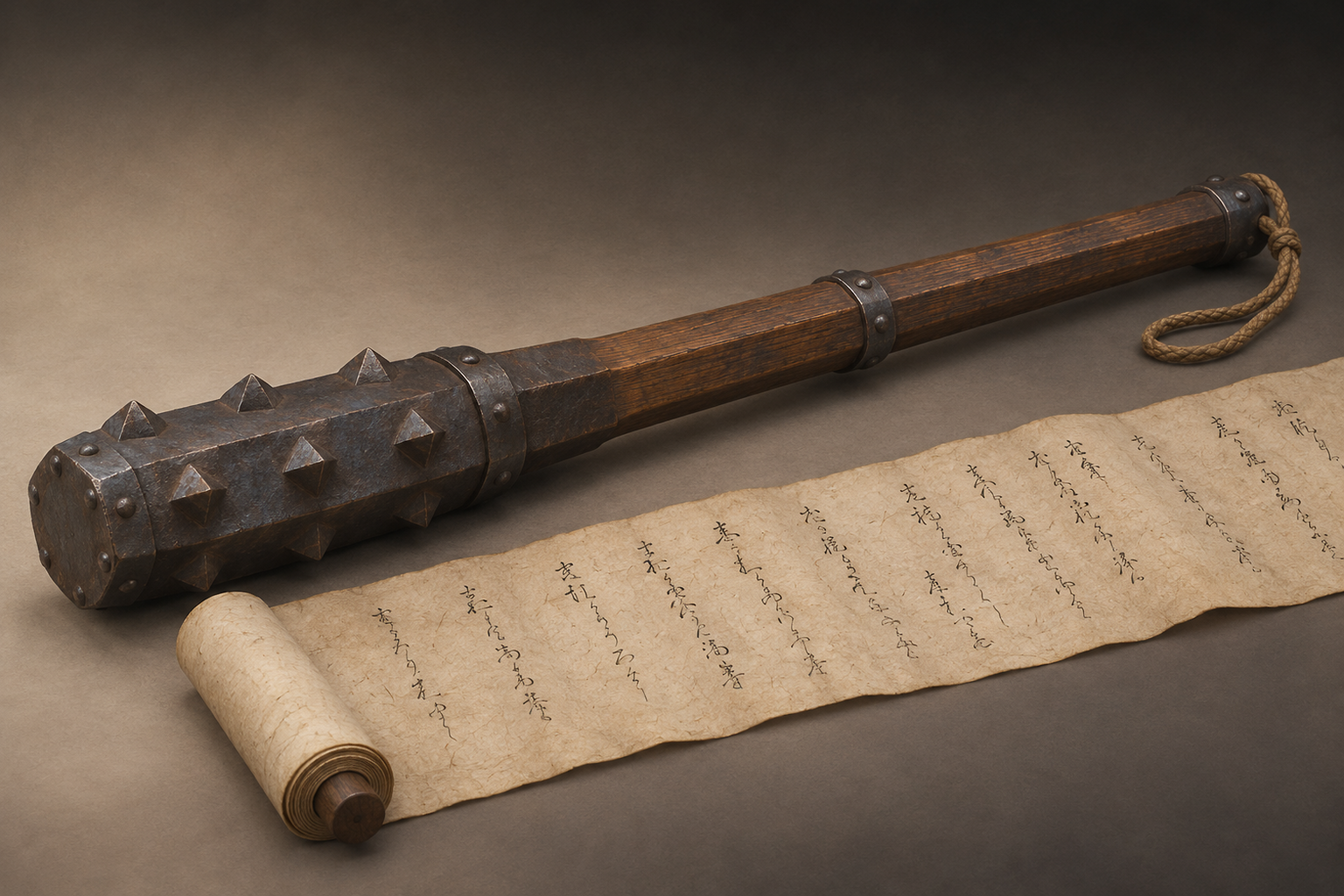
The primary literary witness for the deployment of massive bludgeons is the Taiheiki, a sprawling chronicle compiled in the late fourteenth century recounting the fifty-year conflict between the Northern and Southern Courts. Throughout its narrative, warriors renowned for extreme physical power wield bludgeons styled as kanabō, tetsubō, or kanamudō. Chroniclers frequently paired these weapons with mountain ascetics, rogue monks, and rustic vanguard brawlers (akutō) who operated outside the classical etiquette of mounted archery and single combat.
In one famous episode, the warrior Homma Saburō confronts opponents wielding a four-sided wooden staff bound with iron straps and driven through with thick spikes. While the Taiheiki is celebrated for heroic hyperbole—frequently exaggerating the lengths of swords and the weights of projectiles—its recurring technical descriptions match physical engineering principles. The texts specifically distinguish between all-iron staves, which were rare and cumbersome, and oak staves sheathed or wrapped in iron plates, confirming that fourteenth-century commanders recognized composite construction as standard practice.
Timber Selection: The Strength and Dampening of Shirakashi Oak
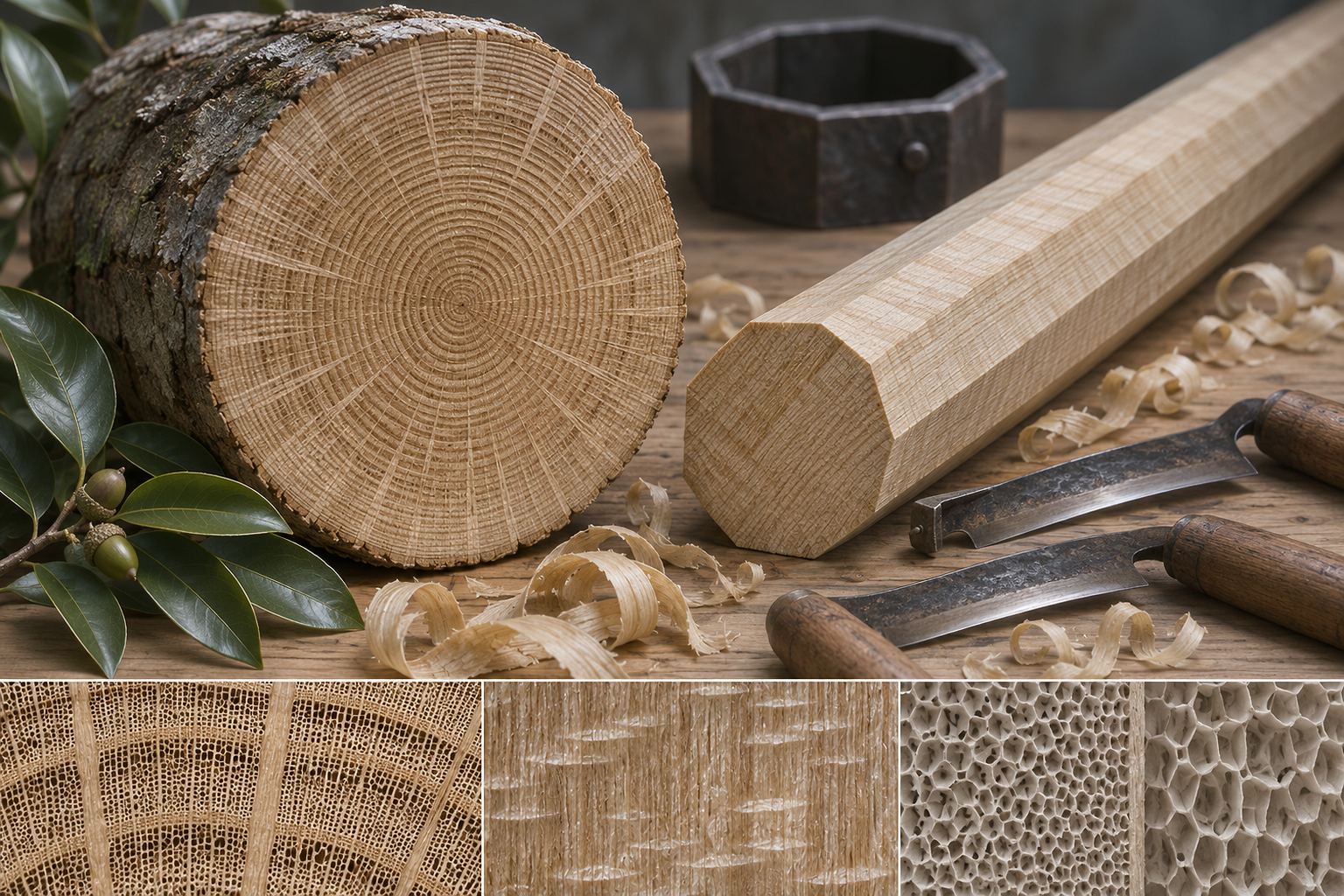
The physical foundation of any composite kanabō was its wooden core. Japanese carpenters and armories favored native evergreen oaks, predominantly shirakashi (Quercus myrsinifolia, white oak) and akakashi (Quercus acuta, red oak). Unlike European ash or hickory, which offer dramatic whip and elasticity, seasoned shirakashi provides exceptional density, hardness, and radial resistance to splitting. It resists grain shearing along its length, allowing it to withstand severe percussive impact without splintering or shattering into the hands of the wielder.
Wood selection was also a vital shock-absorption measure. A blow delivered by a solid iron bar transfers brutal recoil vibrations into the bones and joints of the striker upon hitting an unyielding target, such as a forged helmet or an iron-faced pavise. A dense oak shaft acts as a natural dampener, absorbing high-frequency harmonics before they reach the user's palms. Foresters split and dried these staves slowly across multiple seasons, shaping them with drawknives into hexagonal or octagonal cross-sections that gave both purchase for hands and flat mounting facets for iron plate.
Anatomy of the Composite Shaft: Sleeves, Straps, and Sockets
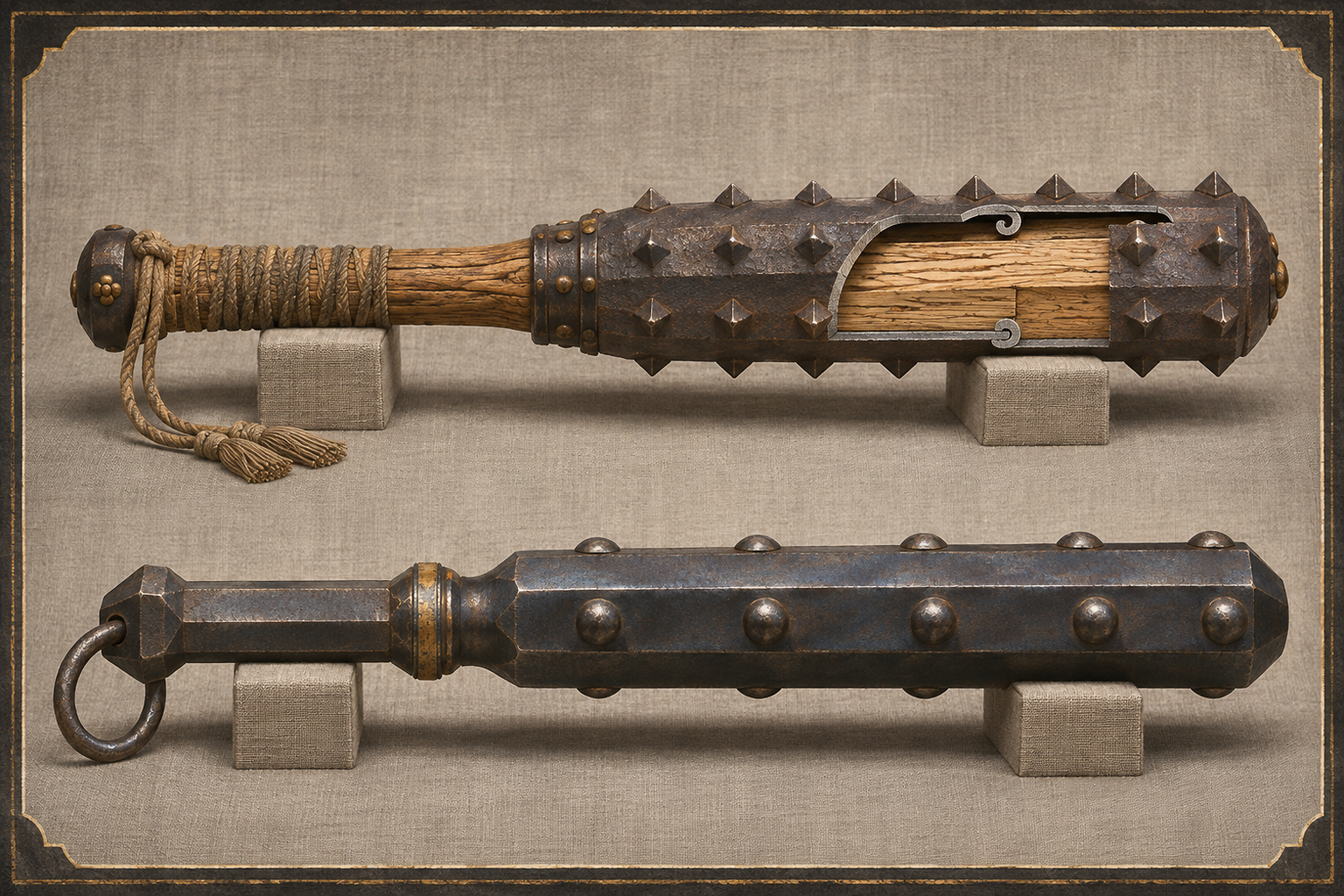
The metallurgical architecture of an authentic kanabō addressed two vulnerabilities: the tendency of wood to split when struck by sharp blades, and the tendency of a bludgeon to glance harmlessly off curved lacquered iron scales. The solution was a multi-part casing of bloomery iron (hōchōtetsu), forged and fitted directly over the timber core. The impact head rarely consisted of a solid cast cylinder; instead, smiths forged an iron socket or rolled a sheet around the distal third of the club, pinning it in place with mechanical rivets.
To protect the balance of the weapon without adding dead weight, blacksmiths ran longitudinal iron strips down the facets of the shaft. Known structurally as shikomi-gane or tetsu-tanzaku, these bands braced the wood against lateral snapping when parrying heavy polearms like the naginata or nagamaki. The weapon terminated in a forged butt-cap or ferrule (ishizuki), which counterbalanced the forward mass, sealed the end-grain against moisture, and served as a secondary striking point in close grappling.
Studs and Spikes: The Geometry of Percussive Studding
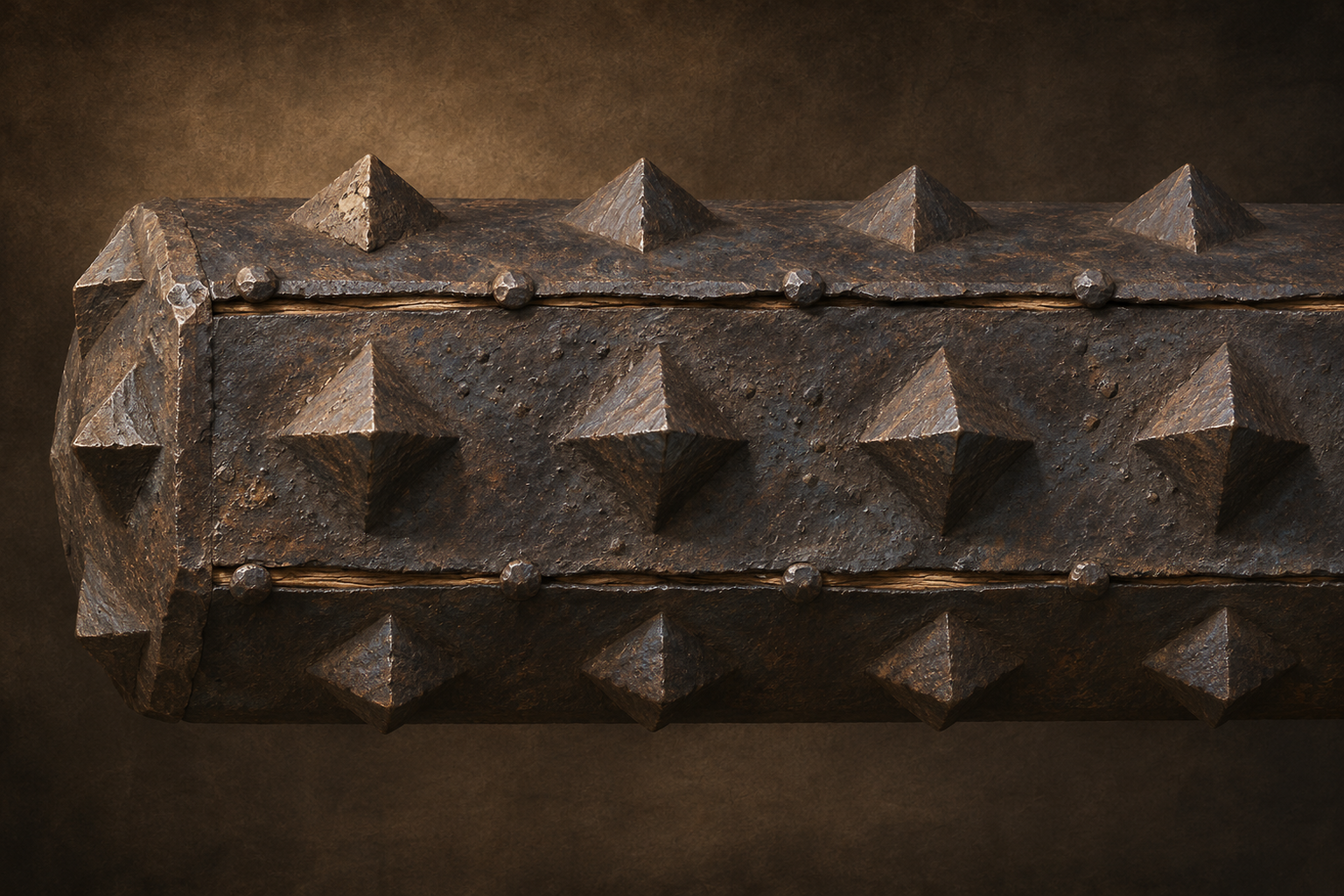
The striking surface of the kanabō gained its reputation from its studded texture, referred to in period terminology as arare (hailstones) or kanatogi. Rather than spikes intended to impale flesh, these studs were pyramid-headed or hemispherical iron rivets driven through the iron sheathing and deep into the oak substrate. The mechanical purpose of this texture was twofold: friction and pressure concentration.
When a smooth metal bar impacts a convex iron helmet or a lacquered shoulder guard (sode), the weapon frequently glances off the slick curvature, dissipating kinetic energy into the air. Pyramid-headed studs bite into metal, silk cords, and lacquered plates upon initial contact, arresting lateral deflection. By focusing impact energy onto the four or five square millimeters at the peak of each stud, the blow broke bones beneath the armor without requiring the weapon to sever the armor plates themselves.
Impact Mechanics Against Fourteenth-Century Armor Suites
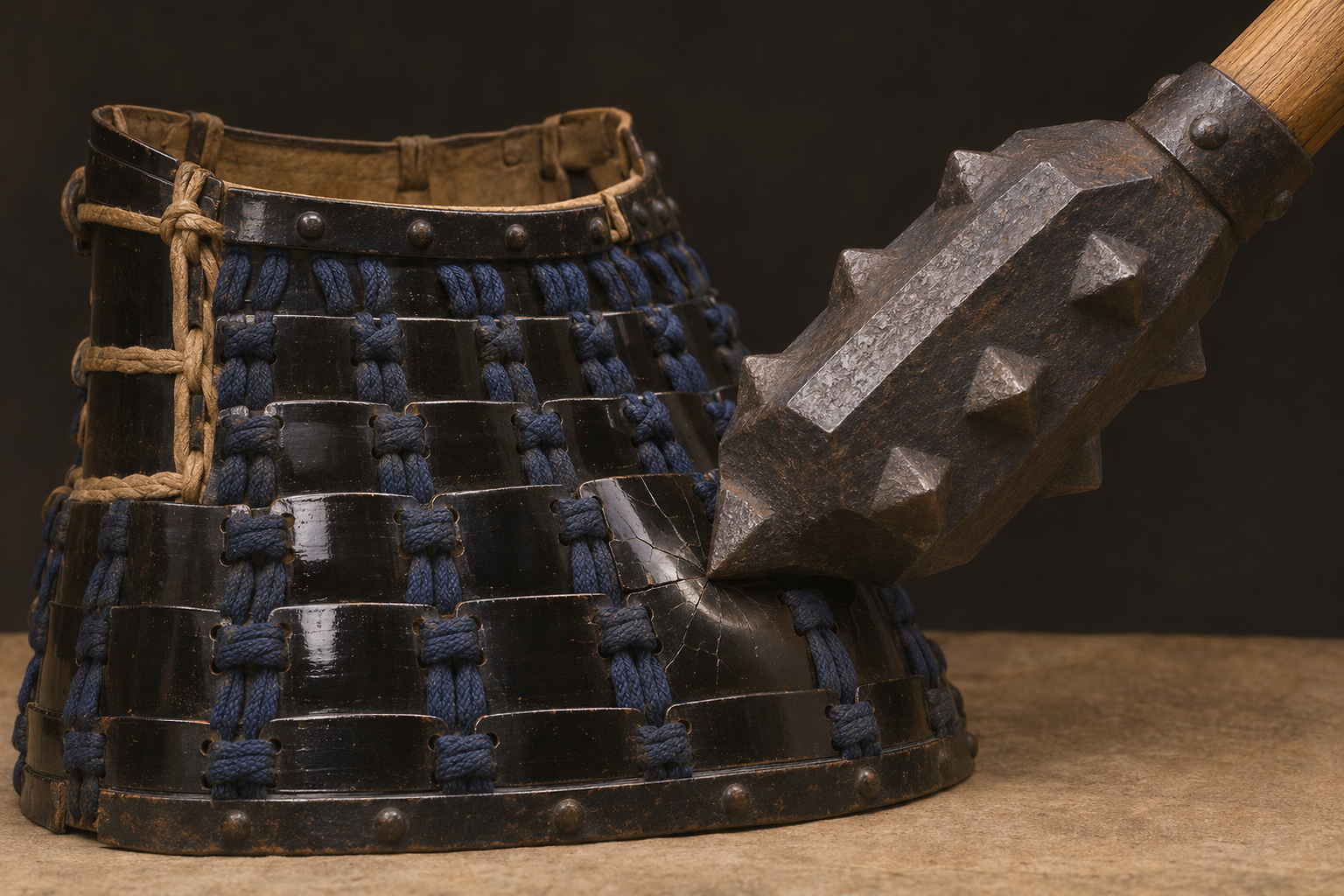
To understand the emergence of the kanabō, one must examine the specific armor it was designed to defeat. The classic ō-yoroi of the Kamakura period was an expensive, rigid box optimized for mounted archery. By the Nanboku-chō era, fighting shifted toward mass infantry maneuvers on broken ground. Warriors adopted lighter, tighter-fitting dō-maru and haramaki armors, which wrapped the torso in small, laced scales (hon-kozane) made of alternating rawhide and iron plates sealed with thick layers of lacquer.
While hon-kozane effectively deflected arrows and slashing sword blades, its flexible lacing made it vulnerable to blunt trauma. A slashing strike from an ōdachi might cut silk lacing, but an iron-sheathed club bypassed the cut resistance altogether, driving kinetic shock straight through the assembled lamellae.
A heavy percussive blow against laced lamellar defenses generated three distinct structural failures:
- Immediate fracturing of the brittle dried urushi lacquer, shattering the weatherproofing and exposing underlying leather and thin iron lamellae.
- Permanent plastic deformation of the inner iron scales, driving them inward to fracture the ribcage, clavicle, or sternum of the wearer.
- Violent disruption of the cervical spine through shock waves transmitted through the iron bowl of the kabuto, causing concussion even when the helmet remained structurally intact.
The Fallacy of the Fifty-Pound Bar: Mass, Velocity, and Balance
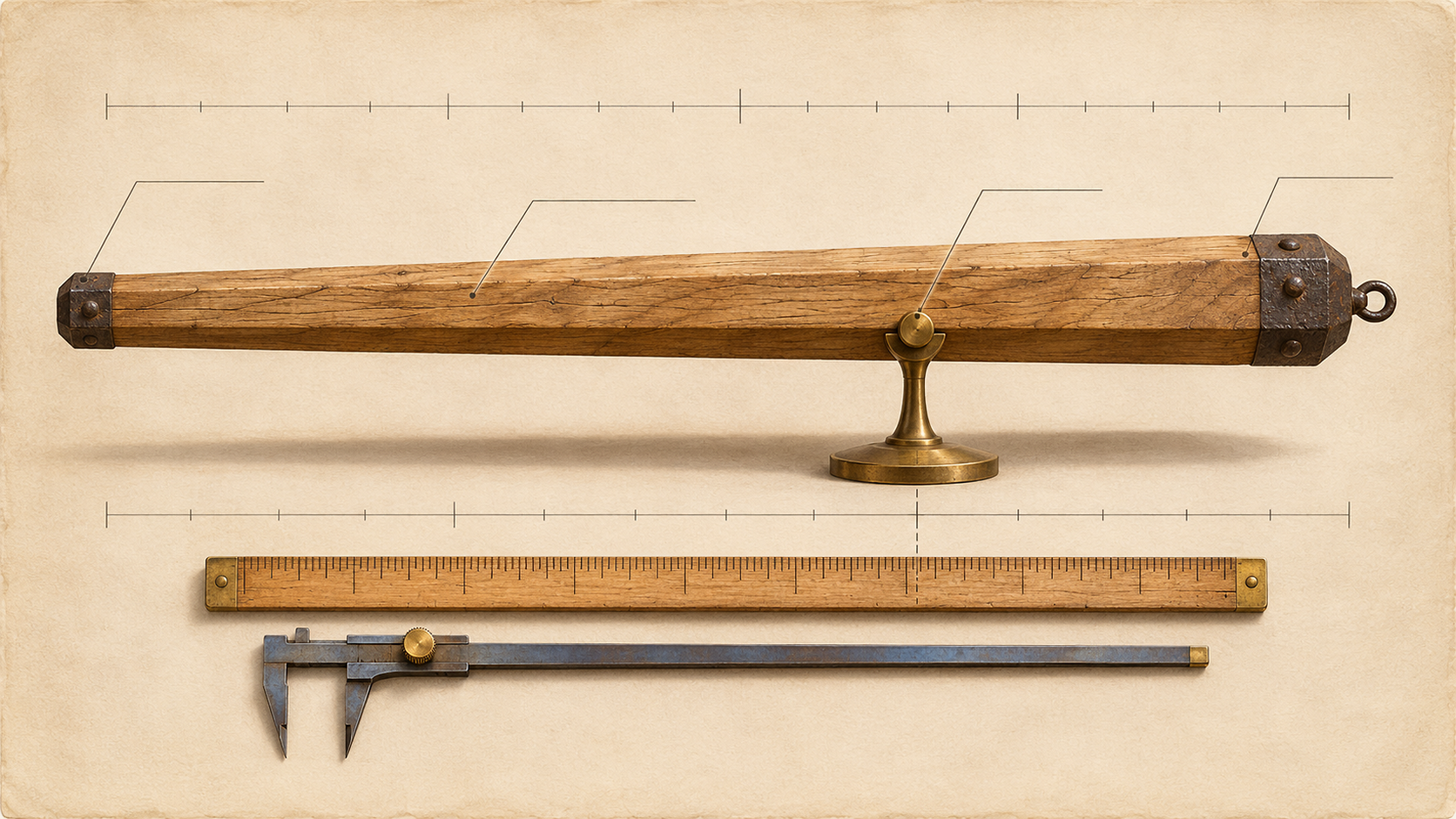
A persistent myth in modern martial arts fiction credits the kanabō with weights ranging from twenty to fifty pounds. Practical physics, surviving implements, and experimental kinetic testing dismiss such figures. A human warrior swinging a fifty-pound weapon cannot accelerate it quickly enough to generate devastating kinetic energy before an opponent side-steps and executes a lethal thrust. Kinetic energy increases linearly with mass but quadratically with velocity; a weapon must be swift to be destructive.
Surviving combat clubs of composite wood and iron typically weigh between 4.5 and 9 pounds (approximately 2 to 4 kilograms), with overall lengths ranging from four to six feet. This mass distribution placed the center of gravity roughly two-thirds of the way up the shaft. The resulting balance produced enormous rotational inertia upon swing execution, yet remained light enough for an athletic warrior to halt, redirect, or draw back into a defensive guard using standard two-handed lever mechanics.
Surviving Artifacts and Archaeological Scarcity
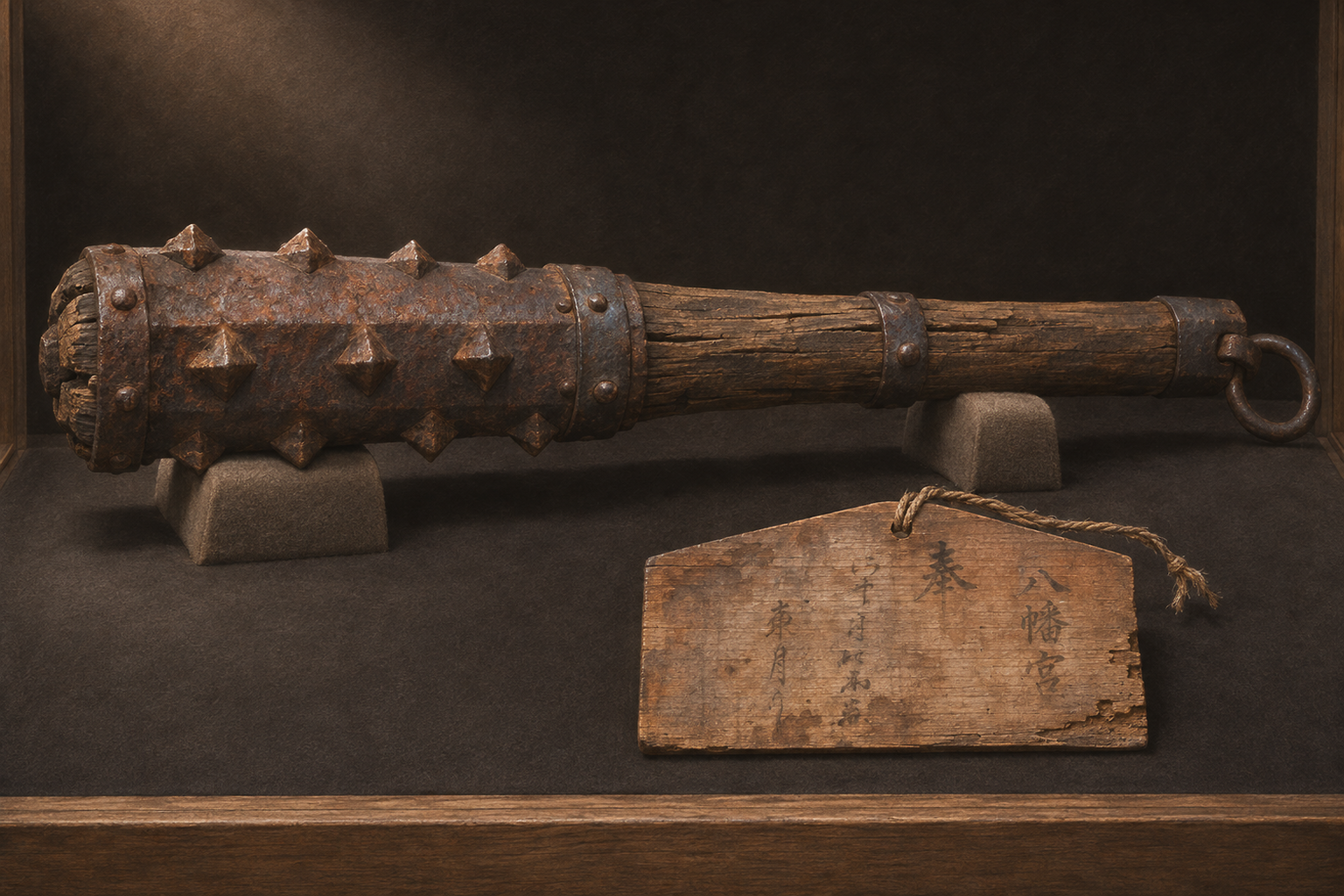
Genuine Nanboku-chō battlefield bludgeons are exceedingly scarce in modern museum collections, a reality that often confuses researchers accustomed to the vast survival rate of fourteenth-century swords. Several clear taphonomic and cultural factors explain this absence. Unlike swords, which were treated as family heirlooms, ancestral treasures, and legal documents of lineage, clubs were functional military hardware manufactured by local armorers and carpenters. When a club suffered splintering or loosened sockets, it was stripped of its iron for scrap and its wooden core was discarded.
The acidic volcanic soils of the Japanese archipelago destroy unlacquered organic materials rapidly. While swords were preserved in plain wooden storage scabbards (shirasaya) and dry storehouses, heavy bludgeons were left in armories, barn rafters, or weapon racks where dampness rotted the oak core from within the iron sleeve. The rare surviving fourteenth-century examples typically endure because they were consecrated as votive offerings (hōnō) at Shinto shrines, such as those dedicated to Hachiman, where sacred isolation protected them from both active warfare and weathering.
Depictions in Fourteenth- and Fifteenth-Century Emaki
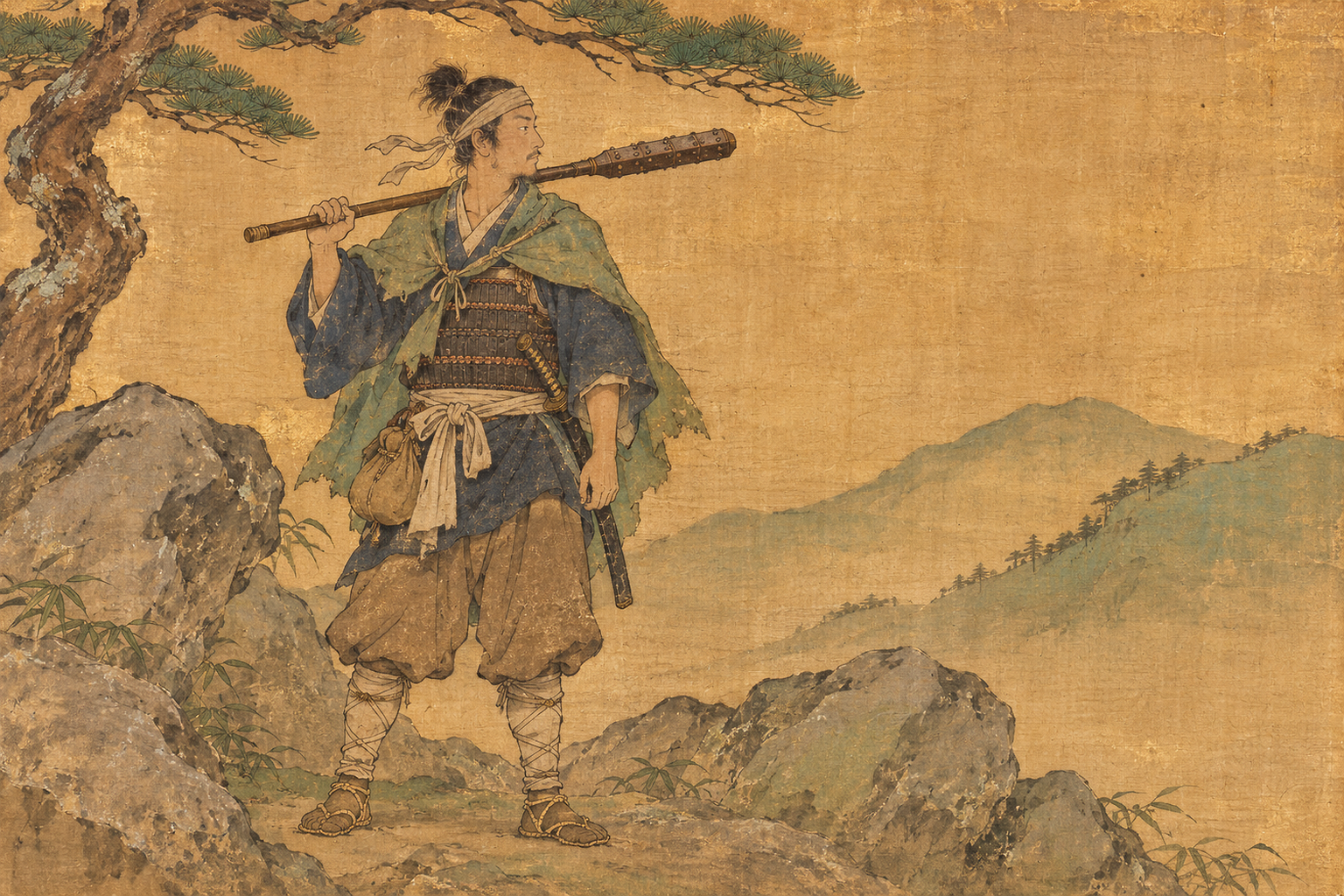
Because archaeological specimens are rare, researchers rely heavily on illuminated narrative handscrolls (emaki) painted during the late Kamakura, Nanboku-chō, and early Muromachi periods. Masterworks such as the Aki no Yo no Naga Monogatari and various battle scrolls depicting the Northern and Southern Courts show foot soldiers, armed monks, and irregulars carrying bludgeons into combat. These visual records provide crucial context for weapon scale, coloration, and carry methods.
In these paintings, the clubs are never rendered as absurdly thick logs. Artists meticulously depicted them as slender, octagonal staves tapering gracefully toward the grip. The striking heads are rendered in dark grey or black ink washes, accented with precise white or metallic flecks indicating the iron studs. The scrolls depict these weapons carried upright over the shoulder or planted like a walking staff on steep terrain, confirming their role as practical trekking and fighting gear for rugged mountain campaigns.
Tactical Role: Anti-Cavalry and Breaching Operations
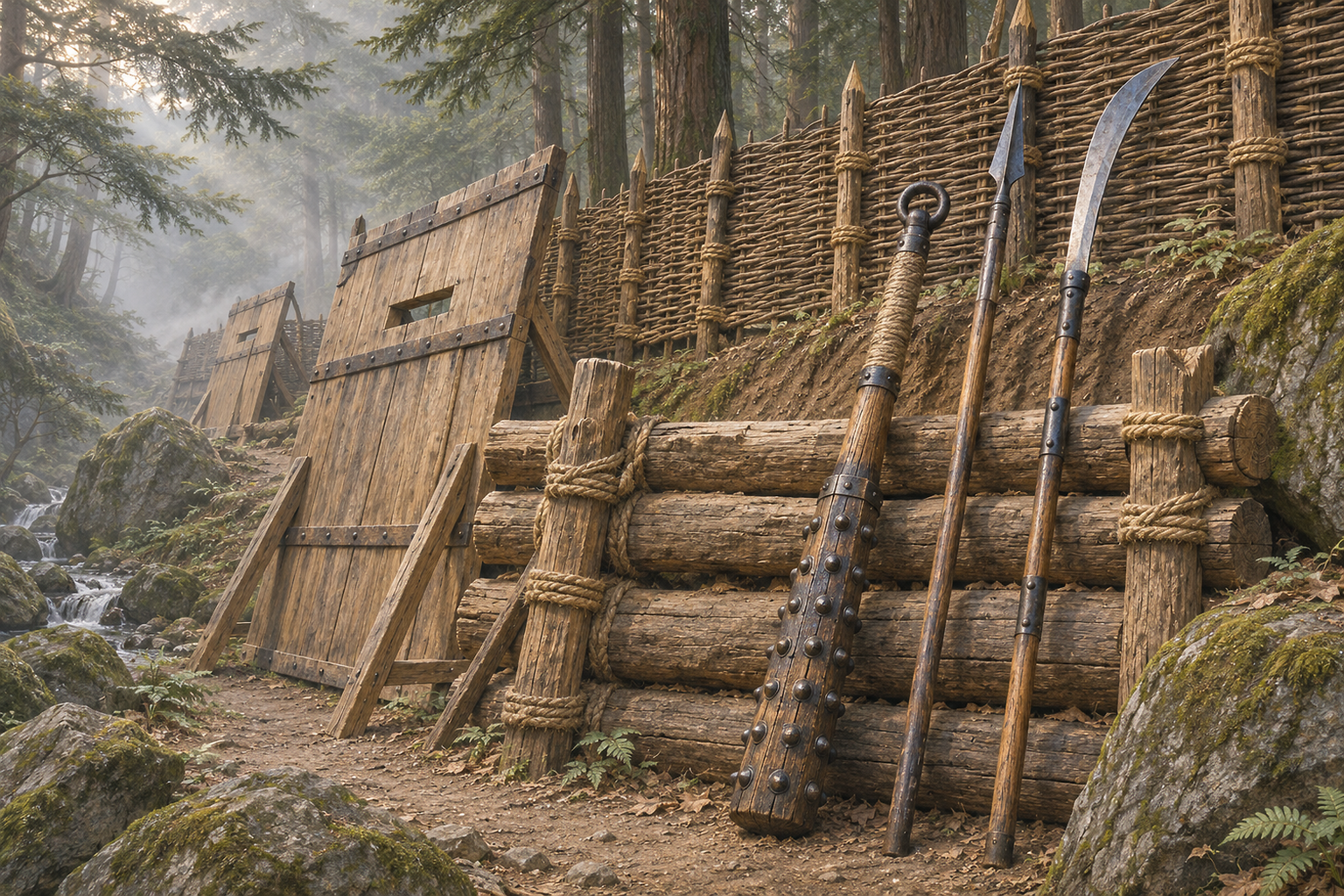
The tactical deployment of the kanabō in fourteenth-century engagements was specialized and situational. It was not the primary weapon of frontline formations, which relied overwhelmingly on bows (yumi), glaives (naginata), and long swords. Instead, the club served as a shock weapon for breach teams and anti-cavalry ambushes in uneven terrain.
When mounted samurai charged through narrow valleys or forest tracks, foot soldiers hidden along the slopes rushed the flanks. A downward strike with an iron-sheathed club against the unprotected knees or hocks of a horse instantly brought the mount down, spilling the heavily armored rider into the mud. In siege contexts, where defenders barricaded gates with heavy timber palisades and interlocking wicker shields (tate), warriors with heavy clubs served as vanguard shock troops, smashing shield lines and fracturing wooden gate latches to open paths for spearmen.
Edo Period Evolution: From Battlefield Tool to Police Tetsubō
With the unification of Japan under the Tokugawa shogunate in 1603, battlefield conditions changed permanently. Massive infantry clashes ceased, and the warrior class entered two and a half centuries of bureaucratic administration. The kanabō adapted to this peaceful era by bifurcating into two distinct cultural objects: the civic law enforcement weapon and the ceremonial strength-testing implement.
Edo-period town guards (dōshin and komono) required non-lethal impact weapons to subdue disorderly samurai without spilling aristocratic blood or drawing swords. Blacksmiths began producing solid-iron rods, known broadly as tetsubō or jitte-bō, often six-sided or eight-sided with blunt knobs instead of sharp pyramid studs. Simultaneously, schools of martial arts (koryū) developed dedicated methods (tetsubō-jutsu) to cultivate physical conditioning, core stability, and wrist endurance, using solid forged bars weighing up to fifteen pounds as training weights rather than frontline arms.
Modern Misconceptions, Replicas, and Pop Culture Distortions
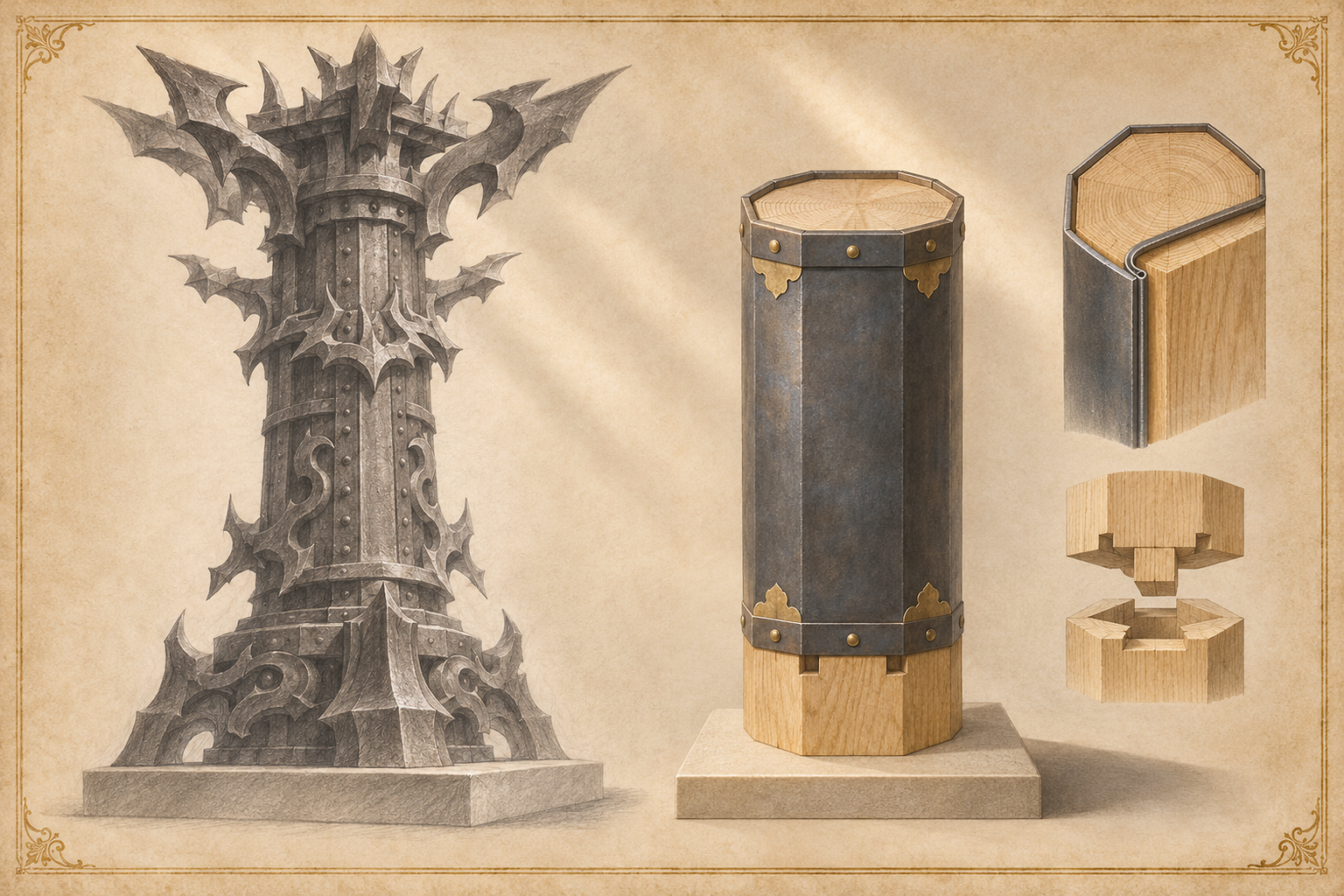
Modern video games, tabletop roleplaying systems, and historical action cinema have frozen the kanabō in its mythic, exaggerated form. It is almost universally presented as an eight-foot, solid cast-iron pillar spiked with wicked barbs, swung solely by towering brutes who sacrifice all defensive speed for single, catastrophic blows. This imagery blends nineteenth-century Edo folklore woodblock prints (ukiyo-e) with modern fantasy tropes, obscuring the weapon's genuine historical engineering.
When modern reenactors and experimental archaeologists reconstruct composite oak-and-iron bludgeons according to fourteenth-century textual and metallurgical specifications, they encounter an agile, efficient weapon. Held with two hands and swung through fluid rotational arcs, the historical kanabō was fast, defensively viable, and mechanically matched to its historical environment. The weapon reflects the tactical demands of the Nanboku-chō period, when fighters adapted traditional wooden staves with iron reinforcement to counter laced armor.
Further reading
Follow the sources to examine the object and its historical context.
Tokyo National Museum: Arms and Armor Collection StudiesExternal reference · Opens in a new tab The Taiheiki: A Chronicle of Medieval Japan, translated by Helen Craig McCullough (Columbia University Press, 1959)External reference · Opens in a new tab Kyoto National Museum: Muromachi Period Armaments and Lacquerware ArchivesExternal reference · Opens in a new tab