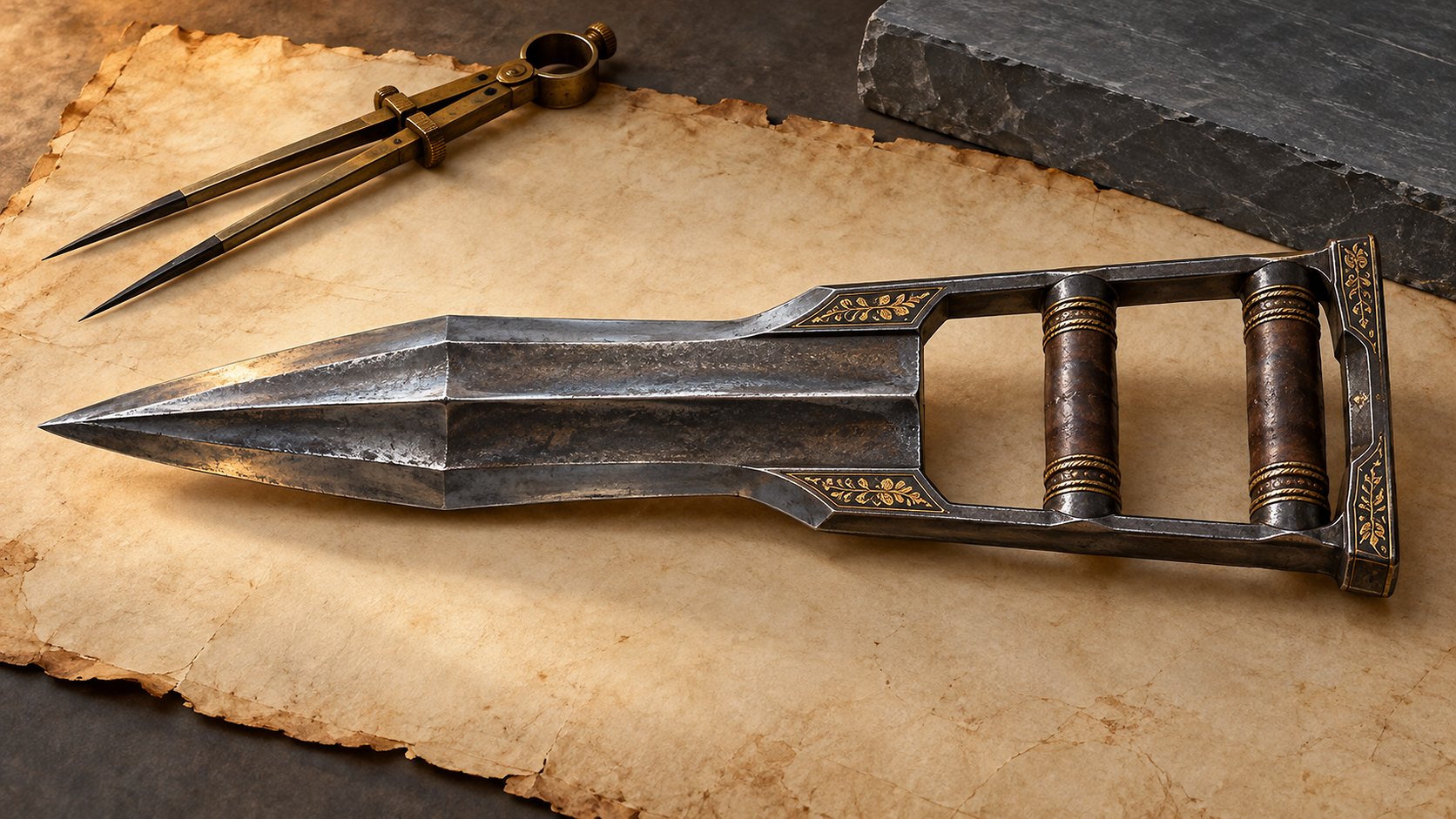
Surviving in museum vaults and private collections across India and Europe, the expanding katar—often labeled in Western literature as a scissor katar or mechanical dagger—remains one of the most misunderstood edged weapons of the early modern world. Its distinctive mechanism features an outer blade split longitudinally along its center line, connected via internal pivots and levers to movable grip rungs. When the wielder grips the transverse bars and squeezes the inner handle toward the outer frame, the split halves fly outward like scissor shears, revealing a second, rigid thrusting blade nested securely beneath them. Popular folklore, fueled by sensationalist nineteenth-century travelogues and colonial weapon catalogues, routinely claims this weapon was engineered to be driven into an adversary's body and expanded internally to inflict devastating trauma. A rigorous examination of period metallurgy, structural mechanics, surviving craft traditions, and court chronicles reveals an entirely different historical reality.
The Classical Katar as a Rigid Baseline
To understand why an expanding katar deviates so sharply from functional arms design, one must first examine the classical jamadhar, commonly anglicized as the katar. Developed on the Indian subcontinent with roots stretching into the fourteenth-century Vijayanagara Empire, the standard katar is a masterclass in structural rigidity. Its design centers on two parallel side bars, or langets, extending backward alongside the forearm, joined by one or two solid transverse grip rungs. When held, the weapon becomes an inline extension of the user's arm bones, directing the full momentum of a punch directly into the blade's point without the wrist flexion or levering torque inherent to conventional daggers.
In military use, the traditional katar was engineered to defeat heavy textile padding, chain mail, and layered plate. Armor-piercing variants feature pronounced diamond cross-sections, swollen reinforced tips, and thick central ridges designed to distribute axial shock across the blade without buckling. Every design choice in a battlefield katar emphasizes monolithic strength: blades were either forged integral with the hilt frame or securely mortised and brazed into deep sockets with heavy iron rivets. There is zero play, no mechanical movement, and no delicate tolerances to maintain.
Kinematics of the Scissor Mechanism
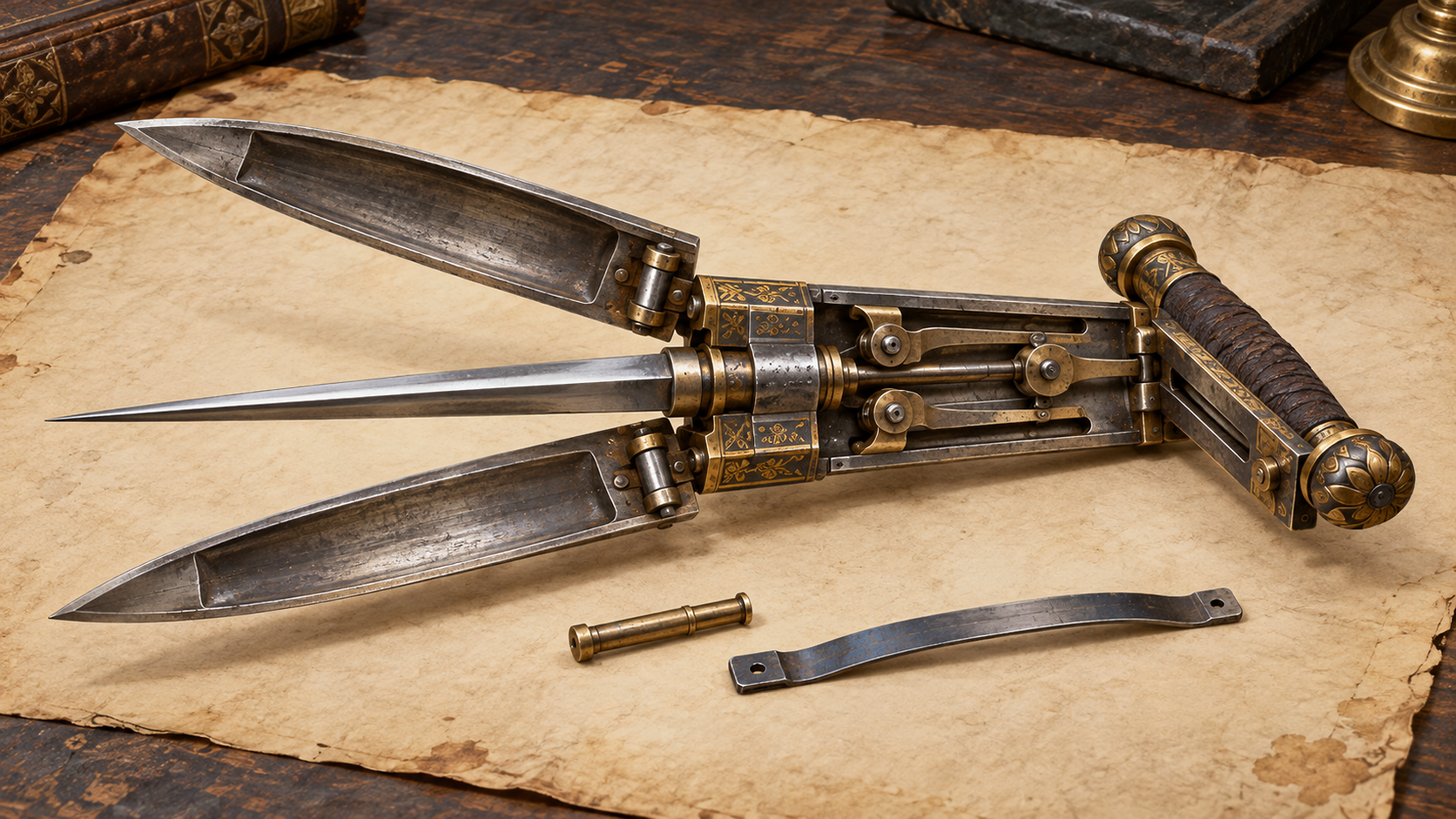
The expanding katar entirely abandons this monolithic architecture in favor of a complex multi-linkage hinge system. In a typical surviving specimen, the outer blade is not a single piece of steel but consists of two symmetrical, longitudinally split shells. These halves are hollow-ground on their interior faces to form a flush sheath. When closed, they tightly enclose a smaller, fixed central dagger that is permanently forge-welded or pinned to the base of the hilt frame.
The operational movement is driven from the grip. Unlike standard static katars, the expanding variant features split transverse grip bars. One bar remains stationary, anchored to the lateral side guards, while the second bar is mounted on internal pivoting rockers or sliding channels. When the wielder contracts their grip, closing their fist against the internal spring tension, the moving rung pulls two internal tie-rods or rocker cams located inside the blade forte. These cams pivot the outer blade shells outward on dual bronze or iron pins, swinging them apart at angles ranging from thirty to sixty degrees. Releasing hand pressure allows a flat leaf spring, tucked between the side guards or within the hilt base, to snap the split halves back into the closed resting position.
Metallurgical Demands and Fabrication Tolerances
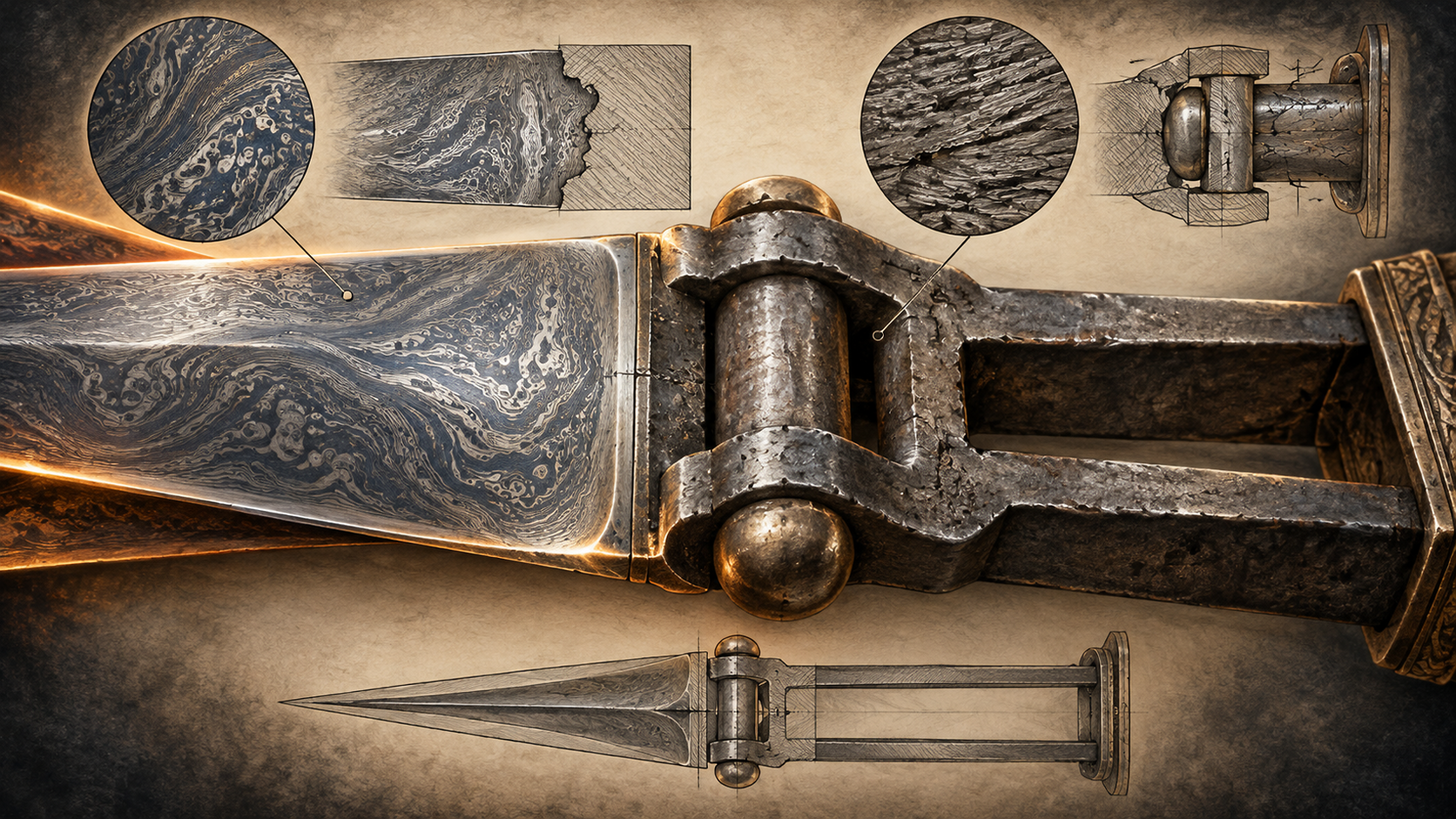
Building a functional expanding katar presented early modern Indian smiths with immense manufacturing hurdles. Traditional high-carbon crucible steel—known widely as wootz or ukku—is celebrated for its exceptional edge retention, fine carbide banding, and high hardness when properly quenched. However, wootz is notoriously brittle under shock and behaves poorly as a structural material for delicate hinges, pins, and leaf springs, which require high yield strength and elasticity rather than brittle hardness.
Consequently, metallurgical examination of historical scissor katars reveals that armorers generally avoided wootz for the mechanical components. The complex linkages, pivot pins, and slotted channels were almost universally hand-filed from softer, low-carbon wrought iron or shear steel. While easier to pierce, drill, and adjust with manual files, these metals lacked the tight manufacturing tolerances seen in industrial-era clockwork. The hinge pins were peened cold, creating localized stress points. If an artisan quenched the outer split blades to a high hardness, the thin areas surrounding the pivot eyes became brittle and prone to catastrophic cracking under perpendicular impact. Conversely, if left soft enough to absorb shock, the pins and holes quickly wore out through friction, causing the blades to wobble and misalign.
The Internal Wound Cavity Myth
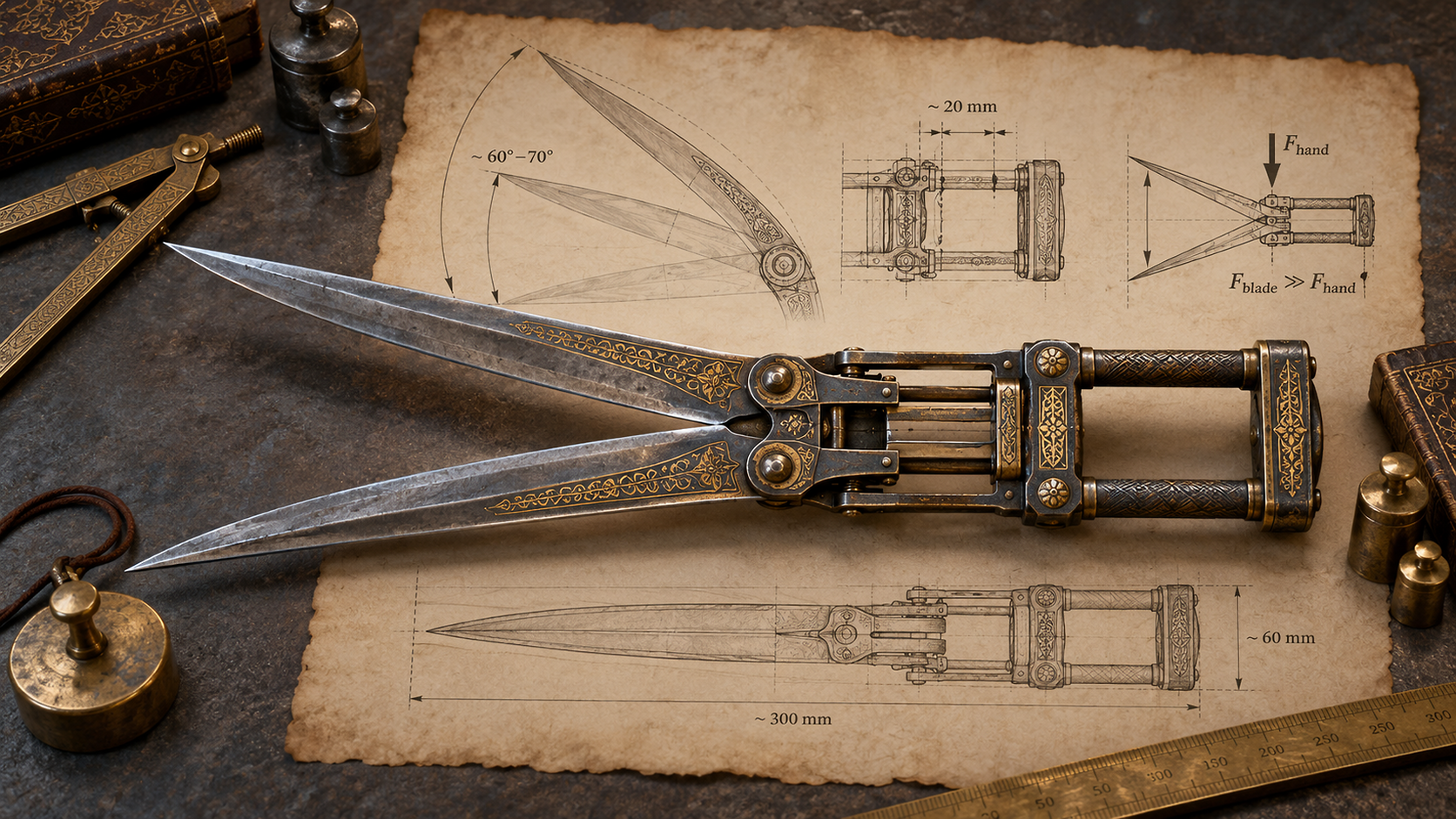
The most pervasive claim regarding the expanding katar is that it was designed to be driven into an opponent's torso in its closed state, after which the wielder would squeeze the grips to split the blade internally, tearing open a massive internal wound and locking the weapon inside the victim. This visceral narrative has persisted in collector circles and popular culture for over a century, yet it ignores basic principles of physical resistance and biomechanics.
Human and animal tissue is composed of dense, elastic muscle fibers, fascia, and viscous fluid under hydrostatic pressure. When a bladed weapon penetrates the body, surrounding muscles instantly contract around the intrusion. To force open two split blade faces against this compressive clamping force requires substantial mechanical leverage. In an expanding katar, the lever advantage is actually inverted: the user must compress a thick grip bar across a short travel distance of barely two to three centimeters, which must then swing two long blade leaves outward against resistant tissue across an arc of ten to twenty centimeters.
Simple lever physics demonstrates that the resistance at the blade tips is multiplied manifold against the wielder's fingers. A human hand, already fatigued by hand-to-hand combat, cannot generate the hundreds of pounds of pressure necessary to pry dense, contracted muscular tissue apart from within. In any realistic scenario, attempting to deploy the mechanism inside a target would either jam the hinge pins, cause the hand grip to slip, or result in the moving parts bending irreparably inside the frame.
Mechanical Compromise and Axial Failure
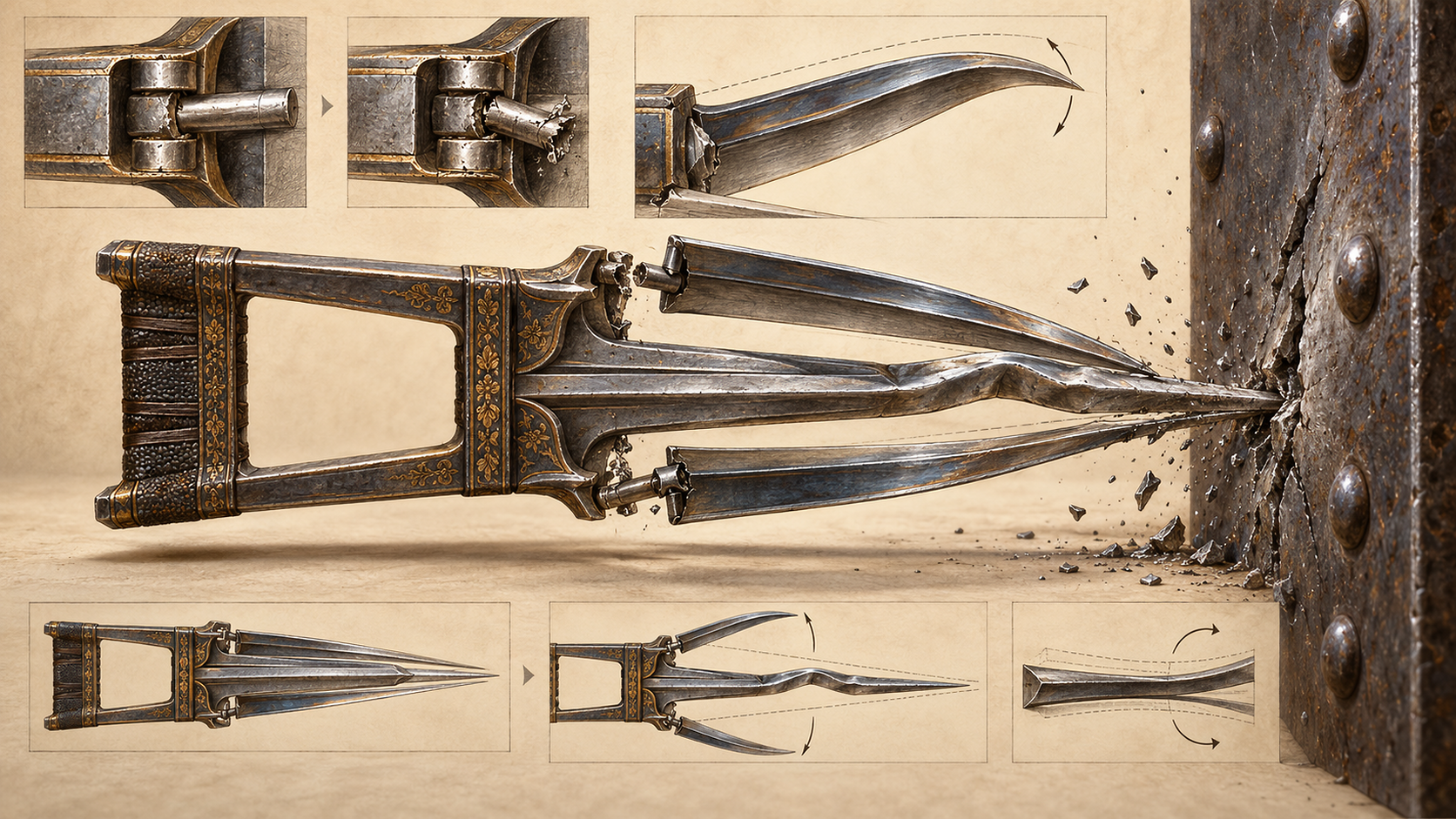
Even before considering deployment inside a target, the mechanical design fatally undermines the katar's primary combat function: surviving the violent impact of an armor-piercing thrust. The traditional katar relies entirely on axial column strength. When driven forward by a warrior's full body weight, the kinetic energy passes directly down the solid side guards into a monolithic steel spine, channeling force to the tip without deflection.
Introducing split leaves, hollow internal voids, and transverse hinge pins destroys this column strength. When an expanding katar strikes a hard surface—such as an iron cuirass, mail links, boiled leather, or even thick bone—the force of impact does not pass cleanly through solid metal. Instead, the force concentrates squarely on the small hinge pins holding the outer leaves. Under moderate axial loading, the pins shear, the split leaves bow outward along their hollow interior faces, and the central stationary stiletto is subjected to severe bending moments.
Rather than punching through defensive armor, the weapon expends its kinetic energy deforming its own articulated parts. An armorer forging a battlefield sidearm would never intentionally replace a solid, hardened diamond-section tip with an assembly held together by two-millimeter-thick iron rivets.
Parrying Hypotheses and European Parallels
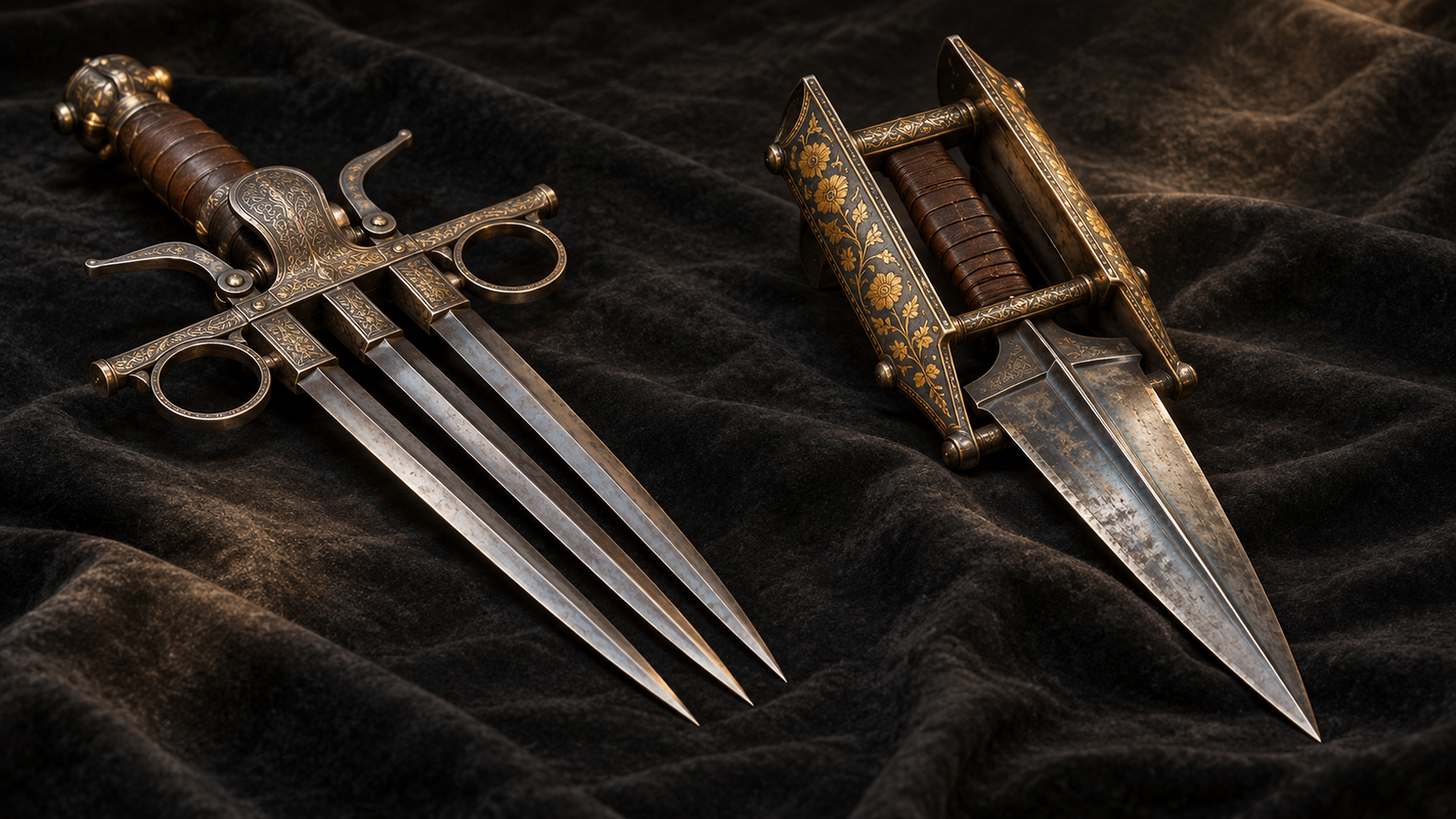
Confronted with the structural absurdity of internal expansion, some arms historians have proposed an alternative functional theory: that expanding katars were parrying weapons inspired by European sword-breakers and triple-bladed fencing daggers. During the late sixteenth and early seventeenth centuries, European duelists utilized specialized main-gauche daggers equipped with spring-loaded side leaves that snapped open at the press of a pommel button to trap an adversary's rapier blade.
While superficial similarities exist between the mechanisms, the functional comparison collapses under close technical scrutiny. European parrying daggers were held with a conventional fist grip, with the quillons positioned perpendicular to the blade to form a defensive cross, specifically designed to catch, bind, and redirect incoming cuts and thrusts from long, slender rapier blades.
The katar's side bars and transverse grip position the hand inside a protective cage, but they severely restrict the rotational wrist movement necessary to bind an enemy's sword. Furthermore, Indian close-quarters sword combat historically revolved around the curved talwar, a weapon optimized for heavy drawing cuts delivered with considerable angular momentum. Squeezing an expanding katar to catch a heavy, curved talwar stroke between its delicate split leaves would almost certainly result in the mechanism being sheared off or wrenched violently from the defender's hand.
Chronological Distribution and Historical Context
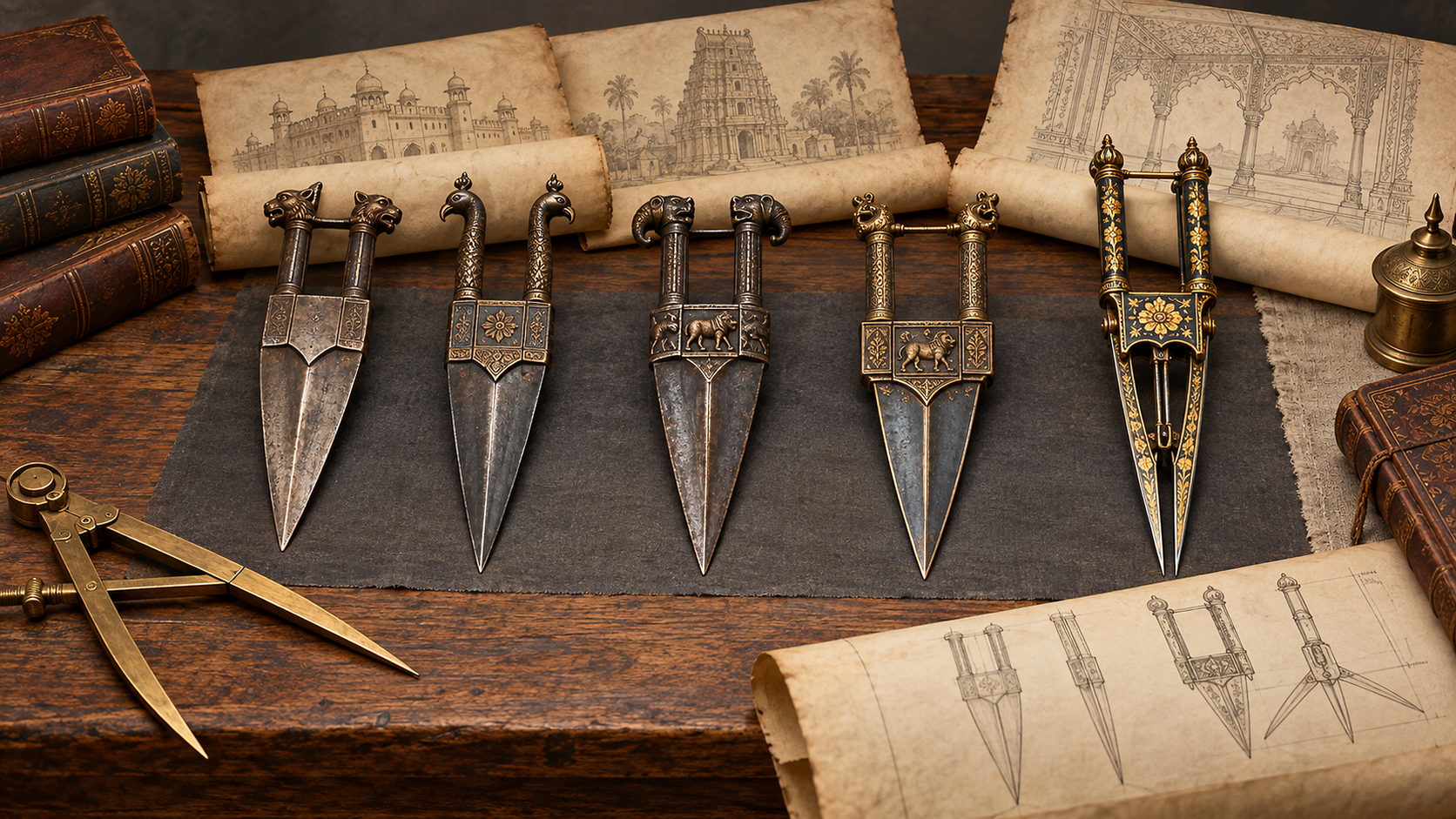
Historical distribution patterns provide the most compelling evidence against the scissor katar being a functional military weapon. In primary visual and textual records from the apex of Indian military mobilization—such as the sixteenth-century Baburnama, the illustrated court records of the Akbarnama, and stone relief carvings from Vijayanagara and Mewar—hundreds of katars are depicted in granular detail. Warriors, hunters, and court guards carry rigid, heavy-bladed weapons characterized by solid chiseled fullers and broad triangular silhouettes. Not a single contemporary sixteenth- or early seventeenth-century document illustrates or describes a split-bladed or mechanical push dagger.
Surviving mechanical katars appear almost exclusively in the material record from the late eighteenth century onward, reaching their peak during the nineteenth century. This era coincided with the widespread adoption of flintlock and percussion firearms, the decline of classic armored cavalry charges, and the progressive demilitarization of Indian princely states under British East India Company hegemony. Weapons produced during this twilight period shifted rapidly from functional battlefield equipment to theatrical court dress, status display, and novelty collecting.
The Courtly Tradition of Mechanical Novelties
In the princely courts of Rajasthan, the Maratha Confederacy, and the Mughal remnants at Lucknow, weapons had long served as symbols of aristocratic masculinity, royal sovereignty, and artistic patronage. Master armorers working within royal workshops (karkhanas) were celebrated not merely for producing practical ordnance, but for demonstrating hunar—consummate artisanal skill, ingenuity, and technical wonder.
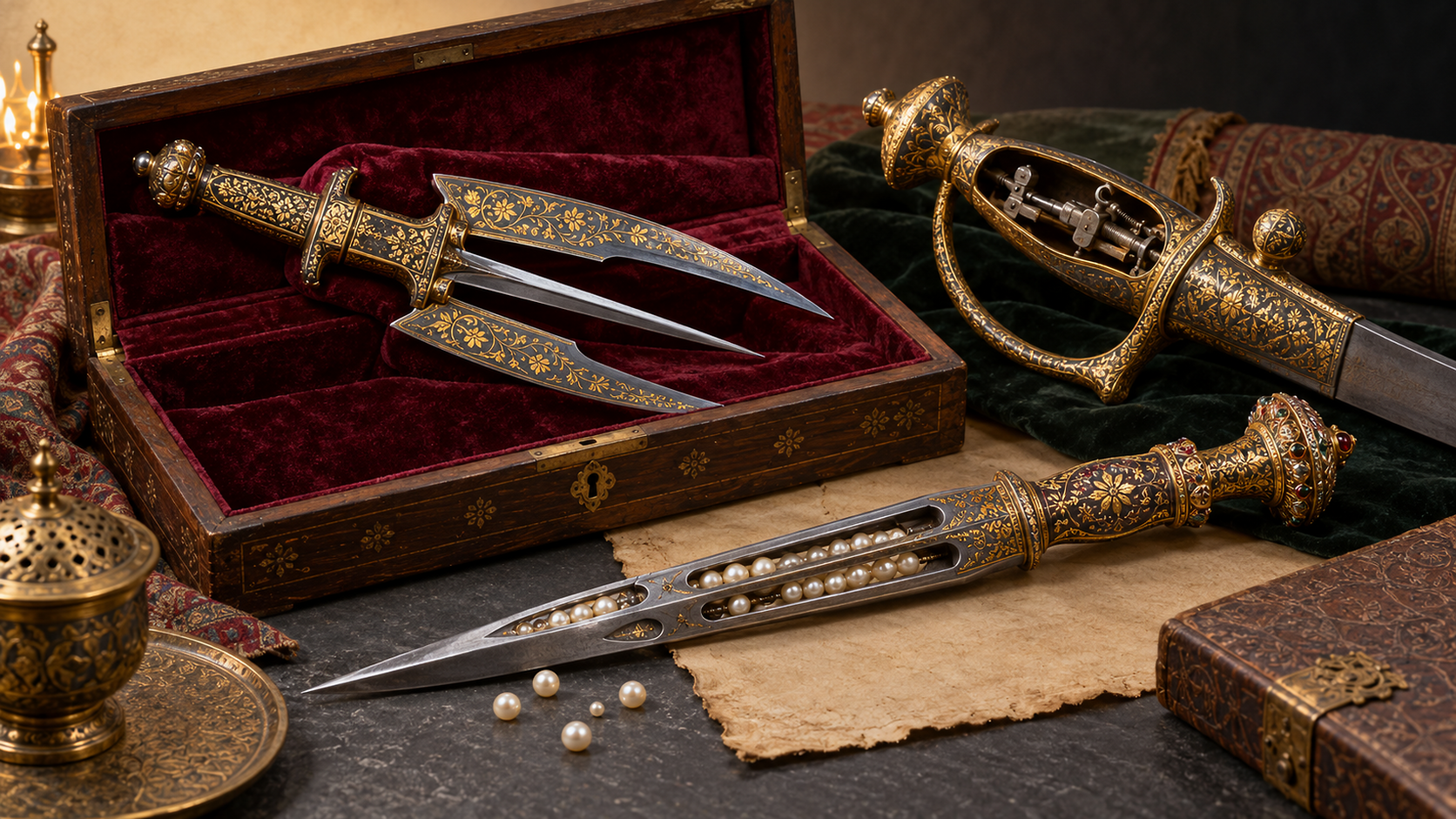
Royal patrons took intense delight in mechanical contrivances, secret compartments, and dual-purpose curiosities known broadly under the cultural category of aja'ib (marvels or curiosities). Workshops produced flintlock pistols embedded in talwar hilts, hollow walking sticks containing concealed stilettos, daggers with rolling pearls chiseled into hollowed blade channels (moti daur), and combination scissors-daggers. In this environment of courtly ostentation, a katar that sprang open into three blades when gripped was not created to slaughter an enemy on the battlefield; it was commissioned to astonish courtiers during a royal durbar, serving as an interactive kinetic toy that highlighted the workshop's mastery over metal.
Architectural Grooving and Chiseled Nesting
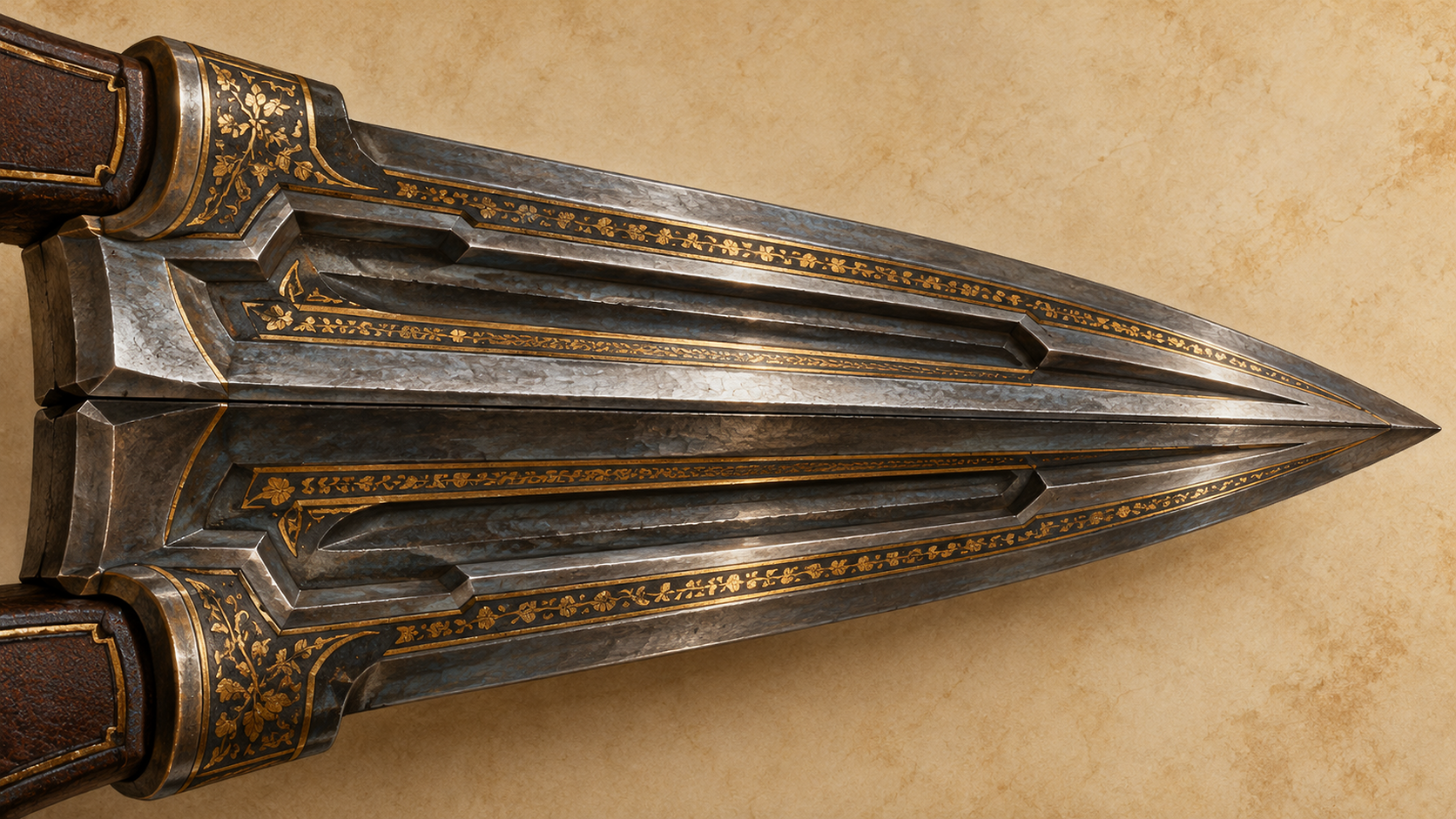
Examining the physical surface of surviving mechanical katars highlights the exquisite metalworking skill required to disguise their secondary blades. The exterior surfaces of the split leaves were rarely left plain. Armorers systematically carved deep longitudinal fullers and stepped geometric channels across the outer faces, mirroring the visual vocabulary of functional armor-piercing blades.
This decorative grooving served a crucial optical function: the chiseled lines aligned precisely with the longitudinal seam where the two split leaves met down the weapon's center. When closed, the seam looked identical to an ordinary decorative fuller or raised central rib, completely concealing the weapon's articulated nature from a casual observer. Furthermore, the interior surfaces were carved with hollow recesses to accommodate the thicker spine and central fuller of the inner stiletto. Achieving such tolerances with manual cold-chisels, files, and charcoal polishing stones represents hundreds of hours of painstaking bench labor, far exceeding the time invested in ordinary field weapons.
Ergonomics of the Articulated Grip
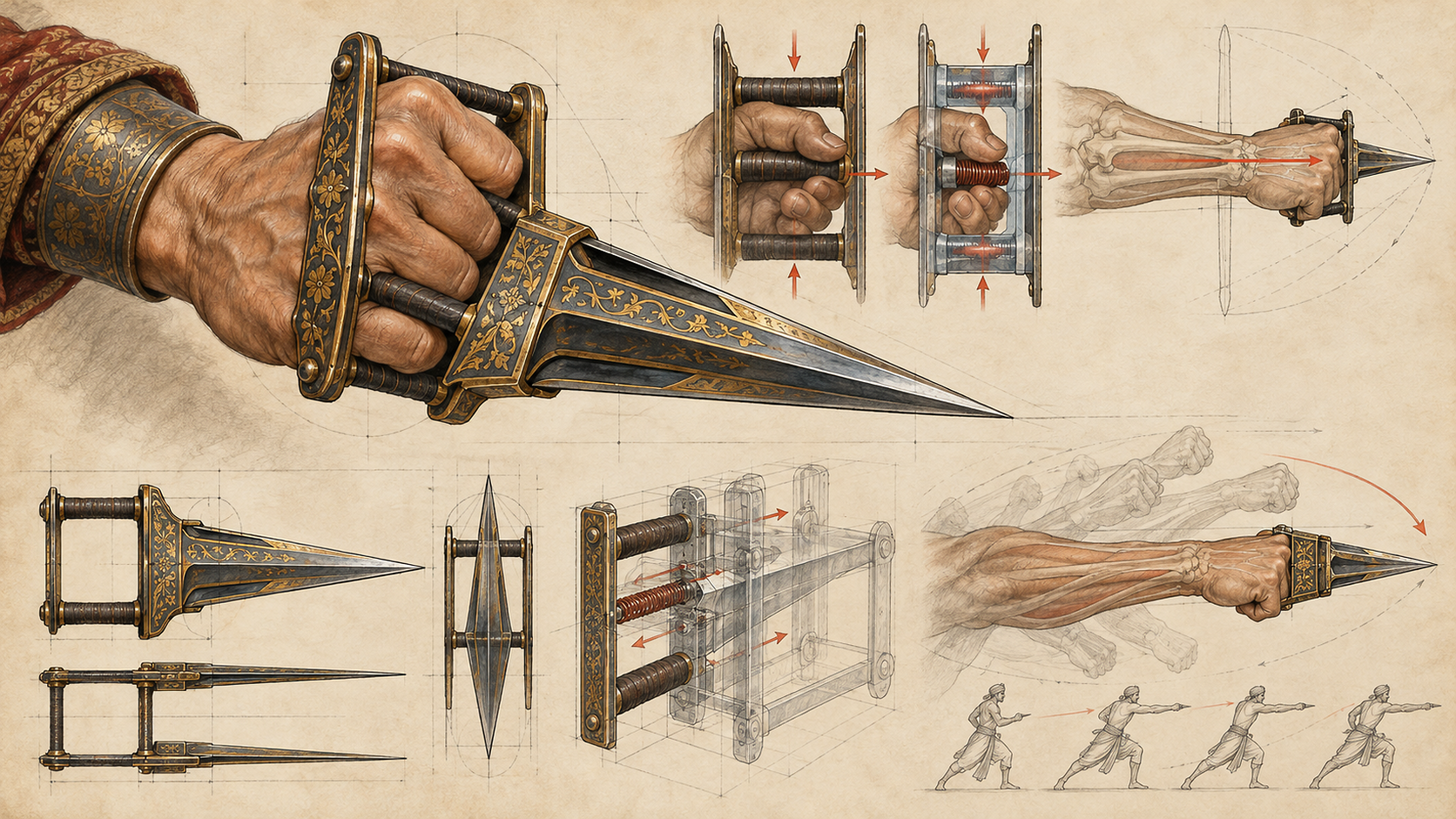
A closer look at the weapon's ergonomics further demonstrates the impracticality of using an expanding katar in real combat. To deliver an effective thrust with a standard katar, the wielder wraps their four fingers around the two transverse bars, locking their wrist and converting their forearm into a rigid kinetic piston. The grip must be unyielding and tight to transmit impact force safely through the arm without buckling.
In an expanding katar, however, the transverse rungs cannot be held rigidly. One of the bars must remain flexible and mobile beneath the fingers to engage the rocker linkage. If the warrior squeezes the weapon too tightly during the forward swing, the blades deploy prematurely in mid-air, drastically increasing wind resistance and destabilizing the alignment of the point before it reaches the target. Conversely, if the warrior grips the bars loosely to keep the blades closed, the weapon lacks the firmness needed to execute a clean thrust, risking a dislocated wrist upon impact. The cognitive overhead required to time the mechanical compression while managing a life-or-death encounter fundamentally contradicts martial ergonomics.
Victorian Catalogues and Orientalist Romanticism
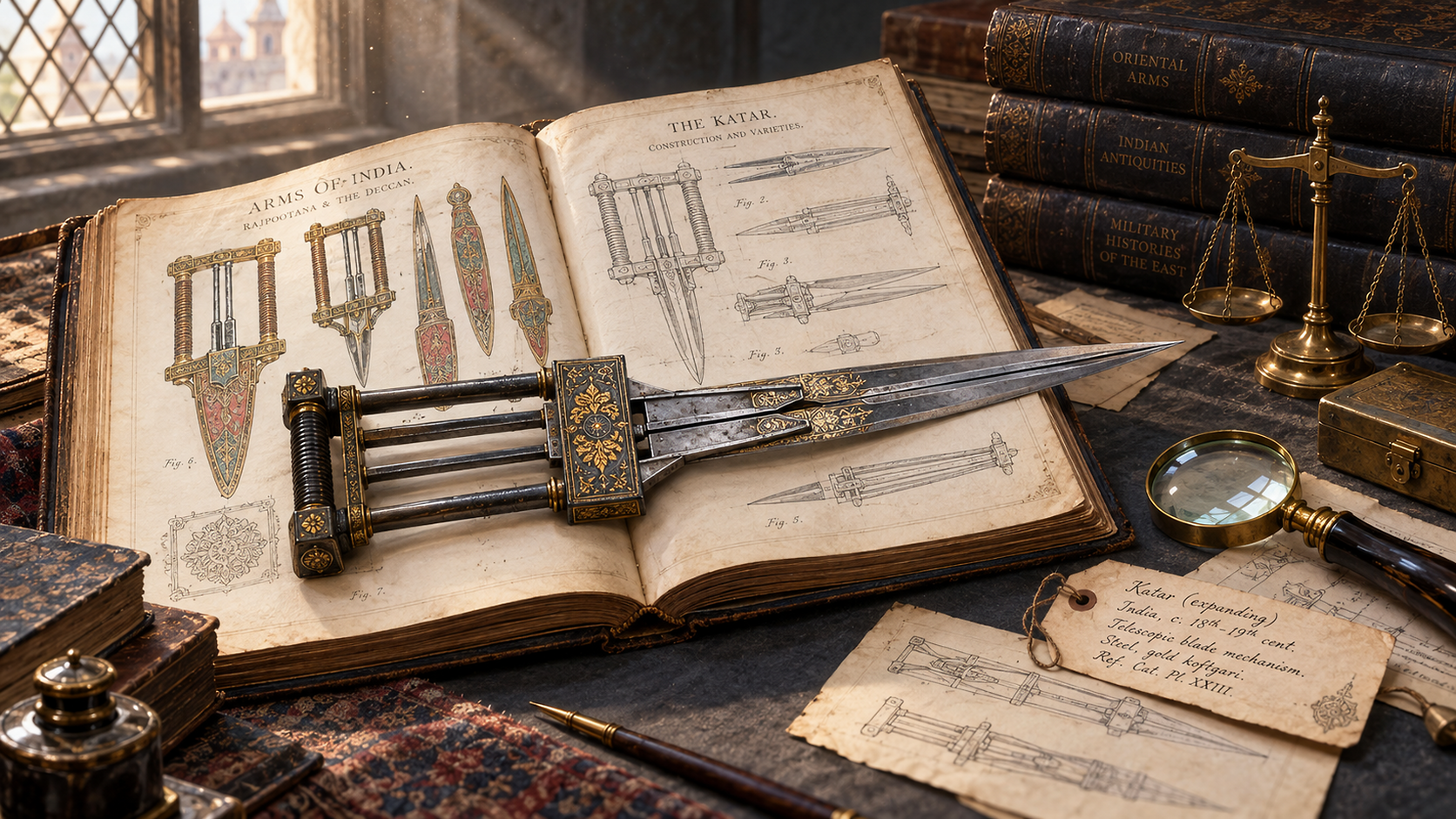
If expanding katars were late court novelties, how did the myth of their gruesome internal expansion become so firmly entrenched in modern arms lore? The origins lie squarely in nineteenth-century colonial literature and Victorian arms collection practices. Following the Indian Rebellion of 1857, the British colonial administration enacted sweeping Disarmament Acts across the subcontinent, confiscating hundreds of thousands of native weapons and consigning them to scrap heaps, armories, and colonial exhibition halls.
British scholars and colonial officers who cataloged these vast arsenals—most notably Lord Wilbraham Egerton in his influential 1880 work An Illustrated Handbook of Indian Arms—approached their subjects through an Orientalist lens. Victorian observers were fascinated by mechanical oddities, which they interpreted not as artistic court curiosities, but as evidence of Eastern cruelty and insidious craftsmanship. Cataloguers routinely embellished their descriptive entries, asserting without combat documentation that expanding daggers were engineered to inflict maximum bodily agony. These lurid nineteenth-century descriptions were repeated uncritically by subsequent collectors, encyclopedists, and military enthusiasts throughout the twentieth century.
Documentary Absences in Maratha and Sikh Chronicles
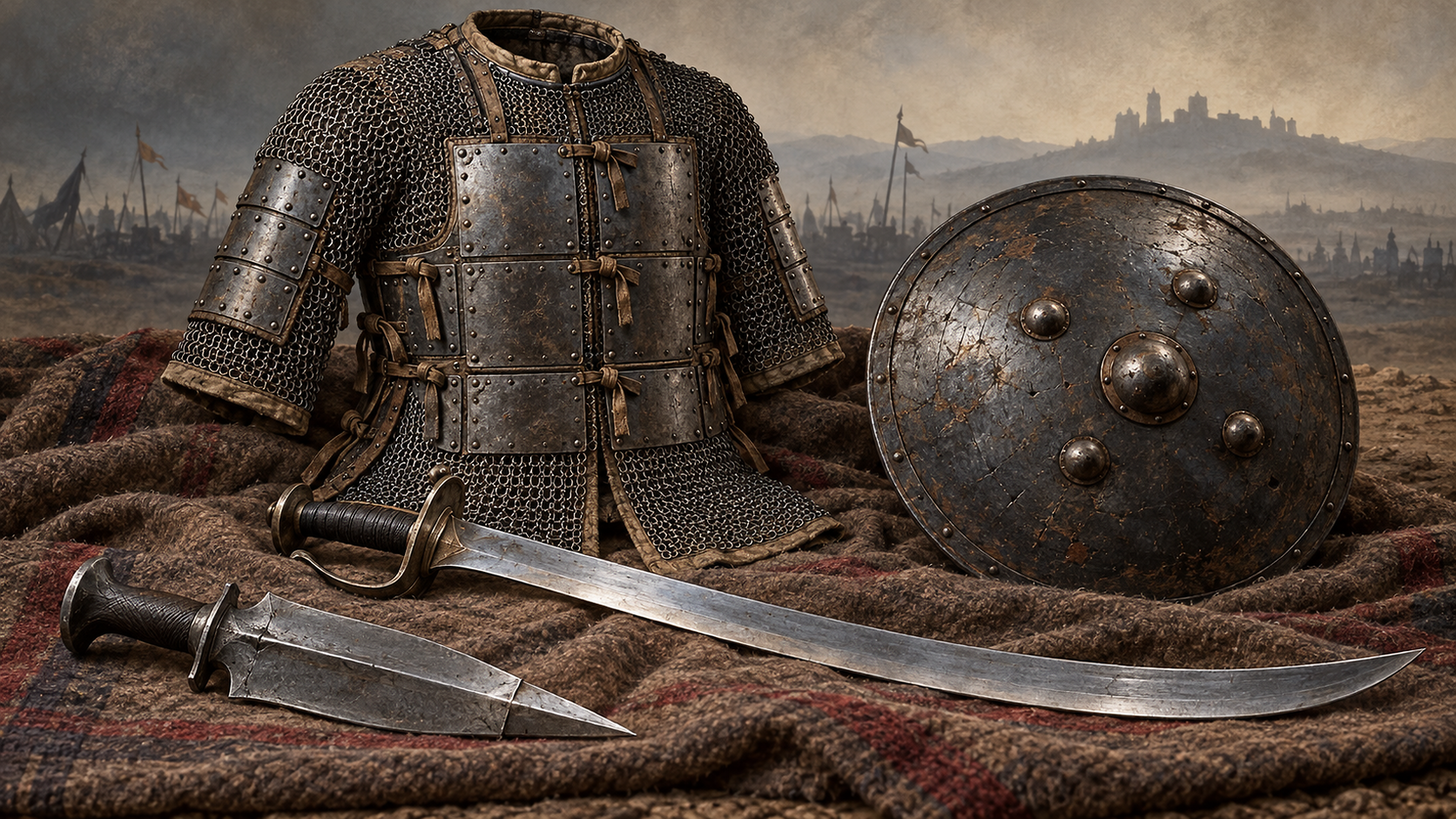
The historical case against combat use is reinforced by the total absence of mechanical katars in primary military chronicles from the most active martial cultures of the eighteenth century. The Maratha bakhars (historical narratives) provide exhaustive accounts of weaponry, detailing the precise performance of swords, lances, matchlocks, and daggers during major campaigns such as the Third Battle of Panipat in 1761. While standard katars are frequently referenced as decisive secondary weapons used in close-quarters melees when cavalry lines collided, expanding or split-bladed variants receive zero mention.
Similarly, detailed Sikh military treatises and eighteenth-century inventories from the court of Maharaja Ranjit Singh classify katars with great precision, distinguishing between katar (straight-bladed), jamadhar (broad-bladed), and curved or double-pointed variants. Yet mechanical expanding knives never appear in lists of field equipment issued to the Khalsa army. Had these mechanical daggers offered any tangible tactical advantage in close combat, they would have been recorded in ordnance accounts, celebrated in heroic epic poetry, or preserved in significant numbers in battlefield armories.
Wear Patterns and Preservation Realities
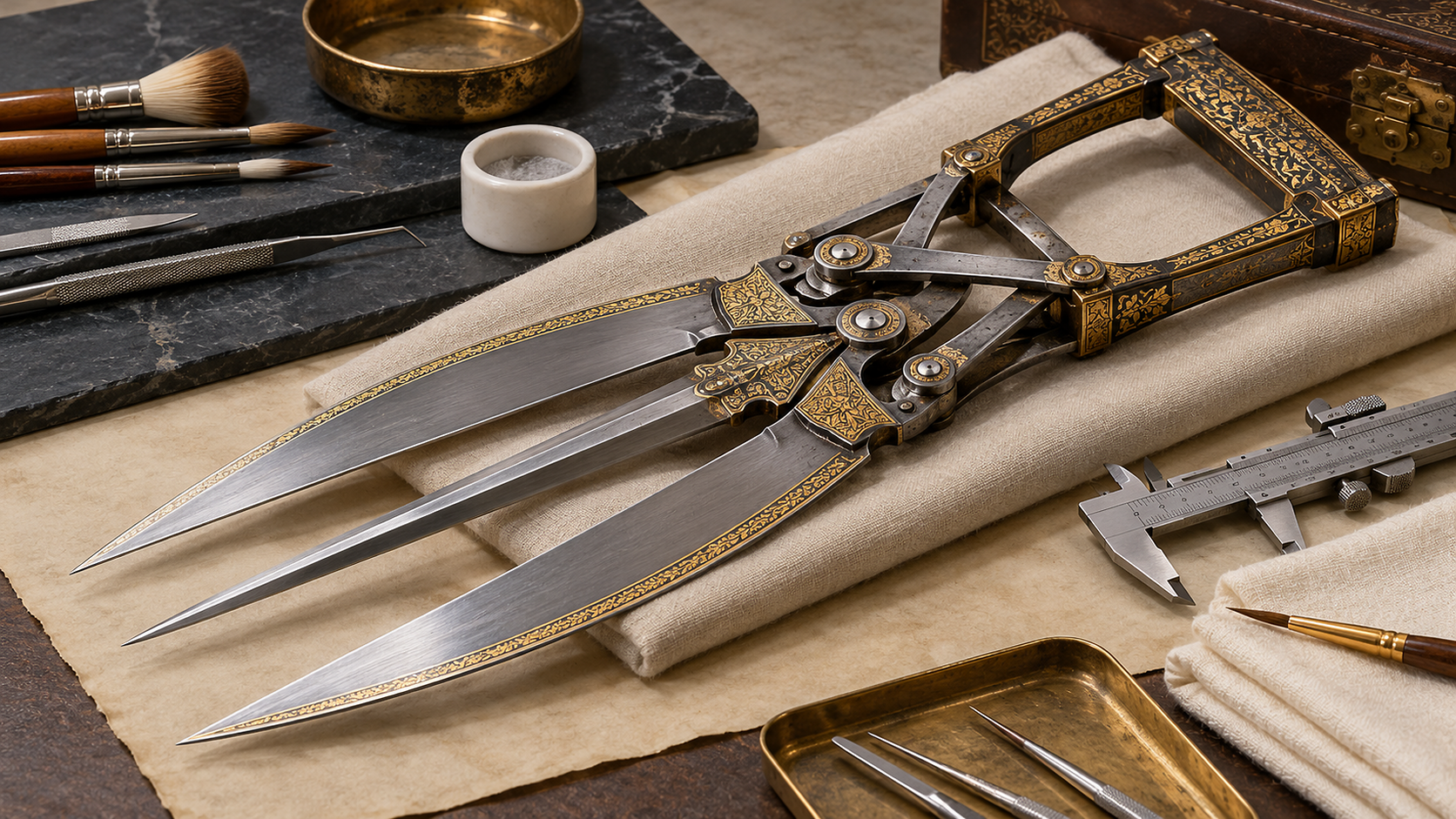
Direct physical inspection of surviving artifacts in modern museum collections provides final, tangible confirmation of their true nature. Functional historical weapons that saw active military service invariably bear diagnostic wear marks: scratched edges from manual whetstones, micro-chips along the primary bevels, replaced rivets, and impact fractures along the structural tangs.
By contrast, mechanical scissor katars preserved in institutions like the Wallace Collection in London, the National Museum in New Delhi, and the Royal Armouries in Leeds typically show pristine, unsharpened blade edges. The exterior leaves and side bars are frequently decorated with delicate gold or silver koftgari (overlay damascening) that extends right up to the blade joints. This ornamentation shows virtually no friction abrasion or holster wear. Where mechanical wear does exist on these artifacts, it is localized entirely to the internal hinge pivots and spring mechanisms—wear patterns consistent with centuries of being opened and closed by curious collectors and courtly admirers rather than striking armor or flesh.
Modern Reimagining and Game Typologies
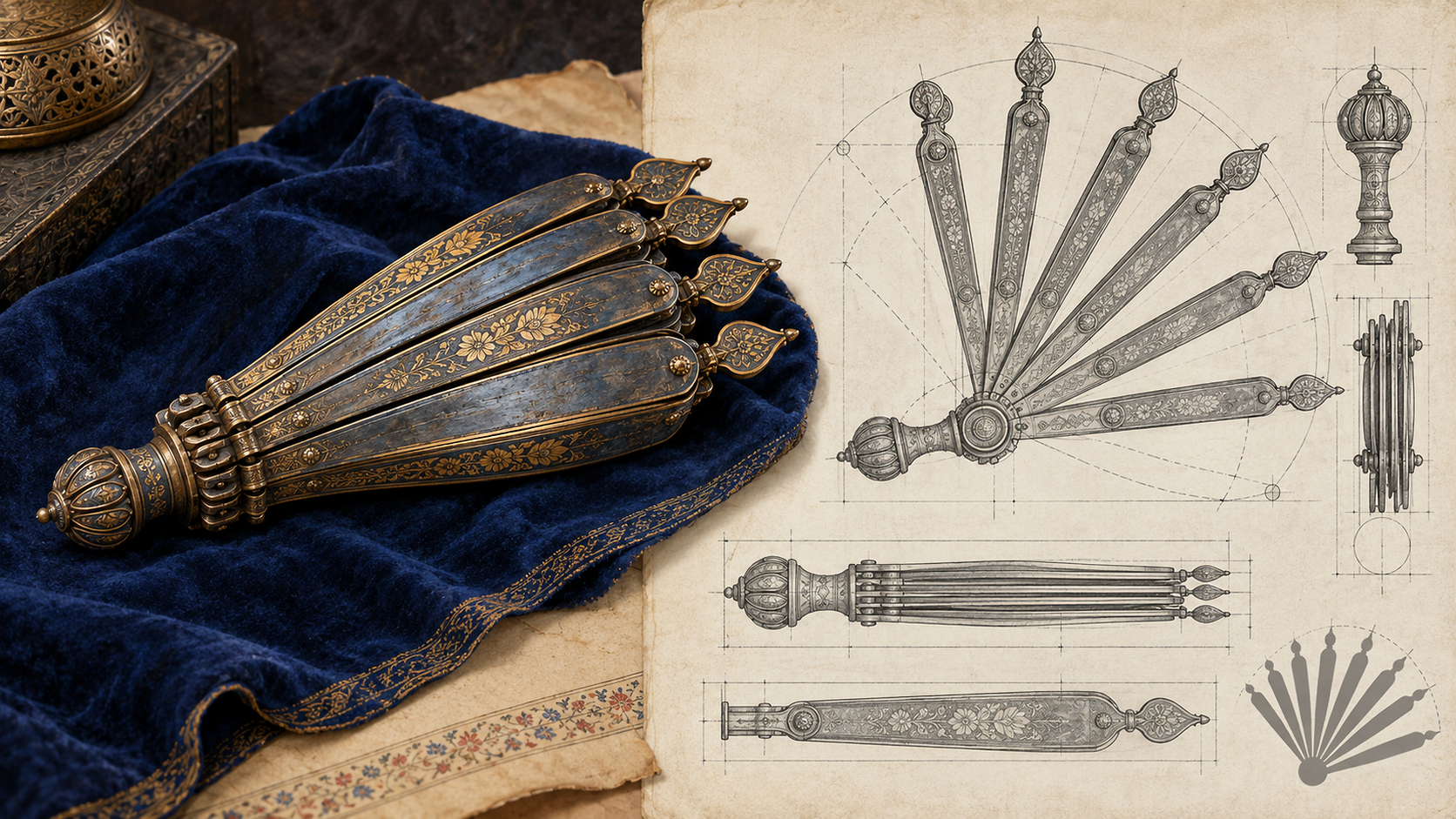
In modern entertainment media, expanding katars have experienced an unprecedented renaissance far removed from historical reality. Role-playing games, fantasy literature, and martial arts cinema routinely depict the scissor katar as the archetypal assassin's weapon, often attributing to it heightened lethality, critical strike modifiers, or armor-stripping capabilities. In these fictional universes, the weapon is presented as a pinnacle of ancient combat engineering, prized specifically for its mechanical devastation.
While these contemporary adaptations provide compelling drama for games, they reverse the historical development of the weapon. They mistake a fragile late-period curiosity for a practical battlefield sidearm. Recognizing the expanding katar as a courtly showpiece highlights the mechanical ingenuity of Indian artisans in the eighteenth and nineteenth centuries without confusing spectacle with combat utility.
Further reading
Follow the sources to examine the object and its historical context.
Egerton, Wilbraham. Indian and Oriental Armour. London: W.H. Allen & Co., 1896External reference · Opens in a new tab Pant, G. N. Indian Arms and Armour, Vol. II: Swords and Daggers. New Delhi: Army Educational Stores, 1980External reference · Opens in a new tab Elgood, Robert. Rajput Arms and Armour: The Rathores and Arming the Land. New Delhi: Niyogi Books, 2017External reference · Opens in a new tab